Gemini 4 Experiment Debriefing, 1967
NASA-UAP-D018 · page 12 of 224
Text
This text came with the file. It may have mistakes. When the text and the image disagree, the image is right.
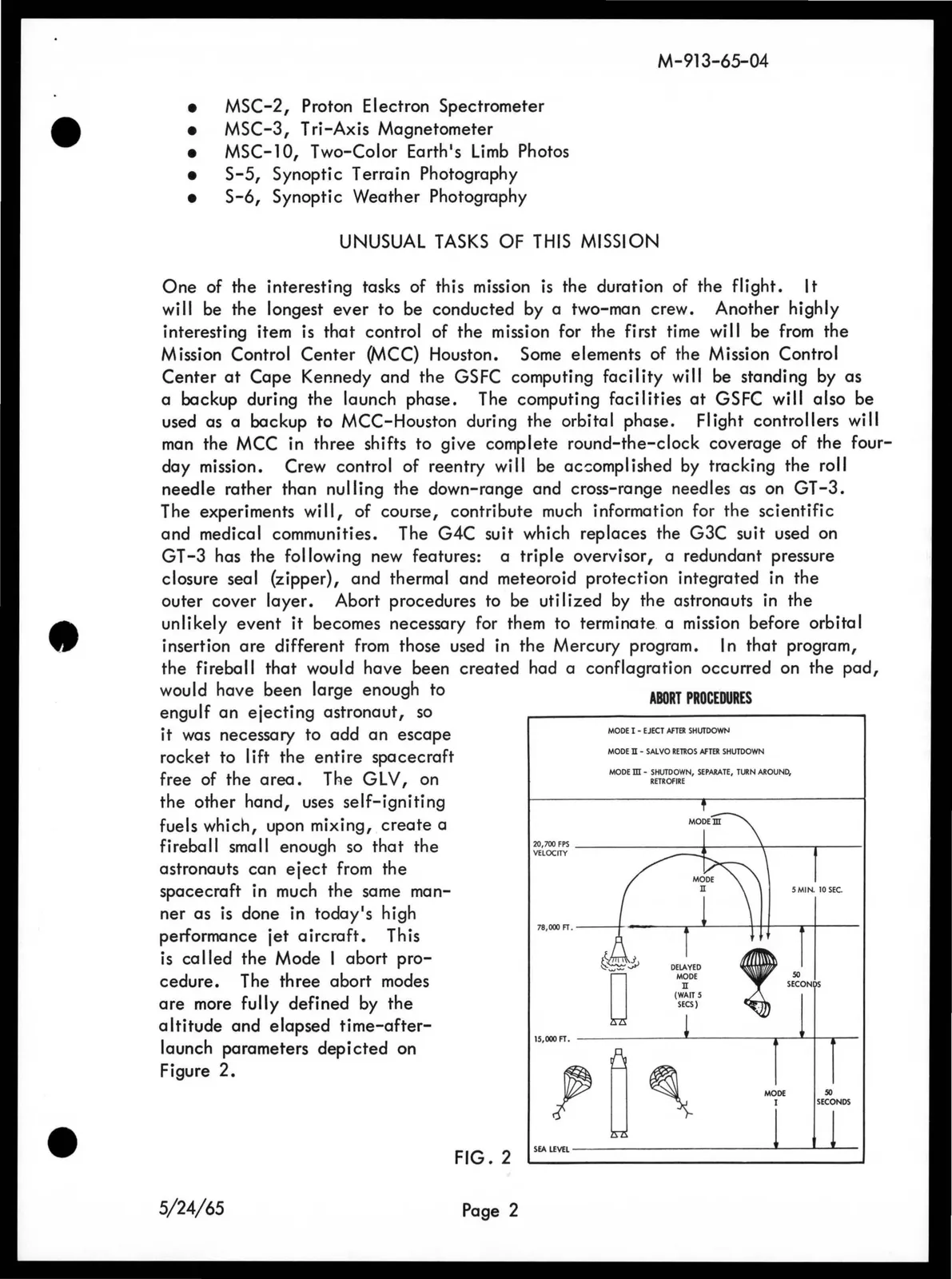
M-913-65-04 • MSC-2, Proton Electron Spectrometer • MSC-3, Tri-Axis Magnetometer • MSC-10, Two-Color Earth's Limb Photos • S-5, Synoptic Terrain Photography • S-6, Synoptic Weather Photography UNUSUAL TASKS OF THIS MISSION One of the interesting tasks of this mission is the duration of the flight. It will be the longest ever to be conducted by a two-man crew. Another highly interesting item is that control of the mission for the first time wil I be from the Mission Control Center (MCC) Houston. Some elements of the Mission Control Center at Cape Kennedy and the GSFC computing facility will be standing by as a backup during the launch phase. The computing facilities at GSFC will also be used as a backup to MCC-Houston during the orbital phase. Flight controllers will man the MCC in three shifts to give complete round-the-clock coverage of the four day mission. Crew control of reentry will be ac~omplished by tracking the roll needle rather than nulling the down-range and cross-range needles as on GT-3. The experiments will, of course, contribute much information for the scientific and medical communities. The G4C suit which replaces the G3C suit used on GT-3 has the fol lowing new features: a triple overvisor, a redundant pressure closure seal (zipper), and thermal and meteoroid protection integrated in the outer cover layer. Abort procedures to be utilized by the astronauts in the unlikely event it becomes necessary for them to terminate. a mission before orbital insertion are different from those used in the Mercury program. In that program, the fireball that would have been created had a conflagration occurred on the pad, would have been large enough to ABORT PROCEDURES engulf an ejecting astronaut, so it was necessary to add an escape rocket to I ift the entire spacecraft free of the area. The GLV, on the other hand, uses self-igniting fuels which, upon mixing, create a fi reba II sma II enough so that the astronauts can eject from the spacecraft in much the same man ner as is done in today's high performance jet aircraft. This is called the Mode I abort pro cedure. The three abort modes are more fully defined by the altitude and elapsed time-after launch parameters depicted on Figure 2. FIG . 2 MOOE I - EJECT AfTEll SHUTDOWN MOOE ll - SALVO RETROS AFTER SHUTDOWN MODE ID - SHUTDOWN, SE PARATE, TURN AROUND, RETROFIRE -□~ OEIAYEO MOOE n (WA IT 5 SECS ) 15,000FT. _ _ ____.____~--'<-+--~- ' ~' MOOE I 50 SECONDS SEA LEVEL-----------''----L--'-- 5/24/65 Page 2