Gemini 4 Experiment Debriefing, 1967
NASA-UAP-D018 · page 30 of 224
Text
This text came with the file. It may have mistakes. When the text and the image disagree, the image is right.
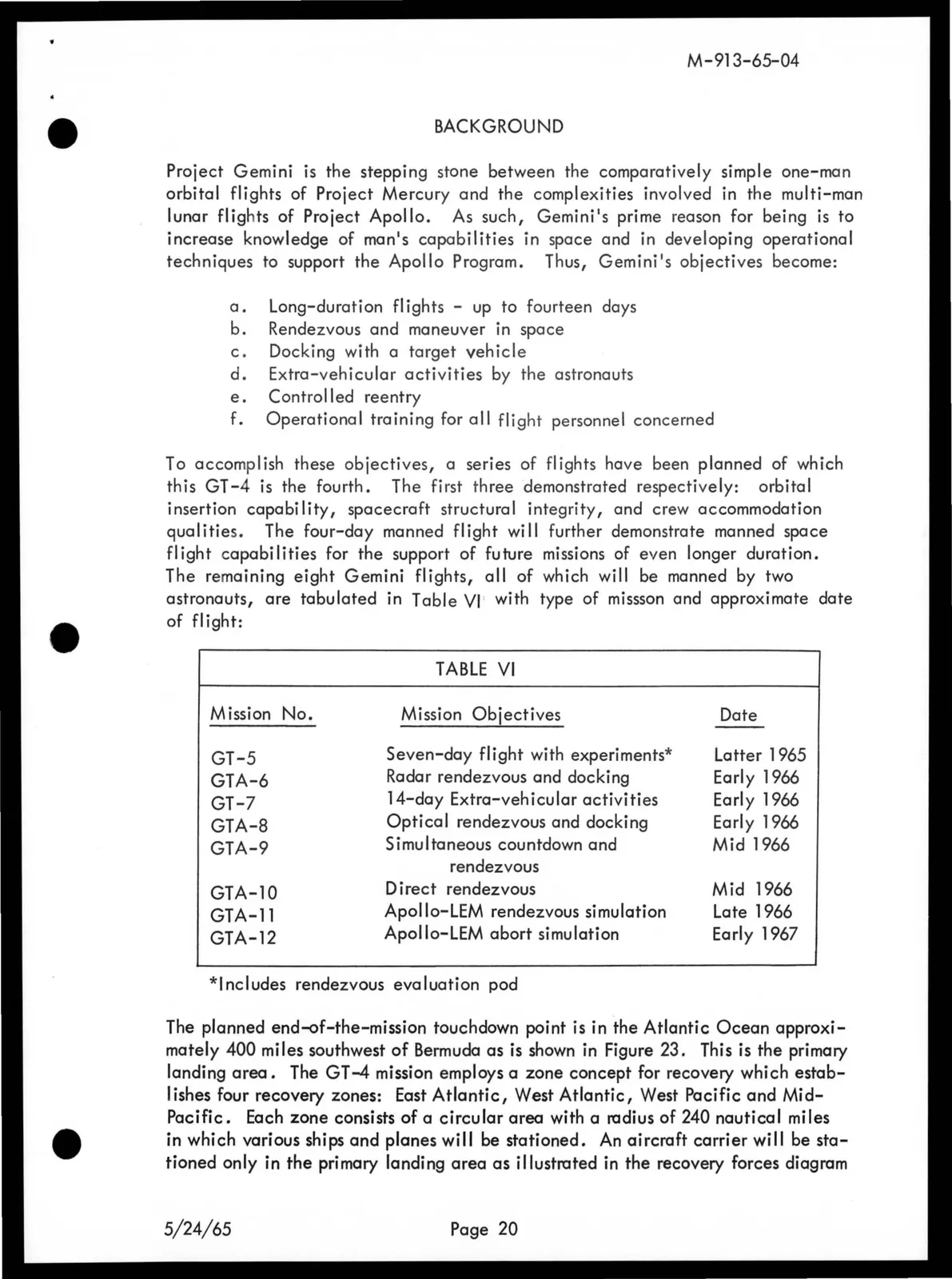
M-913-65-04 BACKGROUND Project Gemini is the stepping stone between the comparatively simple one-man orbital flights of Project Mercury and the complexities involved in the multi-man lunar flights of Project Apollo. As such, Gemini's prime reason for being is to increase knowledge of man's capabilities in space and in developing operational techniques to support the Apollo Program. Thus, Gemini's objectives become: a. b. c. Long-duration flights - up to fourteen Rendezvous and maneuver in space Docking with a target vehicle days d. Extra-vehicular activities by the astronauts e. Control led reentry f. Operational training for al I flight personnel concerned To accomplish these objectives, a series of flights have been planned of which this GT-4 is the fourth. The first three demonstrated respectively: orbital insertion capability, spacecraft structural integrity, and crew accommodation qualities. The four-day manned flight will further demonstrate manned space flight capabilities for the support of future missions of even longer duration. The remaining eight Gemini flights, all of which will be manned by two astronauts, are tabulated in Table VI ' with type of missson and approximate date of flight: Mission No. GT-5 GTA-6 GT-7 GTA-8 GTA-9 GTA-10 GTA-11 GTA-12 TABLE VI Mission Objectives Seven-day flight with experiments* Radar rendezvous and docking 14-day Extra-vehicular activities Optical rendezvous and docking Simultaneous countdown and rendezvous Direct rendezvous Apollo-LEM rendezvous simulation Apollo-LEM abort simulation Date Latter 1965 Early 1966 Early 1966 Early 1966 Mid 1966 Mid 1966 Late 1966 Early 1967 *Includes rendezvous evaluation pod The planned end-of-the-mission touchdown point is in the Atlantic Ocean approxi mately 400 miles southwest of Bermuda as is shown in Figure 23. This is the primary landing area. The GT-4 mission employs a zone concept for recovery which estab lishes four recovery zones: East Atlantic, West Atlantic, West Pacific and Mid Pacific. Each zone consists of a circular area with a radius of 240 nautical miles in which various ships and planes will be stationed. An aircraft carrier will be sta tioned only in the primary landing area as ii lustrated in the recovery forces diagram 5/24/65 Page 20