Gemini 4 Experiment Debriefing, 1967
NASA-UAP-D018 · page 31 of 224
Text
This text came with the file. It may have mistakes. When the text and the image disagree, the image is right.
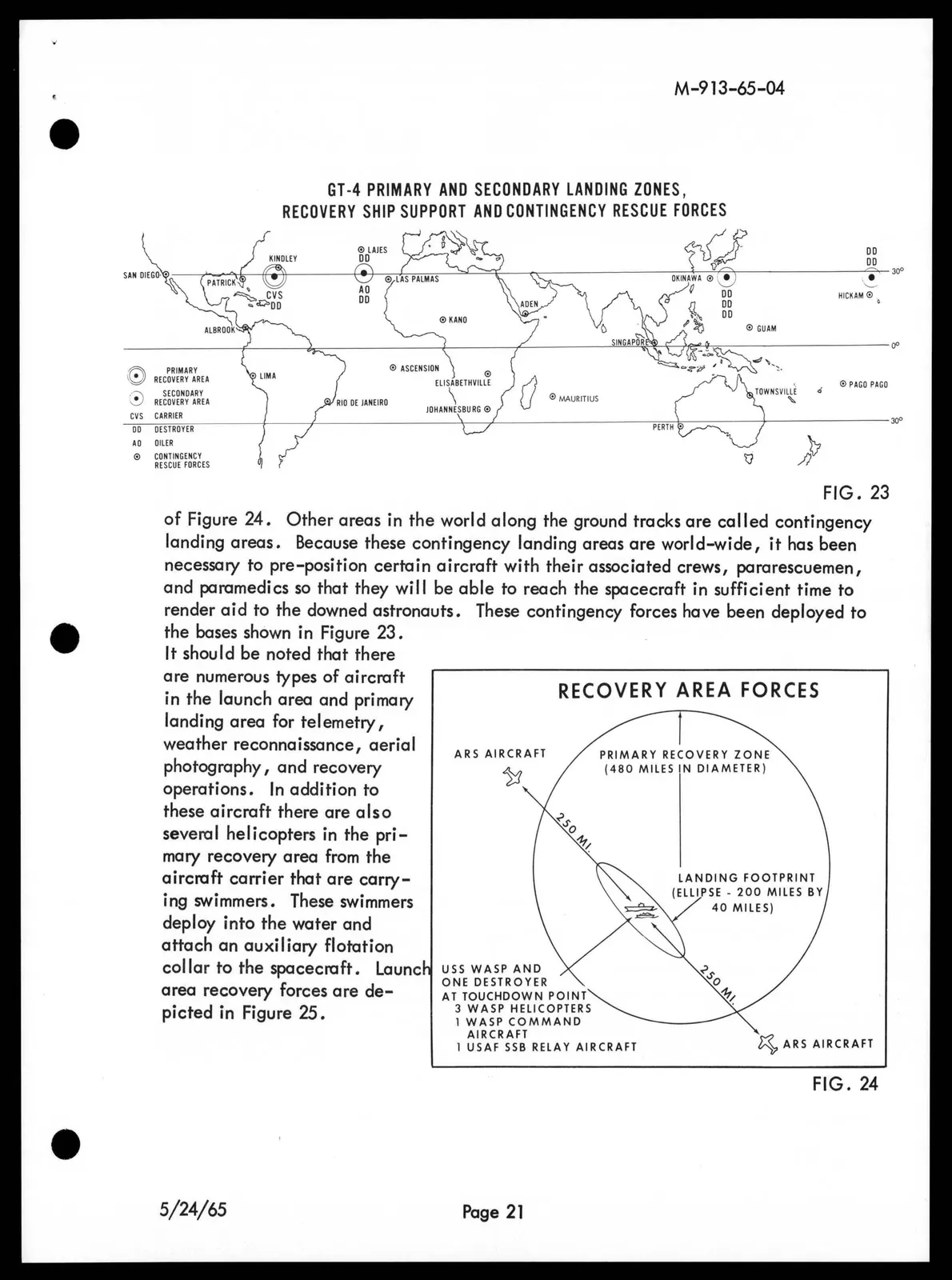
00 M-913-65-04 GT-4 PRIMARY AND SECONDARY LANDING ZONES, RECOVERY SHIP SUPPORT AND CONTINGENCY RESCUE FORCES \);J DO 30" ~ 00 HICKAM 0 00 00 0 GUAM O" ~ PRIMARY l~ RECOVERYAREA 0 PAGO PAGO 8 " REEm;~ANEA CVS CARRI ER 30" 00 OESTROYER AO OILER 0 CO NTINGE NCY RESCUE FORC ES /)};; FIG. 23 of Figure 24. Other areas in the world along the ground tracks are called contingency landing areas. Because these contingency landing areas are world-wide, it has been necessary to pre-position certain aircraft with their associated crews, pararescuemen, and paramedics so that they will be able to reach the spacecraft in sufficient time to render aid to the downed astronauts. These contingency forces have been deployed to the bases shown in Figure 23 . It should be noted that there are numerous types of aircraft in the launch area and primary landing area for telemetry, weather reconnaissance, aerial photography, and recovery operations. In addition to these aircraft there are also several helicopters in the pri mary recovery area from the aircraft carrier that are carry ing swimmers. These swimmers deploy into the water and attach an auxiliary flotation collar to the spacecraft. Launc area recovery forces are de picted in Figure 25. RECOVERY AREA FORCES ARS AIRCRAF T PRIMARY RECOV ERY ZONE 200 MILES BY USS WASP AND ONE DESTROYE R AIRCRAFT 1 USAF SSB RELAY AIRCRAFT AT TOUCHDOWN POINT 3 WASP HELICOPTERS 1 WASP COMMAND (480 MILES N DIAM ETER ) LANDING FOOTPRINT (ELLIPSE - 40 MILES) ~ ARS AIRCRAFT FIG. 24 5/24/65 Page 21