The Central Intelligence Agency and Overhead Reconnaissance; The U-2 and OXCART Programs, 1954-1974
CIA-UAP-003 · page 18 of 406
Text
This text came with the file. It may have mistakes. When the text and the image disagree, the image is right.
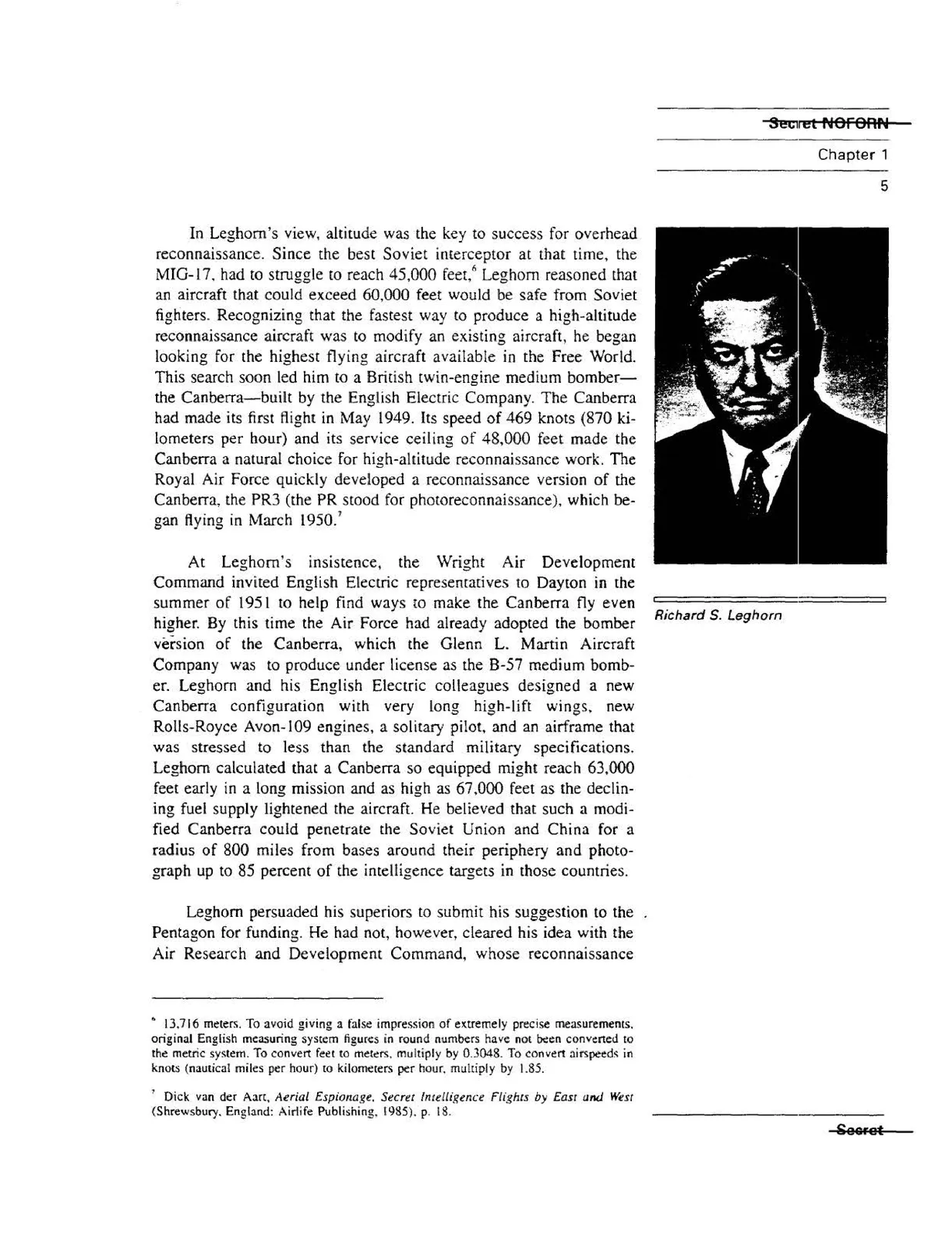
5 In Leghorn's view, altitude was the key to success for overhead reconnaissance. Since the best Soviet interceptor at that time, the MIG-17. had to struggle to reach 45,000 feet,6 Leghorn reasoned that an aircraft that could exceed 60,000 feet would be safe from Soviet fighters. Recognizing that the fastest way to produce a high-altitude reconnaissance aircraft was to modify an existing aircraft, he began looking for the highest flying aircraft available in the Free World. This search soon led him to a British twin-engine medium bomber the Canberra-built by the English Electric Company. The Canberra had made its first flight in May I949. Its speed of 469 knots (870 ki lometers per hour) and its service ceiling of 48,000 feet made the Canberra a natural choice for high-altitude reconnaissance work. The Royal Air Force quickly developed a reconnaissance version of the Canberra, the PR3 (the PR stood for photoreconnaissance). which be gan flying in March 1950. 7 At Leghorn's insistence, the Wright Air Development Command invited English Electric representatives to Dayton in the summer of 1951 to help find ways to make the Canberra fly even higher. By this time the Air Force had already adopted the bomber version of the Canberra, which the Glenn L. Marrin Aircraft Company was to produce under license as the B-57 medium bomb er. Leghorn and his English Electric colleagues designed a new Canberra configuration with very long high-lift wings, new Rolls-Royce Avon-109 engines, a solitary pilot, and an airframe that was stressed to less than the standard military specifications. Leghorn calculated that a Canberra so equipped might reach 63,000 feet early in a long mission and as high as 67,000 feet as the declin ing fuel supply lightened the aircraft. He believed that such a modi fied Canberra could penetrate the Soviet Union and China for a radius of 800 miles from bases around their periphery and photo graph up to 85 percent of the intelligence targets in those countries. Leghorn persuaded his superiors to submit his suggestion to the Pentagon for funding. He had not, however, cleared his idea with the Air Research and Development Command, whose reconnaissance • 13.716 meters. To avoid giving a false impression of e:imemely precise measurement.s. original English measuring system figures in round numbers have not been converted to the metric system. To convert feet to meters. multiply by 0.3048. To convert airspeeds in knots (nautical miles per hour) to kilometers per hour. multiply by 1.85. ' Dick van der Aart, Aerial Espionage. Secret Intelligence Flights by Easr and West (Shrewsbury. England: Airlife Publishing, 1985). p. I 8. ~,etNOFOAN Chapter 1 Richard S. Leghorn