The Central Intelligence Agency and Overhead Reconnaissance; The U-2 and OXCART Programs, 1954-1974
CIA-UAP-003 · page 19 of 406
Text
This text came with the file. It may have mistakes. When the text and the image disagree, the image is right.
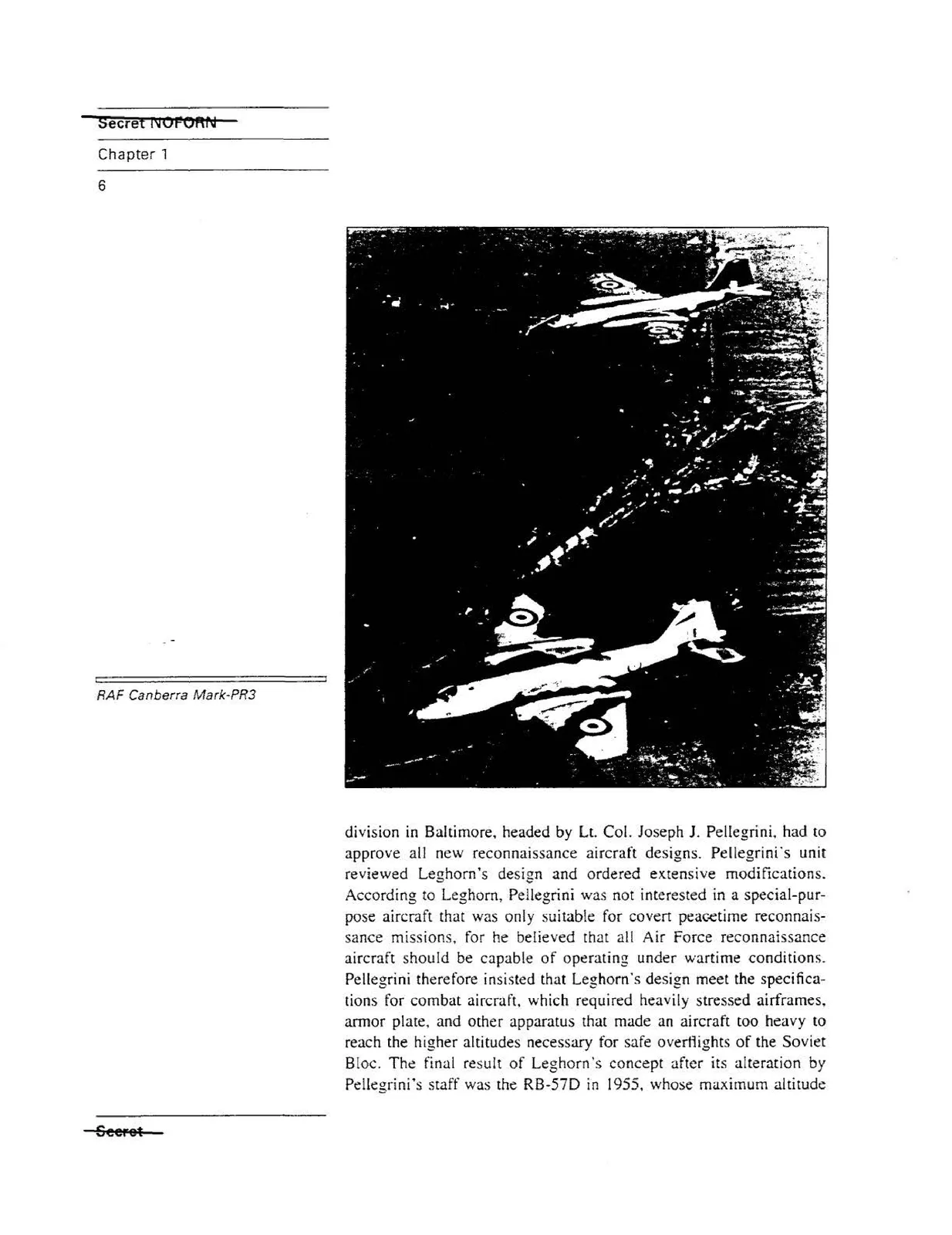
6 Secret i'JOF'OfUd Chapter 1 division in Baltimore, headed by Lt. Col. Joseph J. Pellegrini. had to approve all new reconnaissance aircraft designs. Pellegrini·s unit reviewed Leghorn's design and ordered extensive modifications. According to Leghorn, Pellegrini was not interested in a special-pur pose aircraft that was only suitable for covert peacetime reconnais sance missions, for he believed that all Air Force reconnaissance aircraft should be capable of operating under wartime conditions. Pellegrini therefore insisted that Leghorn ·s design meet the specifica tions for combat aircraft, which required heavily stressed airframes, armor plate. and other apparatus that made an aircraft too heavy to reach the higher altitudes necessary for safe overflights of the Soviet Bloc. The final result of Leghorn's concept after its alteration by Pellegrini ·s staff was the RB-57D in I 955, whose maximum altitude RAF Canberra Mark-PR3 Seeret