Department of the Air Force Report, 1996
DOW-UAP-D048 · page 102 of 181
Text
This text came with the file. It may have mistakes. When the text and the image disagree, the image is right.
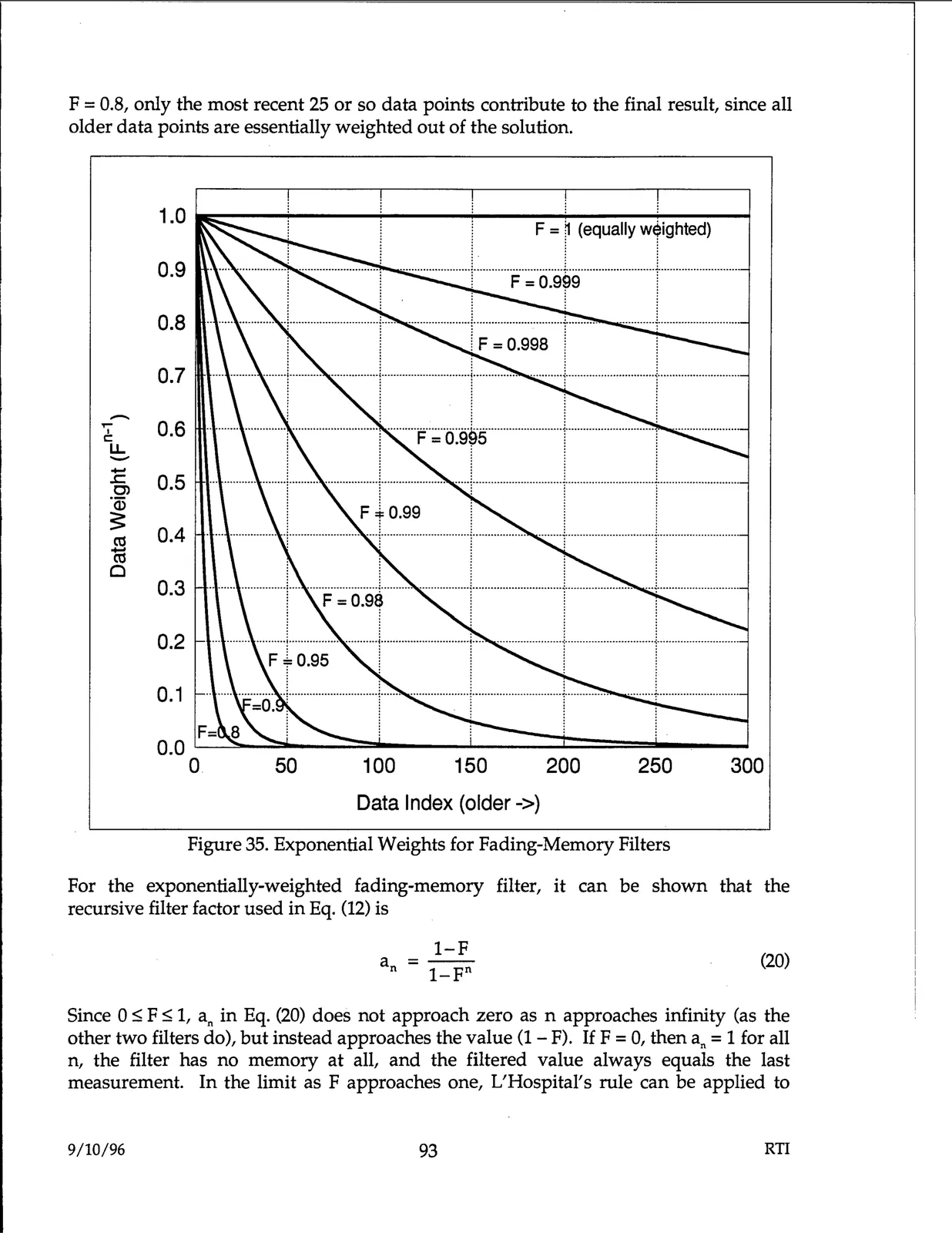
F = 0.8, only the most recent 25 or so data points contribute to the final result, since all older data points are essentially weighted out of the solution. 1.0 0.9 0.8 0.7 ... i:!: 0.6 u..- .c - 0.5 ........ . ........... i ..........................J ...........................+········- F = ~ (equally weighted) ! F=0.J9 I ! I --.: ···········;··························· .... --········-----···-- ···· -•-1- +- =0.9! 5 ! C) ·a5 i I ~ ' ............................~............................ ca 0.4 Cl 0.3 0.2 0.1 0.0 ca i - 0.99 ..... ...........................:....... . ..... 1 /.-····---; -----i·········· -1.................. +o.s .......... , I 0 50 100 150 200 250 300 Data Index (older->) Figure 35. Exponential Weights for Fading-Memory Filters For the exponentially-weighted fading-memory filter, it can be shown that the recursive filter factor used in Eq. (12) is 1-F a=-- (20) n 1-Fn Since OS F S 1, an in Eq. (20) does not approach zero as n approaches infinity (as the other two filters do), but instead approaches the value (1 - F). If F = 0, then an= 1 for all n, the filter has no memory at all, and the filtered value always equals the last measurement. In the limit as F approaches one, L'Hospital' s rule can be applied to 9/10/96 93 RTI