Department of the Air Force Report, 1996
DOW-UAP-D048 · page 101 of 181
Text
This text came with the file. It may have mistakes. When the text and the image disagree, the image is right.
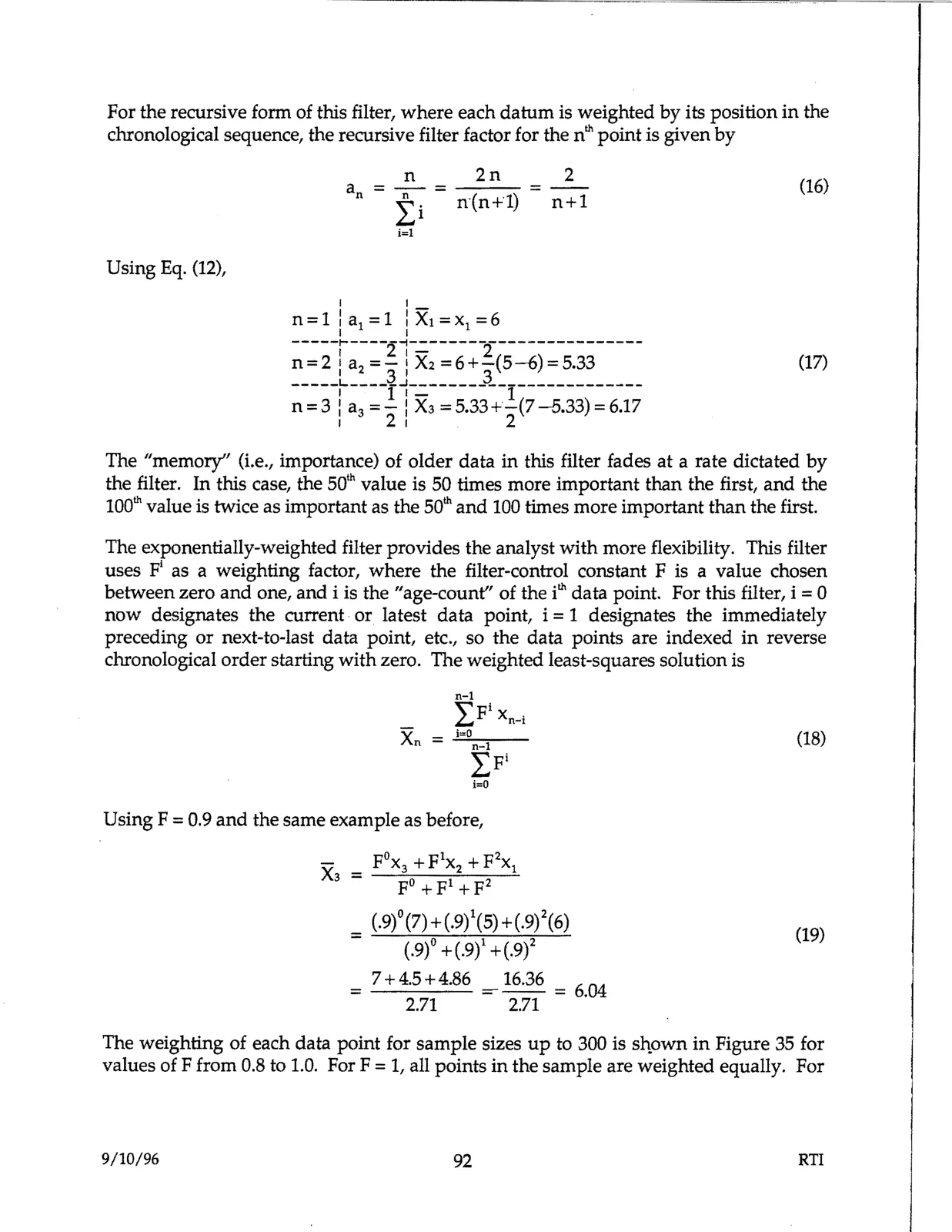
For the recursive form of this filter, where each datum is weighted by its position in the
chronological sequence, the recursive filter factor for the nth point is given by
n
2n
2
a=-=---=--
(16)
n f i
n·(n+l)
n+l
i=l
Using Eq. (12),
(17)
The "memory'' (i.e., importance) of older data in this filter fades at a rate dictated by
the filter. In this case, the 50th value is 50 times more important than the first, and the
100th value is twice as important as the 50th and 100 times more important than the first.
The exponentially-weighted filter provides the analyst with more flexibility. This filter
uses F as a weighting factor, where the filter-control constant F is a value chosen
between zero and one, and i is the "age-count" of the ith data point. For this filter, i = 0
now designates the current -or latest data point, i =1 designates the immediately
preceding or next-to-last data point, etc., so the data points are indexed in reverse
chronological order starting with zero. The weighted least-squares solution is
(18)
Using F =0.9 and the same example as before,
X3 = Fox3 + F1x2 + F2x1
po +Fl +F2
(.9)0(7) +(.9)1(5) +(.9)2(6)
(19)
=
0
1
2
(.9) +(.9) +(.9)
= 7 + 4.5 +4.86 =- 16.36 = 6.04
2.71
2.71
The weighting of each data point for sample sizes up to 300 is sqown in Figure 35 for
values of F from 0.8 to 1.0. For F = 1, all points in the sample are weighted equally. For
9/10/96
92
RTI