Department of the Air Force Report, 1996
DOW-UAP-D048 · page 28 of 181
Text
This text came with the file. It may have mistakes. When the text and the image disagree, the image is right.
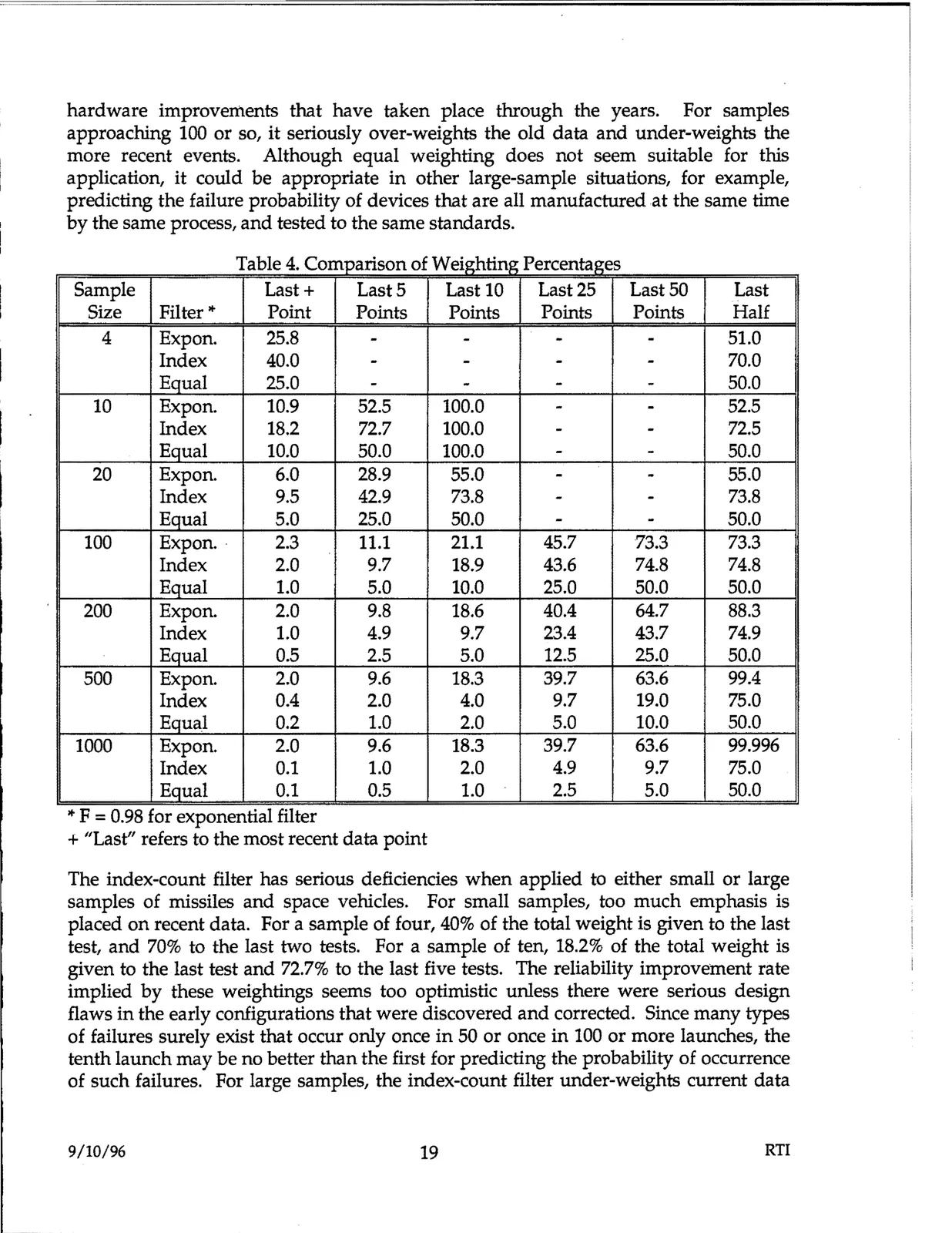
hardware improvements that have taken place through the years.
For samples
approaching 100 or so, it seriously over-weights the old data and under-weights the
more recent events.
Although equal weighting does not seem suitable for this
application, it could be appropriate in other large-sample situations, for example,
predicting the failure probability of devices that are all manufactured at the same time
by the same process, and tested to the same standards.
Table 4. Comparison of Weicllting Percentages
Sample
Size
Filter*
Last+
Point
Last5
Points
Last 10
Points
Last 25
Points
!Last 50
Points
Last
Half
4
Expon.
Index
Equal
25.8
40.0
25.0
--
-
---
---
---
51.0
70.0
50.0
10
Expon.
Index
Equal
10.9
18.2
10.0
52.5
72.7
50.0
100.0
100.0
100.0
---
---
52.5
72.5
50.0
20
Expon.
Index
Equal
6.0
9.5
5.0
28.9
42.9
25.0
55.0
73.8
50.0
---
---
55.0
73.8
50.0
100
Expon. ·
Index
Equal
2.3
2.0
1.0
11.1
9.7
5.0
21.1
18.9
10.0
45.7
43.6
25.0
73.3
74.8
50.0
73.3
74.8
50.0
200
Expon.
Index
Equal
2.0
1.0
0.5
9.8
4.9
2.5
18.6
9.7
5.0
40.4
23.4
12.5
64.7
43.7
25.0
88.3
74.9
50.0
500
Expon.
Index
Equal
2.0
0.4
0.2
9.6
2.0
1.0
18.3
4.0
2.0
39.7
9.7
5.0
63.6
19.0
10.0
99.4
75.0
50.0
1000
Expon.
Index
Equal
2.0
0.1
0.1
9.6
1.0
0.5
18.3
2.0
1.0
39.7
4.9
2.5
63.6
9.7
5.0
99.996
75.0
50.0
* F = 0.98 for exponential filter
+ "Last" refers to the most recent data point
The index-count filter has serious deficiencies when applied to either small or large
samples of missiles and space vehicles. For small samples, too much emphasis is
placed on recent data. For a sample of four, 40% of the total weight is given to the last
test, and 70% to the last two tests. For a sample of ten, 18.2% of the total weight is
given to the last test and 72.7% to the last five tests. The reliability improvement rate
implied by these weightings seems too optimistic unless there were serious design
flaws in the early configurations that were discovered and corrected. Since many types
of failures surely exist that occur only once in 50 or once in 100 or more launches, the
tenth launch may be no better than the first for predicting the probability of occurrence
of such failures. For large samples, the index-count filter under-weights current data
9/10/96
19
RTI