Department of the Air Force Report, 1996
DOW-UAP-D048 · page 27 of 181
Text
This text came with the file. It may have mistakes. When the text and the image disagree, the image is right.
probabilities using index-count filtering are larger than those for exponential filtering.
For Titan, the results are mixed, further suggesting that Titan reliability has not
improved in recent years.
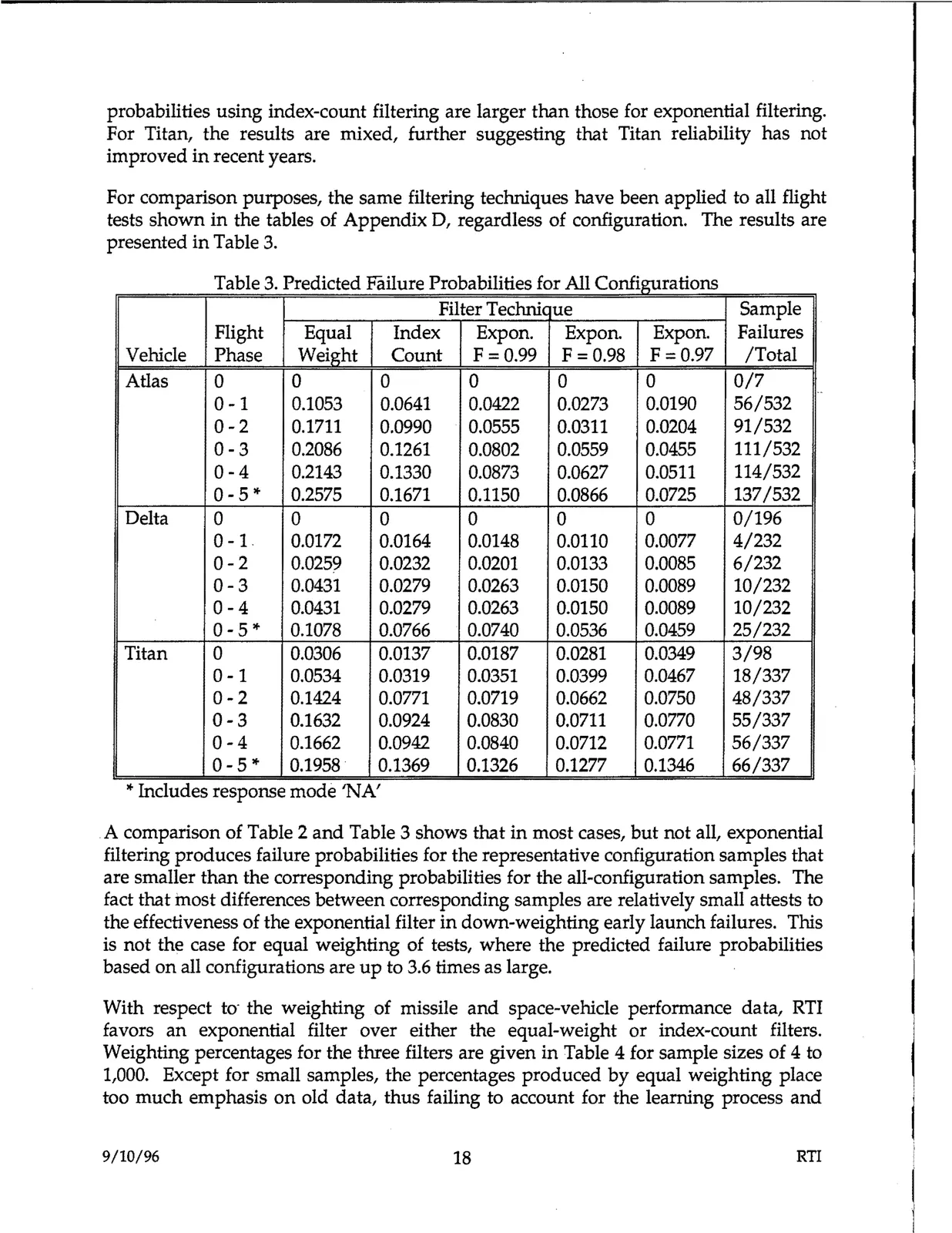
For comparison purposes, the same filtering techniques have been applied to all flight
tests shown in the tables of Appendix D, regardless of configuration. The results are
presented in Table 3.
Table 3. Predicted Failure Probabilities for All Configurations
Vehicle
Atlas
Delta
Flight
Phase
0
0-1
0-2
0-3
0-4
0-5 •
0
0-1.
0-2
0-3
Filter Technic ue
Sample
Failures
/Total
0/7
56/532
91/532
111/532
114/532
137/532
0/196
4/232
6/232
10/232
Equal
Weight
0
0.1053
0.1711
0.2086
0.2143
0.2575
0
0.0172
0.0259
0.0431
Index
Expon.
Expon
Count
F =0.99
F=0.98
0
0
0
0.0641
0.0422
0.0273
0.0990
0.0555
0.0311
0.1261
0.0802
0.0559
0.1330
0.0873
0.0627
0.1671
0.1150
0.0866
0
0
0
0.0164
0.0148
0.0110
0.0232
0.0201
0.0133
0.0279
0.0263
0.0150
Expon
F =0.97
0
0.0190
0.0204
0.0455
0.0511
0.0725
0
0.0077
0.0085
0.0089
0-4
0-5*
Titan
0
0-1
0-2
0-3
0-4
0-5·
0.0431
0.1078
0.0306
0.0534
0.1424
0.1632
0.1662
0.1958·
0.0279
0.0766
0.0137
0.0319
0.0771
0.0924
0.0942
0.1369
0.0263
0.0740
0.0187
0.0351
0.0719
0.0830
0.0840
0.1326
0.0150
0.0536
0.0281
0.0399
0.0662
0.0711
0.0712
0.1277
0.0089
10/232
0.0459
25/232
0.0349
3/98
0.0467
18/337
0.0750
48/337
0.0770
55/337
0.0771
56/337
0.1346
66/337
• Includes response mode 'NA'
. A comparison of Table 2 and Table 3 shows that in most cases, but not all, exponential
filtering produces failure probabilities for the representative configuration samples that
are smaller than the corresponding probabilities for the all-configuration samples. The
fact that most differences between corresponding samples are relatively small attests to
the effectiveness of the exponential filter in down-weighting early launch failures. This
is not the case for equal weighting of tests, where the predicted failure probabilities
based on all configurations are up to 3.6 times as large.
With respect to- the weighting of missile and space-vehicle performance data, RTI
favors an exponential filter over either the equal-weight or index-count filters.
Weighting percentages for the three filters are given in Table 4 for sample sizes of 4 to
1,000. Except for small samples, the percentages produced by equal weighting place
too much emphasis on old data, thus failing to account for the learning process and
9/10/96
18
RTI