Department of the Air Force Report, 1996
DOW-UAP-D048 · page 99 of 181
Text
This text came with the file. It may have mistakes. When the text and the image disagree, the image is right.
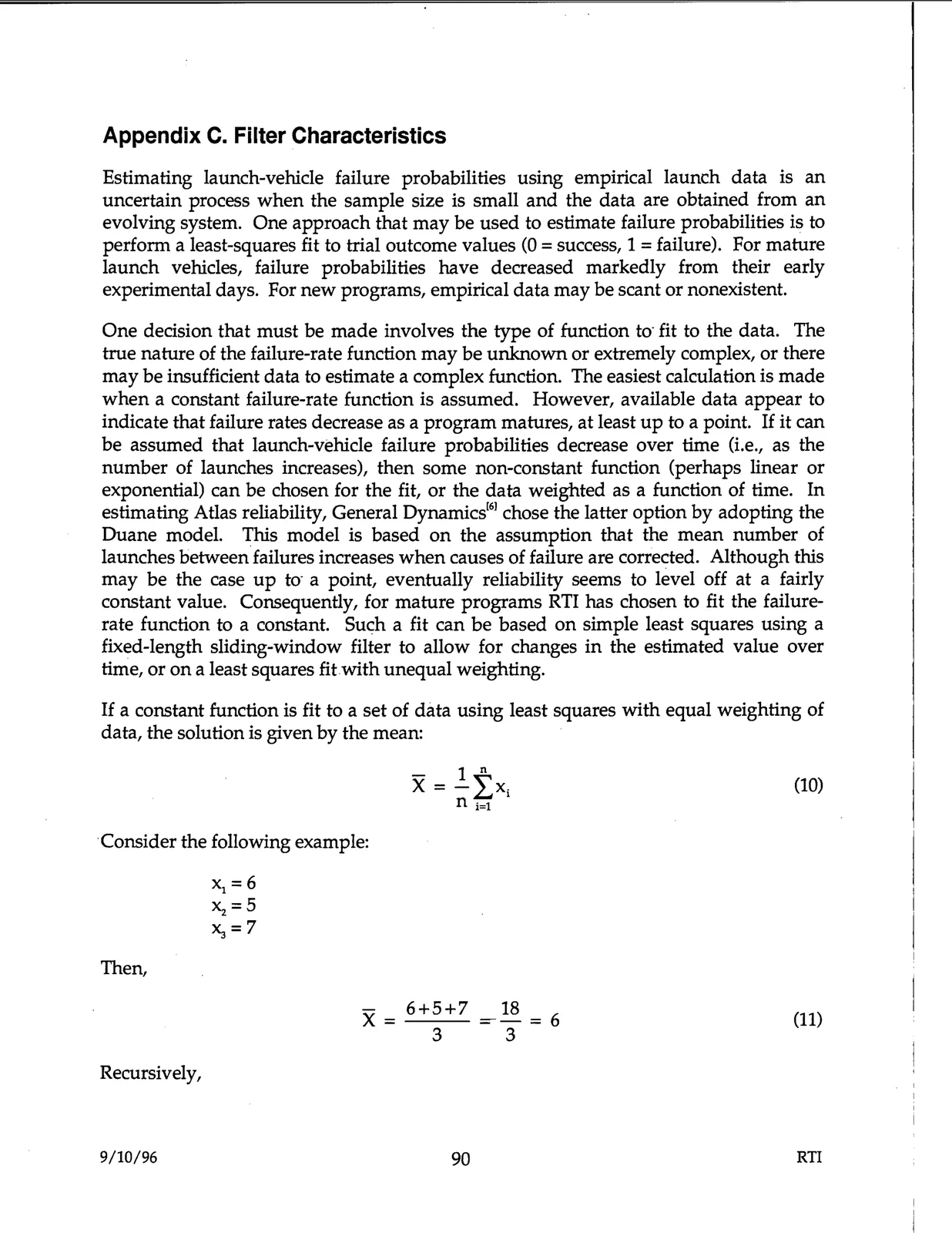
Appendix C. Filter Characteristics Estimating launch-vehicle failure probabilities using empirical launch data is an uncertain process when the sample size is small and the data are obtained from an evolving system. One approach that may be used to estimate failure probabilities is to perform a least-squares fit to trial outcome values (0 =success, 1 =failure). For mature launch vehicles, failure probabilities have decreased markedly from their early experimental days. For new programs, empirical data may be scant or nonexistent. One decision that must be made involves the type of function to- fit to the data. The true nature of the failure-rate function may be unknown or extremely complex, or there may be insufficient data to estimate a complex function. The easiest calculation is made when a constant failure-rate function is assumed. However, available data appear to indicate that failure rates decrease as a program matures, at least up to a point. If it can be assumed that launch-vehicle failure probabilities decrease over time (i.e., as the number of launches increases), then some non-constant function (perhaps linear or exponential) can be chosen for the fit, or the data weighted as a function of time. In estimating Atlas reliability, General Dynamics161 chose the latter option by adopting the Duane model. ~s model is based on the assumption that the mean number of launches between failures increases when causes of failure are corrected. Although this may be the case up to- a point, eventually reliability seems to level off at a fairly constant value. Consequently, for mature programs RTI has chosen to fit the failure- rate function to a constant. Su<;h a fit can be based on simple least squares using a fixed-length sliding-window filter to allow for changes in the estimated value over time, or on a least squares fitwith unequal weighting. If a constant function is fit to a set of data using least squares with equal weighting of data, the solution is given by the mean: (10) ·Consider the following example: X1-6 "2 = 5 "3 = 7 Then, Recursively, X = 6+5+7 =-18 3 3 = 6 (11) 9/10/96 90 RTI