Department of the Air Force Report, 1996
DOW-UAP-D048 · page 100 of 181
Text
This text came with the file. It may have mistakes. When the text and the image disagree, the image is right.
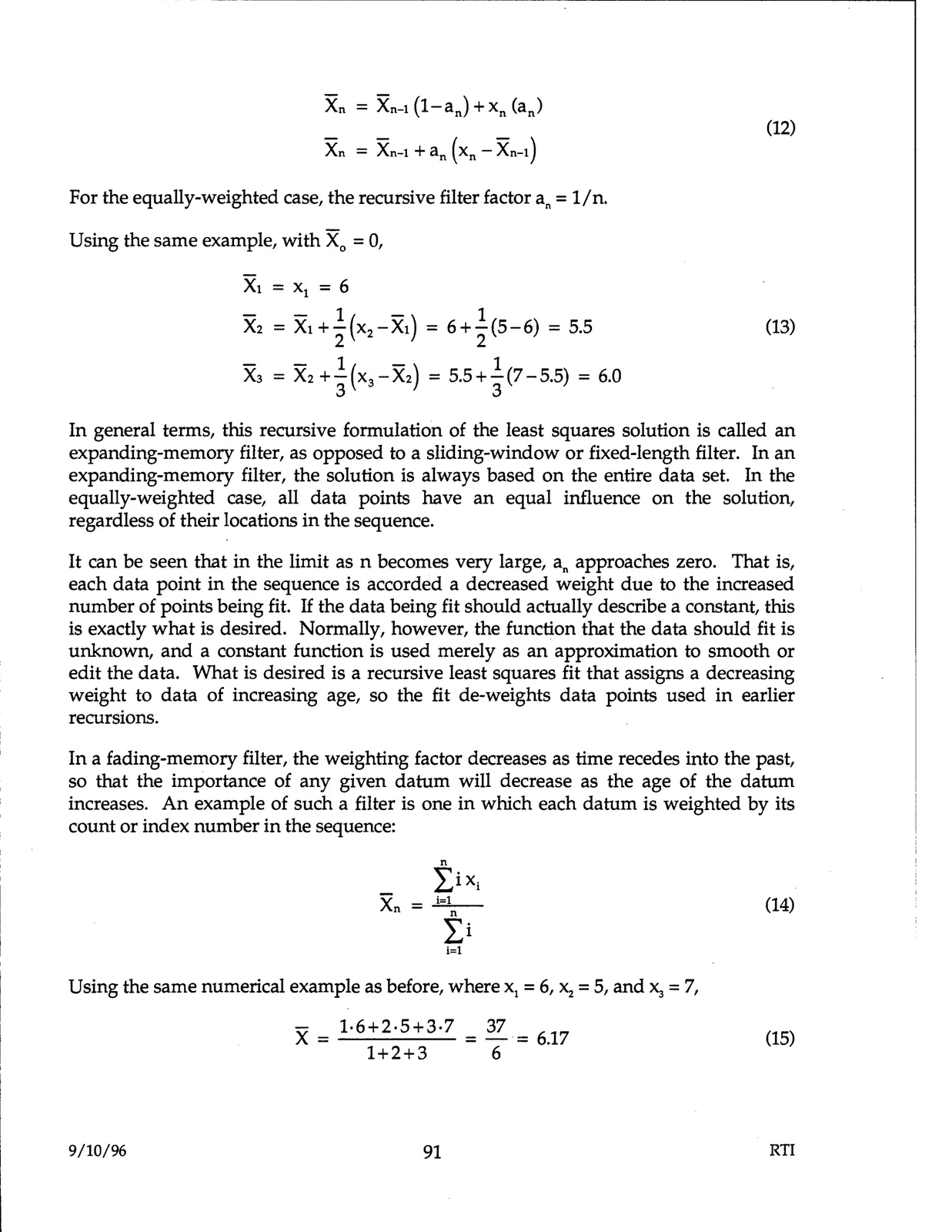
Xn = Xn-1 (1-an) + xn (an)
(12)
Xn = Xn-1 + an (xn -Xn-1)
For the equally-weighted case, the recursive filter factor an= 1/n.
Using the same example, with X0 = 0,
(13)
In general terms, this recursive formulation of the least squares solution is called an
expanding-memory filter, as opposed to a sliding-window or fixed-length filter. In an
expanding-memory filter, the solution is always based on the entire data set. In the
equally-weighted case, all data points have an equal influence on the solution,
regardless of their locations in the sequence.
It can be seen that in the limit as n becomes very large, an approaches zero. That is,
each data point in the sequence is accorded a decreased weight due to the increased
number of points being fit. If the data being fit should actually describe a constant, this
is exactly what is desired. Normally, however, the function that the data should fit is
unknown, and a constant function is used merely as an approximation to smooth or
edit the data. What is desired is a recursive least squares fit that assigns a decreasing
weight to data of increasing age, so the fit de-weights data points used in earlier
recursions.
In a fading-memory filter, the weighting factor decreases as time recedes into the past,
so that the importance of any given datum will decrease as the age of the datum
increases. An example of such a filter is one in which each datum is weighted by its
count or index number in the sequence:
n I,i xi
Xn = i=l n L,i
(14)
i=l
Using the same numerical example as before, where x1 =6, x2 = 5, and x3 =7,
-
1-6+2•5+3•7
37
X = ----- = -
= 6.17
(15)
1+2+3
6
9/10/96
91
RTI