Project Sign Progress Report, 1948
DOW-UAP-D097 · page 39 of 45
Text
This text came with the file. It may have mistakes. When the text and the image disagree, the image is right.
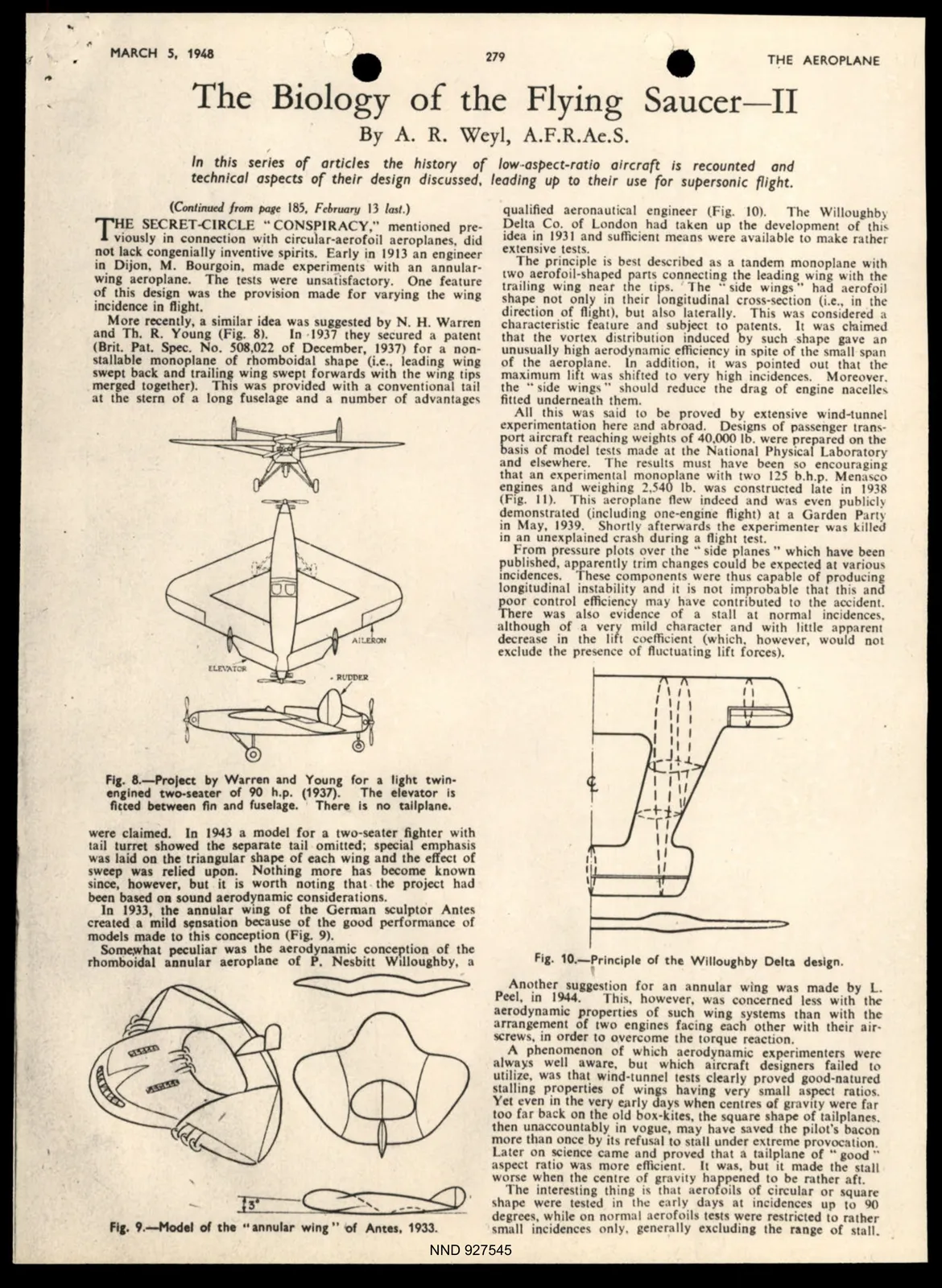
.. ,. MARCH S, 1948 279 - THE AEROPLANE - .. The Biology of the Flying Saucer- II By A. R. Weyl, A.F.R.Ae.S. In this series of articles the history of low-aspect-ratio aircraft is recounted and technical aspects of their design discussed. leading up to their use for supersonic flight. T (Continued from J>Olt 185, February 13 /rut.) HE SECRET-CIRCLE "CONSPIRACY;• mentioned pre viously in connection with circu)ar-aerofoil aeroplanes. did not lack congenially inventive spirits. Early in 1913 an engineer in Dijon. M. Bourgoin. made experiments with an annular wing aeroplane. The tests were unsatisfactory. One feature of this design was the provision made for varying the wing incidence in flight. More recently, a similar idea was suggested by N. H. Warren and Th. R. Young (Fig. 8). In 1937 they secured a patent (Brit. Pat. Spec. No. 508,022 of December, 1937) for a non stallable monoplane of rhomboidal shape (i.e., leading wing swept back and trailing wing swept forwards with the wing lips merged together). This was provided with a conventional tail at 1he stern of a long fuselage and a number of advantage~ Fis. 8.-Project by W arren and Young for a liJht twln en1lned two-seater of 90 h.p. (1937). The elevator is fitted between fin and fuselage. There Is no tailplane. were claimed. lo 1943 a model for a two-seater fighter with tail turret show~ the separate tail omitt~d; special emphasis was laid oo the triangular shape of each wing and the effect of sweep was relied upon. Nothing more bas become_ known since however but it is worth noting that the proJect had been'based oa ;ound aerodynamic considerations. lo 1933 the annular wing of the German sculptor Antes created a mild s~nsation bc<:ause ?f the good performance oC models made to this coocepuon (Fig. 9). Some.what peculiar was the aerodynamic ~onceP.tion of the rhomboidal annular aeroplane of P. Nesbitt W11loughby, a = Fis, 9.--Model of the "annular wing " ~f Antes. 1933. qualified aeronautical engineer (Fig. 10). The Willoughb} Delta Co. of London had taken up the development of th,., idea in 1931 and sufficient means were available to make rather extensive tests. The principle is best described as a tandem monoplane with two aerofoil-shaped parts connecting the leading wing with the trailing wing near the tips. The "side wings" had aerofoil shape not only in their longitudinal cross-section (i.e., in the direction of flight). but also laterally. This was considered a characteristic feature and subject to patents. It was claimed that the vortex distribu1ion induced by such shape gave an unusually high aerodynamic efficiency in spite of the small span of the aeroplane. In addition. it was pointed out that the maximum lift was shifted to very high incidences. Moreover. the "side wings" should reduce the drag of engine nacelle, filled underneath them. All this was said to be proved by extensive wind-tunnel experimentation here and abroad. Designs of passenger trans pon aircraft reaching weights of 40,000 lb. were prepared on the basis of model tests made at the National Physical Laboratory and elsewhere. The results must have been so encouraging that an experimental monoplane with two 125 b.h.p. Menasco engines and weighing 2,540 lb. was constructed late in 1938 (Fig. 11). This aeroplane flew indeed and was even publicl~ demonstraled (including one-engine flight) a1 a Garden Party in May, 1939. Shortly afterwards the experimenter was killed in an uneitplained crash during a flight test. From pressure plots over the "side planes" which have been published, apparently trim changes could be eitpected at various aocidences. These components were thus capable of producing longitudinal inslability and it is not improbable that this and poor control efficiency may have contributed to the accident. There was also evidence of a stall at normal incidences. although of a very mild character and with little apparent decrease in the lift c~fficient (which. however, would not exclude the presence of fl uctuating lift forces). 1 1 Fig. 10.-frinciple or the W illoughby Delta design. Another suggestion for an annular wing was made by L. Peel, in 1944. This. however. was concerned less with the aerodynamic properties of such wing systems than with the arrangement of two engines facing each other with their air screws. in order to overcome the torque reacuon. A phenomenon of which aerodynamic experimenters were alwa)ls well aware. but which aircraft designers failed 10 u1ilizc, was that wind-tunnel tests clearly proved good-natured stalling p_roperties of wings having very small aspect ratios. Yet even m the very e_arly days when centres of gravity were far too far back on the old box-kites, the square shape of tailplanes. then unaccountably in vogue, may have saved the pilot's bacon more than once by its refusal to stall under eittreme provocation. Later on science came and proved that a tailplane of "good" aspect ratio was more eflkient. It was, but it made the stall worse when the centre of gravity happened to be rather aft. The interesting thing is that aerofoils of circular or square shape were tested in the early days at incidences up to 90 degrees, while on normal aerofoils tests were restricted to rather small incidences only. generally ucluding the range of stall. NND 927545