Project Sign Progress Report, 1948
DOW-UAP-D097 · page 40 of 45
Text
This text came with the file. It may have mistakes. When the text and the image disagree, the image is right.
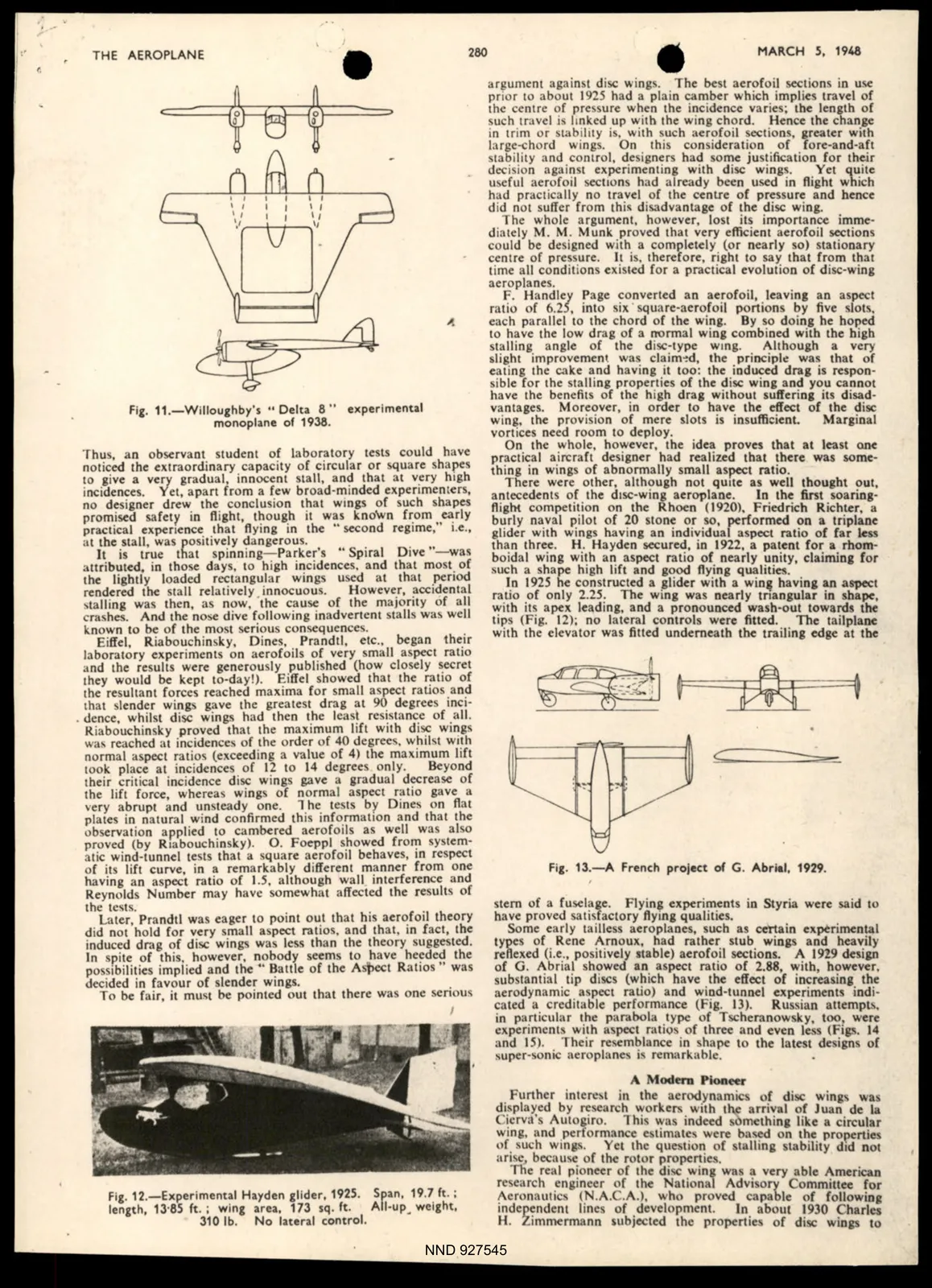
e MARCH S, 1948 THE AEROPLANE 280 c > \ I \ I I I I I I I \,' I I \,' Fig. 11.-Willoughby's "Delta 8" experimental monoplane of 1938. Thus, an observant student of laboratory tests could have noticed the extraordinary capacity of circular or square shapes 10 give a very gradual, innocent stall, an~ that at v!!rY high incidences. Yet, apart from a few broad-minded experimenters, no designer drew the conclusion that wmgs of such shapes promised safety in flight, t~oug_h it w~s known f~om ..~rly practical experience that fly1Dg 10 the second regime, 1.e., at the stall, was positively dangerous. It is true that spinning- Parker's "Spiral Dive "-was attributed. in those days, to high i~cideoces, and that most_of the lightly loaded rectangular wmgs used at that period rendered the stall relatively. innocuous. Howeve_r, :iccidental ~tailing was then, as now. the cause of the maJonty of all crashes. And the nose dive following inadvertent stalls was well known to be of the most serious consequences. . Eiffel, Riabouchinsky, D ines, . Prandtl, etc., began the_1r laboratory experiments on aerofoils of very small aspect rauo and the results were generously published (how closely secret they would be kept to-day!). Eiffel showed that the ratio of the resultant forces reached maxima for small aspect ratios_an~ that slender wings gave the greatest drag at ~ degrees 10c1 . <lence, whilst disc wings had then t_he leas) res\stanc_e of _all. Riabouchinsky proved that the maximum 11ft with d15:C Wl1'!8S wa~ reached at incidences of the order of 40 degrees. whilst with normal aspect ratios (exceeding a value of 4) the maximum lift took place at incidences of 12 to 14 degrees only. Beyond their critical incidence disc wings gave a gradual decrease of the lift force whereas wings of normal aspect ratio gave a very abrupt ; nd unsteady one. 1 he tests by Dines on flat plates in natural wind confirmed this info_rmauon and that the observation applied 10 cambered aerofoils as well was also proved (by Riabouchiosky). 0. Foeppl s_howed frof!l system atic wind-tunnel tests that a square aerofoil behaves, ID respect of its lift curve in a remarkably different manner from one having an aspec't ratio of 1.5, although wall interference and Reynolds Number may have somewhat affected the results of the tests. . Later, Prandtl was eager to point o~t that his aer~fo1l theory did not hold for very small aspect ratios, and that, ID fact, the induced drag of disc wings was less than the theory suggested. In sP.ite of this, however, nobody seems to have he~ded the possibilities implied and the " ~attle of the Aspect Ratios" was decided in favour of slender wings. . To be fair, it must be pointed out that there was one senou~ I Fig. 12.-Experimental Hayden glider, 1925. Span, 19.7 rt. : length, 13·85 rt.; wing area, 173 sq. rt. All-up_ weight, 310 lb. No lateral control. argument against disc wings. The best aerofoil sections in use prior 10 about 1925 had a plain camber which implies travel of the centre of pressure when the incidence varies; the length of such travel is linked up with the wing chord. Hence the change in trim or stabiluy is. with such aerofoil sections, greater with large-chord wings. On this consideration of fore-and-aft stability and control, designers bad some justification for thcir decision against experimenting with disc wings. Yet quite useful aerofoil secuons had already been used in flight which had practically no travel of the centre of pressure and hence did not suffer from thi~ disadvantage of the disc wing. The whole argument, however, lost its importance imme diately M. M. Munk proved that very efficient aerofoil sections could be designed with a completely (or nearly so) stationary centre of pressure. It is. therefore, right to say that from that time all conditions existed for a practical evolution of disc-wing aeroplanes. F. Handley Page converted an aerofoil, leaving an aspect ratio of 6.25, into six square-aerofoil portions by five slots. each parallel to the chord of the wing. By so doing he hoped to have the low drag of a oormal wing combined with the high stalling angle of the disc-type wmg. Although a very slight improvement was claim~d, the principle was that of eating the cake and having it too: the induced drag is respon sible for the stalling properties of the disc wing and you cannot have the benefits of the high drag without suffering its disad vantages. Moreover, in order to have the effect of the disc wing, the provision of mere slots is insufficient. Marginal vortices need room to deploy. On the whole, however, the idea proves that at least one practical aircraft designer had realized that there was some thing in wings of abnormally small aspect ratio. There were other. although not quue as well thought out, antecedents of the disc-wing aeroplane. In the tint soaring flight competition on the Rhocn ( 1920), Friedrich Richter, a burly naval pilot of 20 stone or so, performed on a triplane glider with wings having an individual aspect ratio of far kss than three. H. Hayden secured, in 1922, a patent for a rhom boidal wing with an aspect ratio of nearly unity, claiming for such a shape high lift and good flying qualities. In 192S he constructed a glider with a win, having an aspect ratio of only 2.25. The wing was nearly tnangular in shape, with its apex leading, and a pronounced wash-out towards the tips (Fig. 12); no lateral controls were fitted. The tailplane with the elevator was fitted underneath the trailing edge at the c ==---=- Fig. 13.-A French project of G. Abrial, 1929. stern of a f11selage. Flyinf experiments in Styria were said 10 have proved satisfactory flying qualities. Some early tailless aeroplanes, such as certain experimental types of Rene Arnoux, had rather stub wings and heavily reflexed (i.e., positively stable) aerofoil sections. A 19?9 design of G. Ab rial showed an aspect ratio of 2.88, with, however, substantial tip discs (which have the effect of increasing the aerodynamic aspect ratio) and wind-tunnel experiments indi cated a creditable performance (Fig. 13). Russian attempts, in particular the parabola type of Tscheranowsky, too, were experiments with aspect ratios of three and even less (Figs. 14 and IS). Their resemblance in shape to the latest designs of super-sonic aeroplanes is remarkable. . A Modttn Pioneer Further intcre~t in the aerodynamics of disc wings was displayed by research workers with th.e arrival of Juan de la Cicrv:i's Autogiro. This was indeed s<>mcthing like a circular wing, and performance estimates were based on the properties of such wings. Yet the question of stalling stability did not arise, bccau~e of the rotor properties. The real pioneer of the disc wing was a very able American research engineer of the National Advisory Committee for Aeronautics (N.A.C.A.), who proved capable of following independent lines of development. In about 1930 Charles H. Zimmermann subjected the properties of disc wings to NND 927545