Project Sign Progress Report, 1948
DOW-UAP-D097 · page 41 of 45
Text
This text came with the file. It may have mistakes. When the text and the image disagree, the image is right.
MARCH S, 1948
281
THE AEROPLANf
e
wing , tructures as well as for the pos\lbility of housing every·
thing w11hm a wing.
Hence 1hc1e are very real design reasons for the preference
of disc wings, quite a pan from the ea~cd accommoda11on of
short-span aeroplanes.
Some Rernurkable Results
Zimmermann establ.shed that the optimum a~pcct rauo "'"~
found bet,..een the values of 0.75 and 1.5.
l he,c value,
include both ,quare and ctrcubr wmg ,hapes.
For a g1Hn
wing sccuon (Clark Y) the latter gave the h1gh~t hft coefficient.
1.85 at 45 degrees incidence, compared "uh a value of t.:!4
at 14 degree, mc1dencc for an aspect ratio of six.
Funhcrmore. an important result "'•'\ evidence that at ~,n
a,pect ra110 of unity hquare or elhpllcal .... ,ng,), and :11 an
a,pect rauo of 0.9 (" mg "11h faired ups), no tendcnc)' 111
autorotauon could be found.
A circular " mg (:1,ix-ct raw,
...
/---
of 1.27) ind c.llcd the po\\1hili1y of ~1urnrntation (1.e., ,rinningl
at incidence\ below that of maximum lif1.
1 he 1nm1biht)' of
,pinning before the actual ,tall is reached is. indeed, e,tra·
ordinary.
All these rcwh, r.:fer to te,t• "ith the ( lar~ ,
Fig. _14.-A Russian • puabola' glider of 1924.
aerofoil section.
Less establi,hed "as the contenuon th:11 d1..c wing would
11ive improved la11:ral and longuudmal ,1.1h1htv at low incidence,
extensive wind-tunnel investigation and the publbhed reports
1 hi, ..ecm, ,11II 10 be a moot point of the Flyin!l Saucer.
\till form the ba,is of prc~ent development.
In places.
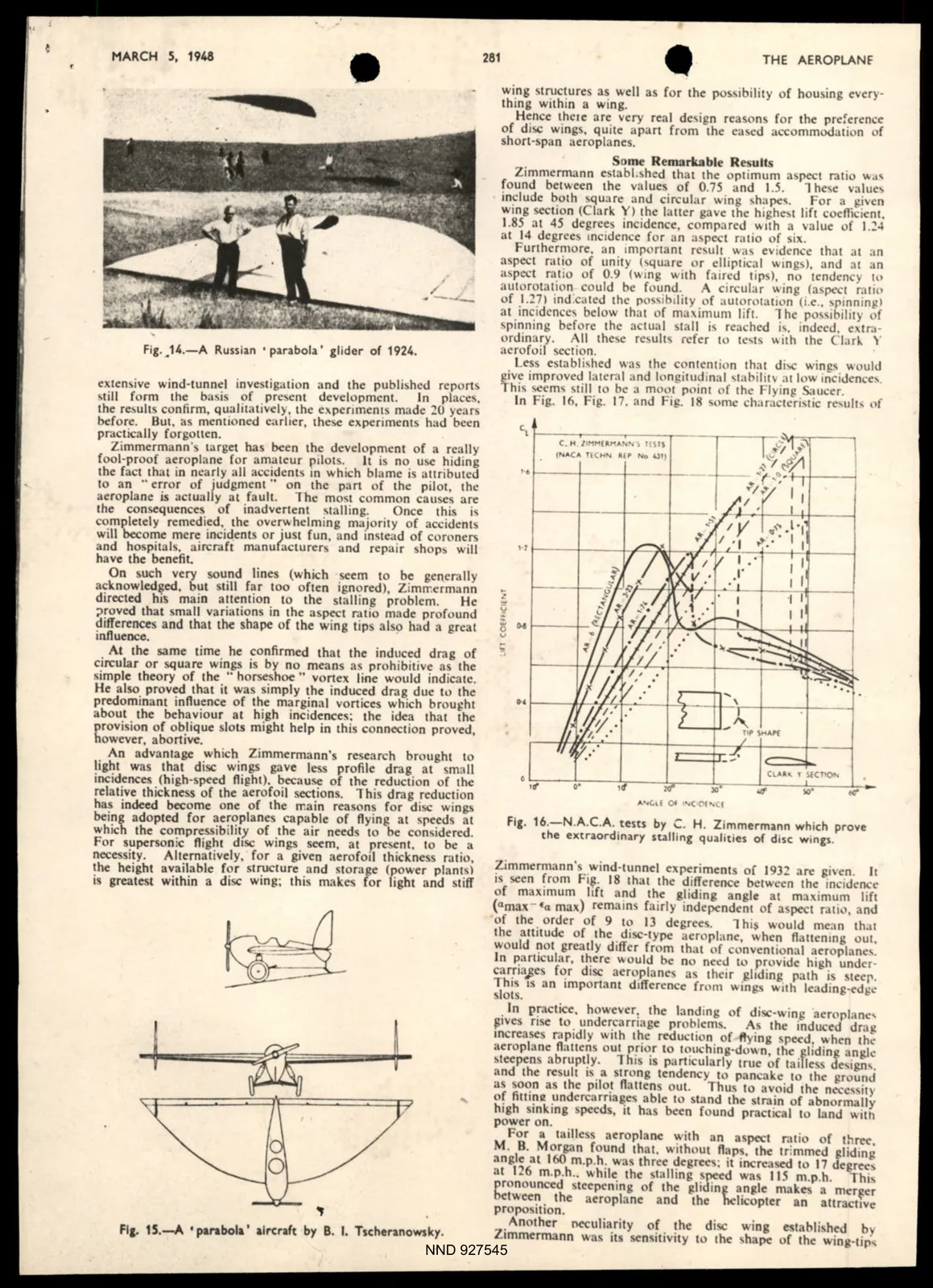
In Fig. 16, Fig. 17. and Fig. 18 some charactcri,tic result, ,,f
the re,ults confirm, qual1tat1vel)', the experiments made '.!O year~
before. But, as mentioned earlier, these experiments had been
praet1C111ly forgotten.
Zimmermann's target has been the development of a really
7
fool-proof aeroplane for amateur pilots.
It is no u<,c hiding
the fact that in n.:arly all accidents in which blame is attributed
to an .. error of /'udgment" on the part of the p1lo1, th.:
aeroplane is :ietual y at fault.
The moq common causes arc
the consequences of inadvertent ~tailing.
Once this
1~
completely remedied, the overwhelming majority of accident
will become mere incidents or just fun, and instead of coroners
and hospitals. aircr.1ft manufacturer) and repair shop) will
I!
have the benefit
I I
On such very sound lines (which seem to be generally
acknowled$ed, but still far too often ignored), Zimrrcrmann
I I
directed his main attention to the stalling problem.
He
:;.,
;>roved that small variations in the aspect ratio made profound
't
differences and that the shape of the wing tips also had a great
0-,
influence.
...
~.
~
At the same time he confirmed that the induced drag of
circular or square wings is by no means as proh1b111ve as the
simple theory of the " horseshoe " vortex line would indicate.
He also proved that it was simply the induced drag due to the
predominant influence of the marginal vortices which brou~ht
••
about the behaviour at high incidence~: the idea that the
provision of oblique slots might help in this connection proved,
however, abortive.
An advantaae which Z1mmermann's research brought to
liaht was that disc wings gave less profile drag at small
CIA°', IIC,,O,.
incidences (high-speed flight). because of the reduction of the
-1....____..._
.,,.
JO'
-:
relative thickness of the aerofoil sections. 1 his drag reduction
has indeed become one of the rr.ain reasons for di.c wings
being adopted for aeroplanes capable of flying at ~reeds at
which the compressibility of the air needs to be considered.
Fl&, 16.-N.A.C.A. tests by C. H. Zimmermann which prove
the extraordinuy sull1ng qual1t1es of disc wines,
Fo r supersonic flight disc wings seem, at P.rcscnt, to be a
necessity.
Alternatively, for a given aerofoil thickness ratio,
!he height avail_able f<?r st,:ucture _and stora1te (J?Ower plant_sl
Zimmem1ann·~ _wind-tunnel experiments of 1932 are given.
It
1s greatest within a disc wmg; this ma.,es for light and sutr
1~ seen from F,,. 18 that the difference between the mc1deoce
of ma,umum hft and the gliding angle at m:i1t1mum hft
("ma'< •a ma'<) rem:im'I fairly independent of aspect ratt,,, and
of the o rder of 9 to 13 degree,.
1 h1~ would me:in th.11
the attitude of the . disc-type aeroplane, when flattening out,
would not greatly differ from that of convcnuonal aeroplane,
In particular, there "'ould be no need 10 provide h1g_h under·
cama;ies for disc aeroplane, a .. their gliding path 1s steer
Thi, 1s an important difference from "''"IJS w11h lead1ng-cd~~
,lots.
. In P!'3Ctice, however: the landing of disc-wing aeroplane,
~•vcs rise to undercarriage problem,.
As the induced dra~
mcrcascs rapidly "ith the reduction of !tying ~recd, when the
aeroplane flattens out prior to touchina·do" n, the ihdtnti angle
.iecpens abruptly.
This 1s particularly true of ta1llc..s de"gn,.
and the result •~. a strong tendency to pancake 10 the ground
a, so~n as the p1lo_t fl:\ltcn, out.
Thu~ to avoid the nccc\,il)
of litt1!)2 _undercamal\cs able to sta nd the strain of abnormally
high sink mg ~pecds, 1t has been found practical to land "Jtll
power on.
For a ta11le~s aeroplane " ith an aspect ratio of three,
M. B. Morgan found that. without flaps, the trimmed l\liding
angle at 160 m.p.h. was three degree,: it increased to 17 degree,
at 126 m.p.h .. while the \tailing speed was I IS m.p.h.
Thi,
pronounced , teepcning of the g)idintt anttle makes a mer~er
hct""ce~. the aeroplane and
the helicopter an attrac11ve
,
propos111on.
.Another occulia_rity of . !he di~ wing cstahlished
b~
Fie, 15.-A ' puabola ' aircraft by B. I. Tschennowsky
NND 927545
.
Zimmermann wns us scns111v11y to the , hape of the wing•ur,,