Project Sign Progress Report, 1948
DOW-UAP-D097 · page 42 of 45
Text
This text came with the file. It may have mistakes. When the text and the image disagree, the image is right.
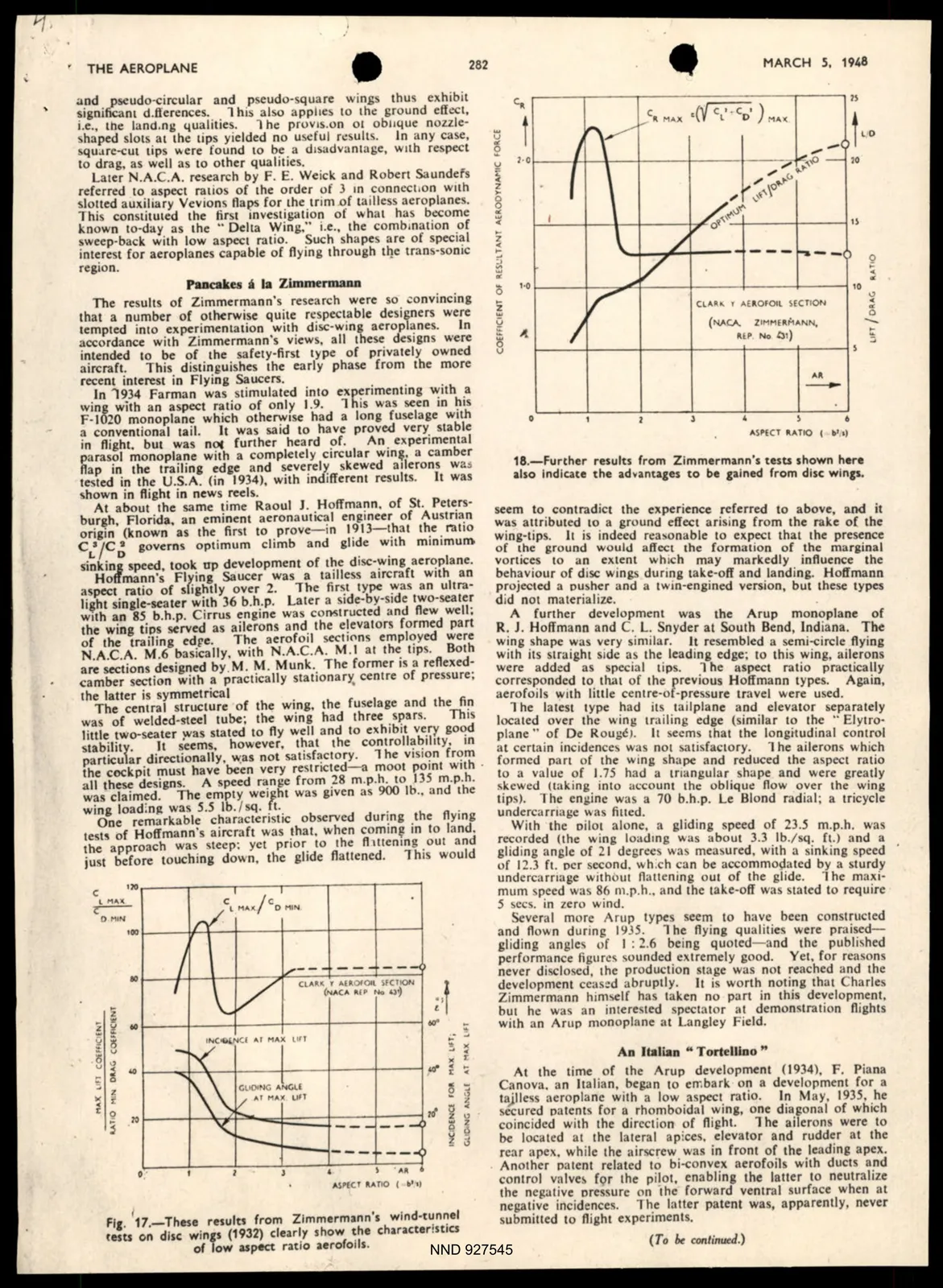
-- 10 282 ' THE AEROPLANE and _pseudo-circular and pseudo-square wings thus exhibit ~ignificam d.fferences... 1 his also applies to the ground eff.:ct, 1.e., tbe tand.ng <juahues. 1 he prov1s.on 01 ob11que nozzle shaped slots at the lips yielded no useful r.:sults. In any case, squo1re-cut tips Vvere found to be a disadvantage, w11h respect to drag, as well as to other qualities. Later N.A.C.A. research by F. E. Weick and Robert Saundefs referred to aspect ratios of the order of 3 1n conncct,on w11h slotted auxiliary Vevions flaps for the trim of tailless aeroplanes. This constituted the first investigation of what has b.x:ome known to-day as the .. Delta Wing.'' i.e., the combination of sweep-back with low aspect ratio. Such shapes are of special interest for aeroplanes capable of flying through the trans-sonic region. • Pancakes Ii la Zimmermann The results of Zimmermann's research were so ~onvincing that a number of otherwise quite respectable designers were tempted into experimentation with disc-wing aeroplanes. In accordance with Zimmermann's views, all these designs were intended to be of the safety-first type of privately owned aircraft. This distinguishes the early phase from the more recent interest in Flying Saucers. In '1934 Farman was stimulated into experimenting with a wing with an aspect ratio of only 1.9. 1 his was seen in his F-1020 monoplane which otherwise had a long fuselage with a conventional tail. It was said to have proved very stable in flight. but was noc further heard of. An experimental parasol monoplane with a completely circular win$, a camber flap in the trailing edge and severely skewed ailerons Wl?.$ tested in the U.S.A. (in 1934), with indifferent results. It was shown in flight in news reels. At about the same time Raoul J. Hoffmann. of St. Peters· burgh, Florida, an eminent aeronautical engineer of Austrian origin (known as the first to prove-in 1913-that the r:itio C '/C 9 governs optimum climb and glide with minimum L D sinking speed, took up development of the disc-wing aeroplane. Hoffmann's Flying Saucer was a tailless aircraft with an aspect ratio of slightly over 2. The fi rst type was an ultra· li$ht single-seater with 36 b.h.p. Later a side-by-side two-seater with an 85 b.h.p. Cirrus engine was constructed and flew well; the wing tips served as ailerons and the elevators formed part of the trailing edre. The aerofoil sectir,ns employed were N.A.C.A. M.6 basically. with N.A.C.A. M.1 at the tips. Both are sections designed by.M. M. Munk. The former is a reflexed camber section with a practically stationarY, centre of pressure; the latter is symmetrical The central structure of the wing, the fuselage and the fin was of welded-steel tube; the wing had three spars. This little two-seater }"as stated to fly well and to exhibit ve_ry go(!d stability. It seems, however. that the controllab1hty, m particular directionally, was not satisf~ctory. 1 he visi(?n fr(?m the cockpit must have been very restncted--a moot point wllh • all these designs. A speed range from 28 m.p.h. to 13S m.p.h. was claimed. The empty weight was given as 900 lb •• and the wing loading was 5.5 lb. / sq. ft. One remarkable characteristic observed during the flying tests of Hotrmann's aircraft was that, when comin(! in to land. the approach was steep: yet prior to the fl lltening out and just before touching down, the glide flattened. 1 his would l MAJ( C jc Cl MA.( 0 MIN r 0 MIN ,001----.U---4---1---4----4-----+---~ CI..Akl( T AUl,OfOtL SfCTl()N C,.ACA • IP No u,) z ;•f .., .,,. ~ 60 ~ J ::,., l5 r " • "< .. " fl" It . !i "' z J ~ •> • It ~ " It ti 0 11f 2 10 z c!, " ~ 6 t i; AA o· • ASP(Cf U flO ( •' 1J Fig. 117.-These resulu from Zlmmermann's wind-tunnel tests on disc; wings (1932) clearly show the character!stits of low aspect ratio aerofoils. • MARCH 5, 1948 c:,_ i g: 0 10 "< Cl ARK I AEAO FOtl SECTION "' 0 (i-v-CA ZIMME~MANN, .. ~l P No ()1) :; o'----~---L---JL_.__..L.__...L._......:~, ASPECT AATIO ., ., 18.-Furthcr results from Zimmermann's tesu shown here also indicate the advantages to be gained from disc wings. seem to. contradict the experience referred to above and it w~s aunbuted. to. a ground effect arising from the rak~ of the wing-tips. It 1s indeed rea:.onable to e)(pcct that the presence of t_he ground would affect the formation of the marginal vort1c~s to an ex\ent which may markedly influence the beh~v1our of disc wings during take-off and landing. Hoffmann proJected a ousher and a twin-engined version but these types did not materialize. • A further development was the Arup monoplane of R: J. Hoffmann and C._L: Snyder at South Bend, Indiana. The w!ng _shape ~as v~ry s1m1lar. I~ resembled a semi-circle flying w11h 11s straight side a_s the_leading edge; to this wing, ailerons were added as special ups. 1 he aspect ratio practically corres~onded to. that of the previous Hoffmann types. Again, aerofoils wtth little centre-of-pressure travel were used. 1 he latest type ~ad it~ _tailplane and elevator separately locate~ over the wing tr:11lmg edge (similar to the .. Elytro· plane of De Rouge!). It seems that the longitudinal control at certain incidences was not satisfactory. 1 he ailerons which formed part of the wing shape and reduced the aspecl ratio to a value ~f I: 15 had a triangular shape and were greatly s_kewed (taking_ into account the obliqui: flow over the wing tips). The engine was a 70 b.h.p. Le Blond radial; a tricycle undercarriage was fitted. With the oilot alone, a gliding speed of 23.S m.p.h. was r~o_rded (lhe wing loading was about 3.3 lb./sq. ft.) and a gliding angle of 21 degrees was mea~ured, with a sinking speed of 12.3 ft. ocr si:cond. wh.ch ~an be accommopated by a sturdy undercarriage without nattening out of the glide. 1 he maxi· mum speed was 86 m.p.h .. and the take-off was stated to require S secs. in zero wind. Several more Arup types seem to have been constructed an_d _flown during 1935. 1 h~ flying qualities were pr.iised ghding angle~ or I : 2.6 bemg quoted- and the published performance figures sounded extremely good. Yet, for reasons never disclosed, the production stage was not reached and the development ceased abruplly. It is worth noting that Charles Zimmermann himself has taken no part in this development, b1;11 he was an interested spectator at demonstration flights wnh an Arup monoplane at Langley Field. An Italian "Tortelllno " At the time .of the Arup development (1934). F. Piana Canova. an Italian, began to embark on a development for a tajlless aeroplane with a low aspect ratio. In May, 1935, he secured patents for a rhomboidal wing, one diagonal of which coincided with the direction of flight. 1 he ailerons were to be located at the lateral apices. elevator and rudder at the rear apex. while the airscrew was in front of the leading apex. Another patent related to bi-convex aerofoils with ducts and control valve~ for the pilot, enabling the latter to neutralize the negative oressure on the forward ventral surface when at negative incidences. The latter patent was, apparently, never submitted to flight experiments. NND 927545 (To ~ confin~d.)