Project Sign Progress Report, 1948
DOW-UAP-D097 · page 43 of 45
Text
This text came with the file. It may have mistakes. When the text and the image disagree, the image is right.
,
MARCH 19, 1948
337
THE AEROPLANE
The Biology of the Flying Saucer- III
By A. R. Wcyl, A.F.R.Ac.S.
Previous articles In this series appeared In " The Aeroplane" for February 13 and Morch 5
W
I 0 -·1UN l· L I F-••n S w.:rc made in I unn and at Rnme
of five C:anovo1 project\ {de-.cnbcd m the prcvtom tn\1,11
"'!Cnl of 1h1, ar1de). It " in1erc,11ng 10 note that 1he Canov.1
d1-.c-wmg lype, did not mal.e u,e of rellc'<ed~ambcr aerofoil,.
S1abili1y ,ind mm could. 1hercforc. be -..:cured only by an
upward, dcllec1iu11 of enlarged eleva1or,.
F.arly in 1935. :in ·open ghdl!r of 1he " Zoegling" t} pc wo1~
con,1ructed by a ,~ilan firm and M. A. Garbell made fairly
~ucce,,ful l11ghh w11h 11.
He reported that the longitudinal
stability (w11h the enlarged eleva1or) wa~ good and 1hat
par.i.chute-lil.e landing, could be performed.
rhc lateral
stability ch.i.racteri\lic. however, proved deficient. ~ince a
•• Dutch-roll " motion was experienced: turn, were of quc,tion·
able steadine,,.
In this rc,pcct, in~uffidcnt damping 1n foll
and yaw a_re mentionr.d.
Wi1h winch-launching, thi~ glider
reached altitude~ of 600 fl.
On 1he ba"' of thi, dc,ign, a ligh1 aeroplane wa\ developed
and the Italian Government financed the conMruction of two
l~~gcr e,-perimental aeroplane~. includmg one with 130 b.h.p.
Gip,y engine.
A faial accident de~ribcd as "not necessarily
retlccti~f? on 1he 1echnical _merit5 of the design," cau,cd the
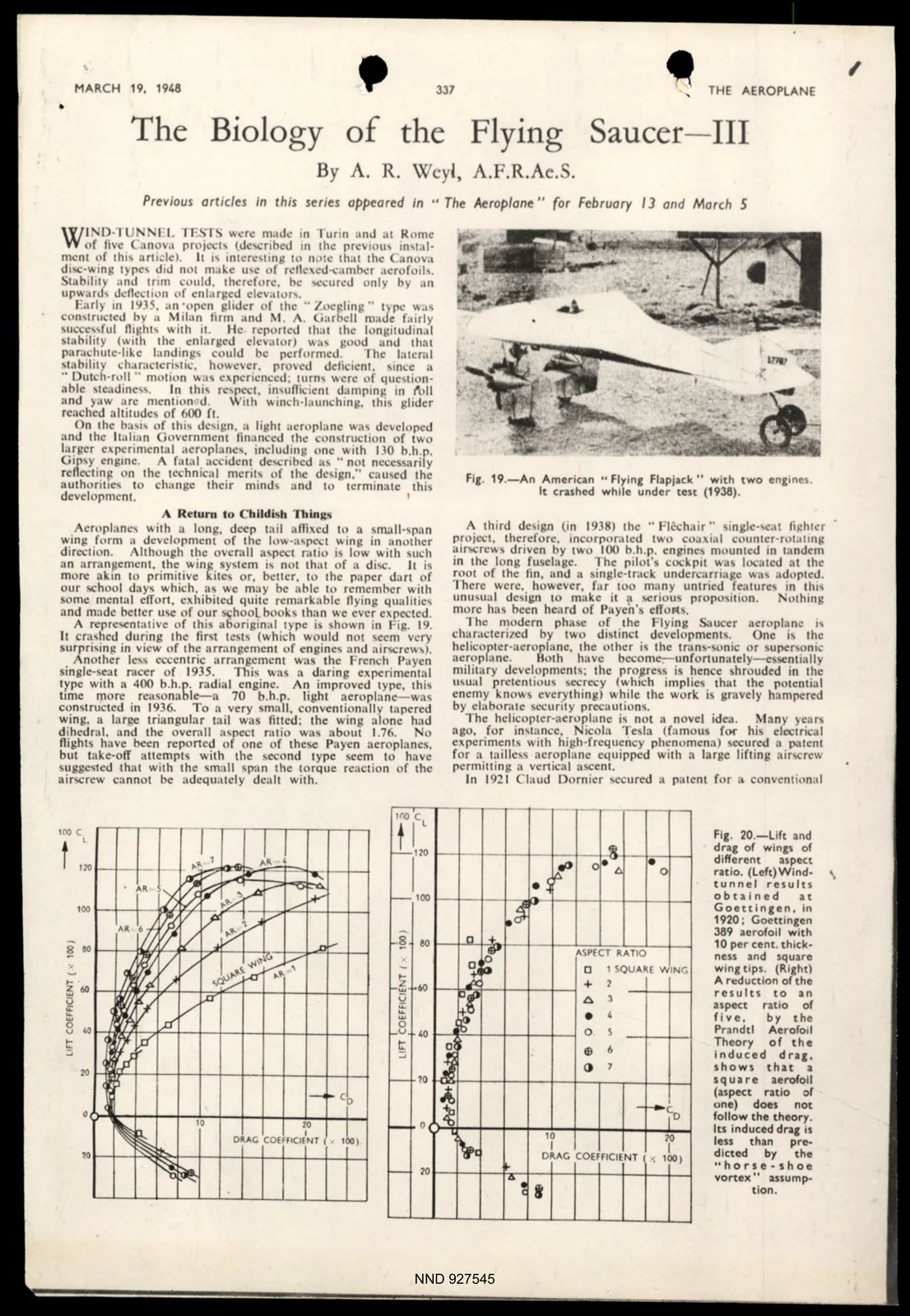
Fig. 19.-An American "Flying Flapjack" with two engines.
authorities to change 1hc1r minds and 10 terminate this
It crashed while under test (1938).
development.
1
A Return to Childish Things
Aeroplane, with a long, deep tail affi'<Cd to a smalhpan
A third de,ign tin 1938) 1hc "Flcchair" \tngle-,cat fil!hlcr
wing form a development of lhe low•tl'pect wing in another
rroiect. therefore. incorporalcd two co.1xial coun1cr•rot.11mg
direclion.
Although the overall a~pect ratio is low wi1h such
~tf'>Crcws driven by two 100 b.h.p. engines mounted in 1andem
an arr.rngemcnt. the wing system i, not tha1 of a di-.c.
It is
m the long fuselage.
1 he pilot's cockpit was located at the
more akin to primitive kites or. belier, to the paper dart of
root of lhe fin, and a single·lrack undercarriage w.is adopted.
our school day~ which. a, we may be able to remember wi1h
1 here were. however, far too m.iny untried feature
in th"
some mental effort, exhibited quite remarkable nying quali1ie,
unusual design 10 make ii a ~rious proposi1ion.
Nothing
more has been heard of Payen's cffoA~.
and made better use <>four schoolbooh than we ever expt-ctcd.
A rcpresent:11ive of 1his aboriginal 1ype is shown in Fig. 19.
l he ll)Odern ph:ll!e of . 1he Flying Saucer aeroplane i,
It crashed during the first tests (which would not seem very
charactcn1ed by two d1,ttncl development~.
One is the
surprising in view of the; arrangement of engine, and air;crew,).
hclicop1er-aeroplane, 1he other is the tranb•\onic or buper,on1c
Ano1her Je,s eccentric arrangement was the French Payen
aeroplane.
Hoth have bccome:-unforiunately--cs<;entially
single-seat racer of 1935.
This was a daring experimental
military dcvcl_opment~; the proJ_!re~~ is ~cnce bhroudcd in the
type with a 400 b.h.p. radial engine. An improved type, this
u~ua I pretcnuou~ \ecrccy Iwhich implies that the potential
time more
reasonable--a 70 b.h.p. light aeroplane- was
enemy knows everything) v. hile the work is gravely hampered
constructed in 1936.
To a very small. conventionally tapered
by elabora1c securi1y precautions.
wing, a large triangular tail was fitted: the wing alone had
The helicopter-aeroplane is not a novel idea.
Many }Cars
dihedral. and the overall aspect ra1io was about 1.76.
No
ago, for in,iance, Nicola Te~la (famous for his elccirical
flights have bc.:n reported of one of these Payen aeroplanes.
experiment~ wi1h high-frequency phenomena) bccured a pa1en1
but take-off attempts with the ~econd type seem to have
for a taille,~ aeroplane equipped with a large lifting air~rcw
sugges1cd that with 1he small span the 1orque reaction of the
pcrmi11ing a vertical ascent.
air,;crcw cannot be adequa1ely dealt with.
In 1921 Claud Dornier ~ecured a pa1ent for a eonvcnlmnal
-
- ·-~
1/lO C
1110 C
L
Fig. 20.-Llft and
.__._
GI
drag of wings of
lL:
different
aspect
f 120
c• t
• 0
ratio. (Left) Wind-
\
~
. :
tunnel results
I
'--- 100
,_
obtained
at
Goettingen , in
~j
1920; Goettingen
-
389 aerofoil with
n
...
~~ 80
10 per cent. thick
~ eo t--t--;illt":!'-~ -+7"lr--+--+..-t---c¥~--+~
19"
ASPECT RATIO
ness and square
~
.»
0
1 SQUARE v, ING
wing tips. (Right)
"
...
2
A reduction of the
1
0
...a:; ~60
+
r esults to an
A
3
~
~(
aspect
ratio of
...
h
'
w 0
(t
fi ve.
by t he
•
1·
._u ,o
0
5
Prandtl
Aerofoil
Theory
of t he
6
:::; t
4l
Induced d rag ,
()
7
s ho ws t hat a
~ w
squar e
aerofoil
(aspect ratio of
.t
one)
does
not
oQ-"11~t---t--t--:,~o- r-+ ---l- +-~ 20-+--+--I
I D
follow the theory.
- i--c
I
-
I- 0 i€
I
Its induced drag is
ORAG C0EfFICIENT
100)
10
20
less
than
pre
I
~
I
I
dicted
by
the
DRAG COEFFICIENT < 100)
"h orse-s h o e
'--
20
vortex " assump
0. : I
tion.
NND 927545