AAWSAP DIRD, Space Access: Where We’ve Been and Where We Could Go, March 2010
DOW-UAP-D124 · page 12 of 56
Text
This text came with the file. It may have mistakes. When the text and the image disagree, the image is right.
UNCLASSIFIED/fFOR OFFl&IAL YSIE er•tv
Whatever goes into orbit must enter the atmosphere many times if it is to be a
sustained-use vehicle. If it is to be a commercial vehicle, then the flexibility to land
wherever the commercial customers are is essential. Consider how successful FedEx,
UPS, or DHL would be if there were only two pickup and delivery sites in the United
States and a few more elsewhere in the world. A ballistic capsule has even fewer
landing options, and a saltwater landing and recovery is too costly to be commercially
feasible. What is needed is a hypersonic glider with the flexibility to enter when
necessary, without waiting, and to land at different operational bases, just as a
transport might. There were three serious competitors in the United States with
respect to hypersonic glider configurations: the AFFDL at Wright-Patterson Air Force
Base, the McDonnell Douglas Corporation (MDC), and the Lockheed Corporation.
NASA Ames and NASA Langley were also generating hypersonic configurations, but
NASA's views on hypersonic gliders (fundamentally research and development projects)
and their glide range requirements differed from those of the three organizations listed
above. That difference is clearly exemplified by the difference between the operational
requirements of an experimental aircraft (such as X-1, X-2, X-10, X-15, or X-20) that
flies infrequently and at the convenience of the research organization and those of an
operational Air Force or Navy aircraft that must be able to fly on any day in almost any
weather when needed (also a Russian spacecraft operational rule). From the middle of
the 1960s to the early 1970s, the U.S. Air Force and NASA had disagreements over the
operational capability of these aircraft and their requirements. As a result, each went
its own development direction, and much of the originality and practicality of the AFFDL
concepts has not been reflected in the space access configurations developed by NASA.
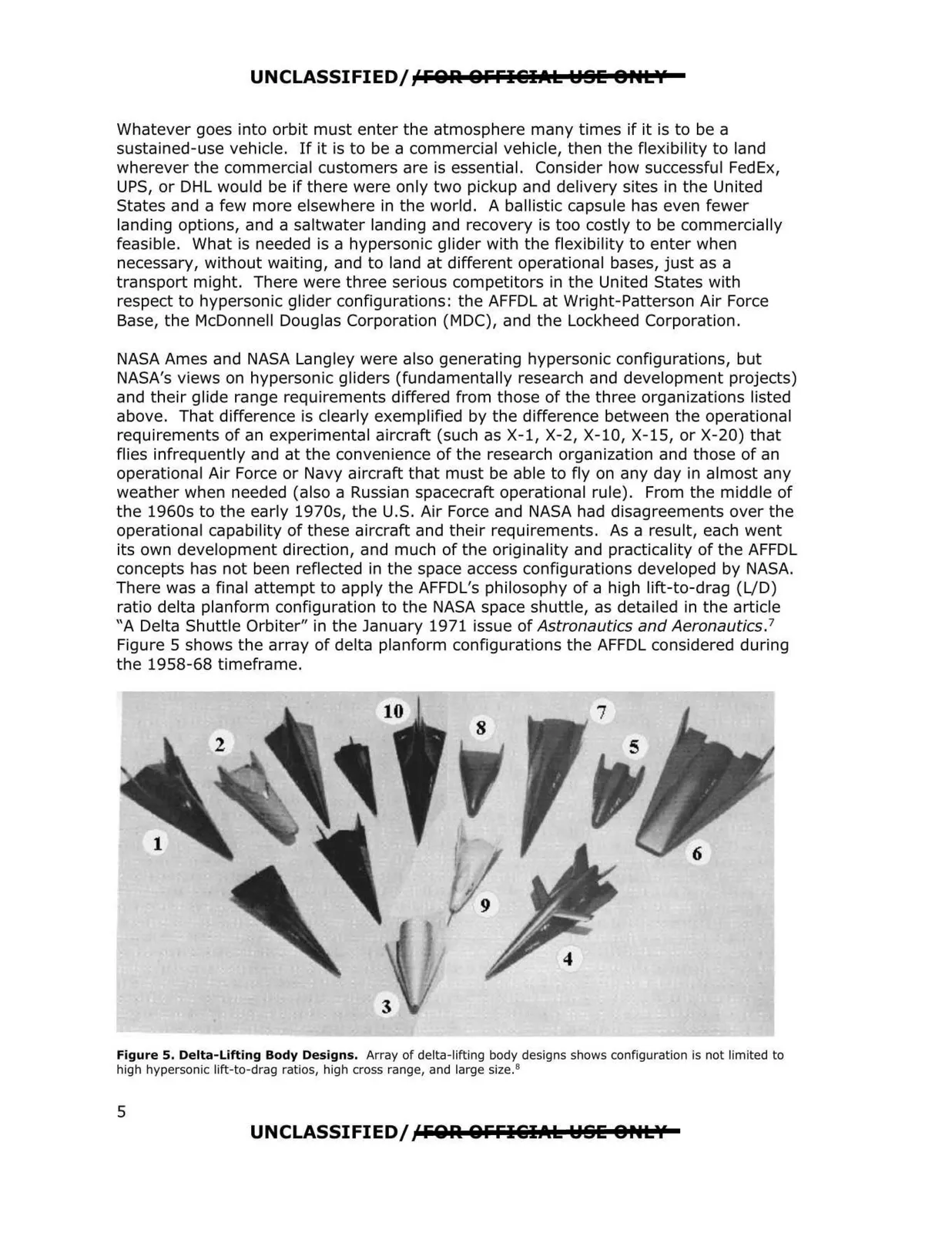
There was a final attempt to apply the AFFDL's philosophy of a high lift-to-drag (L/D)
ratio delta planform configuration to the NASA space shuttle, as detailed in the article
"A Delta Shuttle Orbiter" in the January 1971 issue of Astronautics and Aeronautics. 7
Figure 5 shows the array of delta planform configurations the AFFDL considered during
the 1958-68 timeframe.
Figures. Delta-Lifting Body Designs. Array of delta-lifting body designs shows configuration is not limited to
high hypersonic lift-to-drag ratios, high cross range, and large size. 8
UNCLASSIFIED/,<FOR OFFI&IAL YSIE 8HLY
5