AAWSAP DIRD, Space Access: Where We’ve Been and Where We Could Go, March 2010
DOW-UAP-D124 · page 13 of 56
Text
This text came with the file. It may have mistakes. When the text and the image disagree, the image is right.
UNCLASSIFIED/,CFOA OFFl€1Ak Uliliii ONkY
The AFFDL's approach was to design a hypersonic performance configuration that would
minimize the waiting time in orbit to return to the continental United States (CONUS).
This resulted in configurations with sharper leading edges and smaller nose radii than
found in NASA and Russian configurations. All of the material, structural, and
thermodynamic details related to the sharper configurations were tested and verified in
ground test facilities and flight tests (BGRV and ASSET). Characteristics of selected
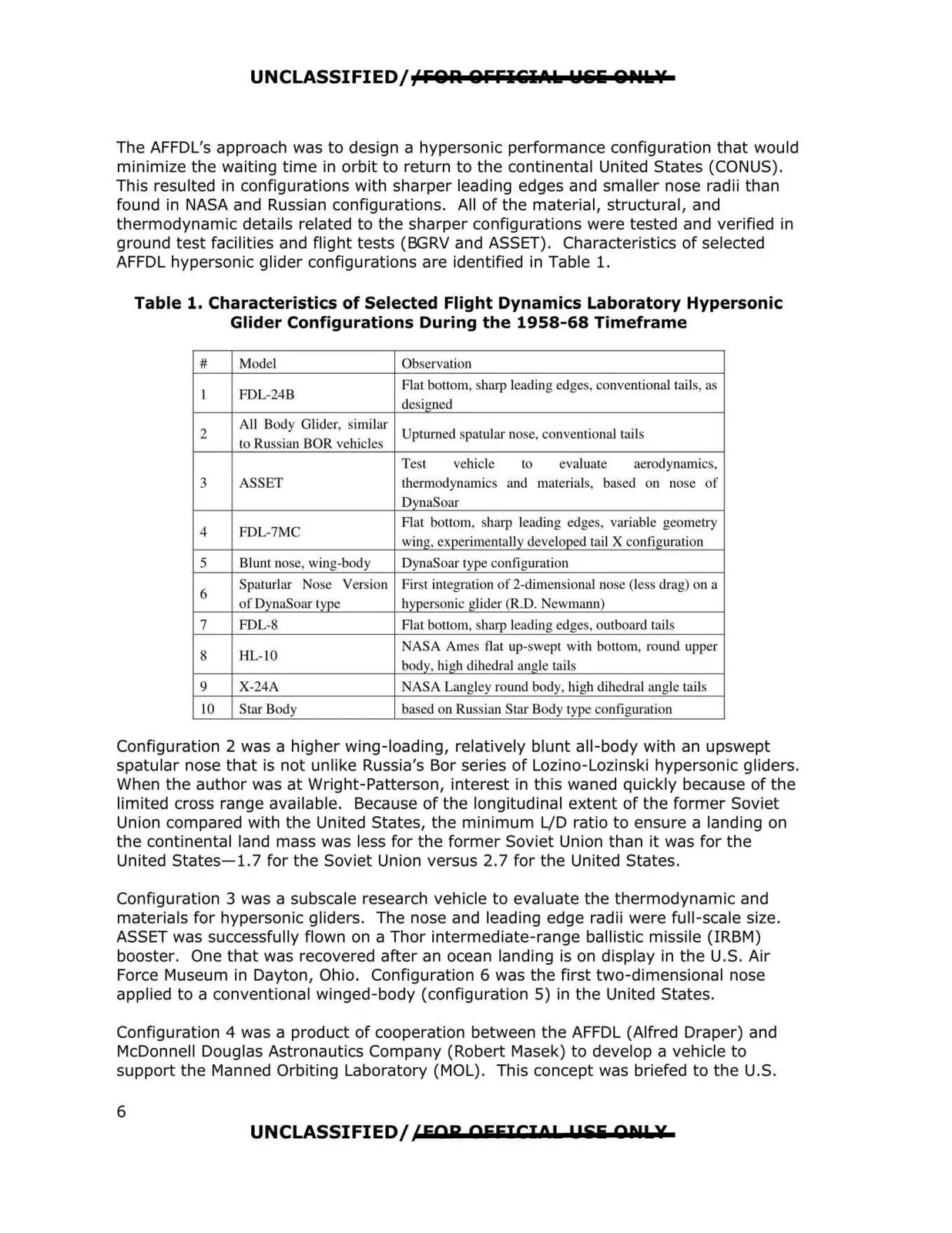
AFFDL hypersonic glider configurations are identified in Table 1.
Table 1. Characteristics of Selected Flight Dynamics Laboratory Hypersonic
Glider Configurations During the 1958-68 Timeframe
#
Model
Observation
l
FDL-24B
Flat bottom, sharp leading edges, conventional tails, as
designed
2
All Body Glider, similar
to Russian BOR vehicles
Upnirned spatular nose, conventional tail s
3
ASSET
Test
vehicle
to
evaluate
aerodynamics,
thermodynamics and materi als, based on nose of
DynaSoar
4
FDL-7MC
Flat bottom, sharp leading edges, variable geometry
wing, ex perimentally developed tail X configuration
5
Blunt nose, wing-body
DynaSoar type configuration
6
Spaturlar Nose Version
of DynaSoar type
First integration of 2-dirnensional nose (less drag) on a
hypersonic glider (R.D. Newmann)
7
FDL-8
Flat bottom, sharp leading edges, outboard tails
8
HL-10
ASA Ames flat up-swept with bottom, round upper
body, high dihedral angle tai ls
9
X-24A
NASA Langley round body, high dihedral angle tails
LO
Star Body
based on Russian Star Body type configuration
Configuration 2 was a higher wing-loading, relatively blunt all-body with an upswept
spatular nose that is not unlike Russia's Bor series of Lozino-Lozinski hypersonic gliders.
When the author was at Wright-Patterson, interest in this waned quickly because of the
limited cross range available. Because of the longitudinal extent of the former Soviet
Union compared with the United States, the minimum L/D ratio to ensure a landing on
the continental land mass was less for the former Soviet Union than it was for the
United States-1.7 for the Soviet Union versus 2. 7 for the United States.
Configuration 3 was a subscale research vehicle to evaluate the thermodynamic and
materials for hypersonic gliders. The nose and leading edge radii were full-scale size.
ASSET was successfully flown on a Thor intermediate-range ballistic missile (IRBM)
booster. One that was recovered after an ocean landing is on display in the U.S. Air
Force Museum in Dayton, Ohio. Configuration 6 was the first two-dimensional nose
applied to a conventional winged-body (configuration 5) in the United States.
Configuration 4 was a product of cooperation between the AFFDL (Alfred Draper) and
McDonnell Douglas Astronautics Company (Robert Masek) to develop a vehicle to
support the Manned Orbiting Laboratory (MOL). This concept was briefed to the U.S.
UNCLASSIFIED//FOR OFFICIO! 1ISliii AIIL¥
6