AAWSAP DIRD, Space Access: Where We’ve Been and Where We Could Go, March 2010
DOW-UAP-D124 · page 24 of 56
Text
This text came with the file. It may have mistakes. When the text and the image disagree, the image is right.
----------------------
----------------------
----------------------
----------------------
----------------------
UNCLASSIFIED//POil 8FFIEiIAk Wlilii QJslL¥
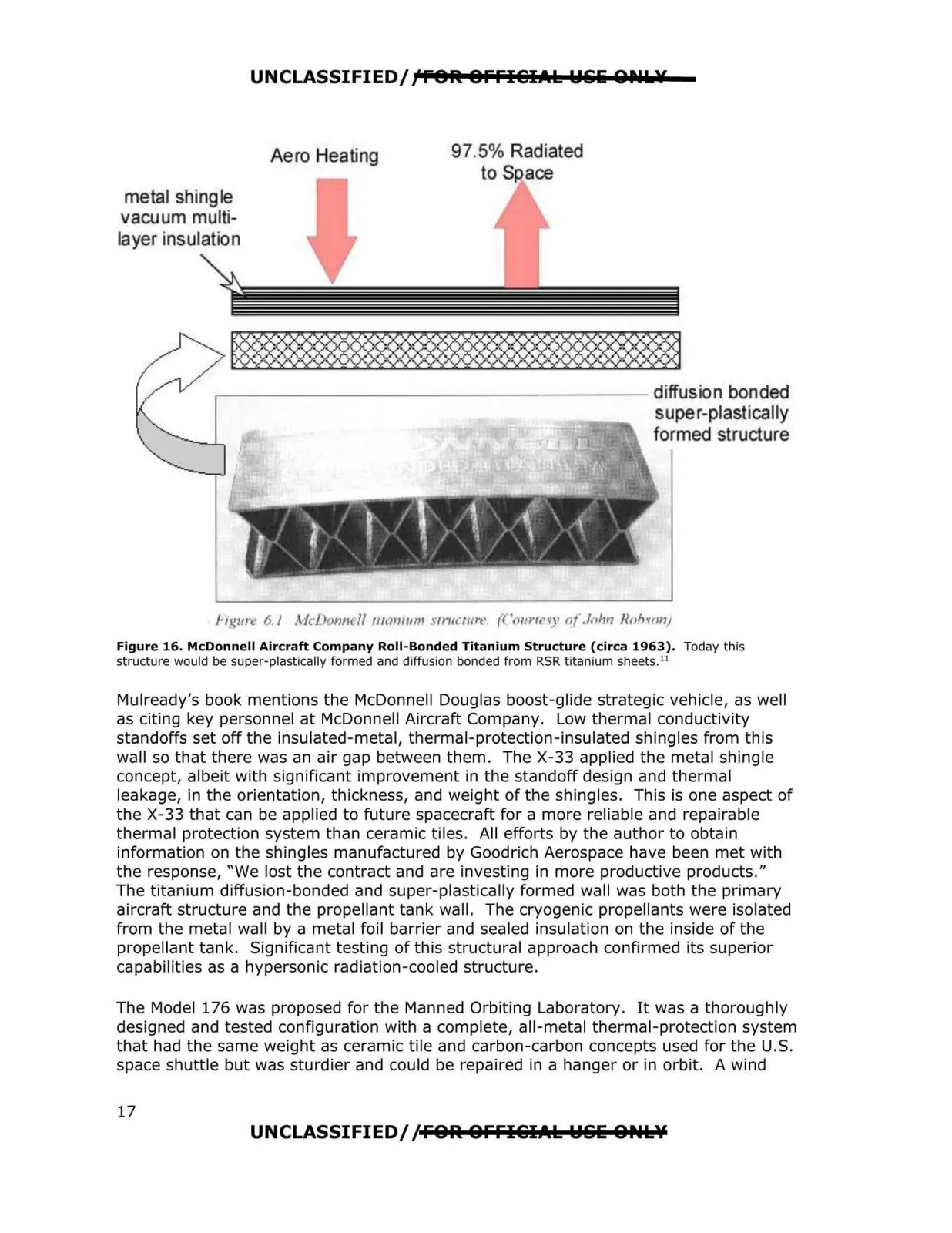
Aero Heating
97.5% Radiated
to Space
metal shingle
vacuum multi
layer insulation
-
, ---------------------
---------------------
,--------------------- diffusion bonded
super-plastically
formed structure
l-1gure 6.i Mel onnc 11 111m111m1 into 1rt' (('m1rrr1y of.!"Im Rohwn1
Figure 16. McDonnell Aircraft Company Roll-Bonded Titanium Structure (circa 1963). Today this
structure would be super-plastically formed and diffusion bonded from RSR titaniu m sheets. u
Mulready's book mentions the McDonnell Douglas boost-glide strategic vehicle, as well
as citing key personnel at McDonnell Aircraft Company. Low thermal conductivity
standoffs set off the insulated-metal, thermal-protection-insulated shingles from this
wall so that there was an air gap between them. The X-33 applied the metal shingle
concept, albeit with significant improvement in the standoff design and thermal
leakage, in the orientation, thickness, and weight of the shingles. This is one aspect of
the X-33 that can be applied to future spacecraft for a more reliable and repairable
thermal protection system than ceramic tiles. All efforts by the author to obtain
information on the shingles manufactured by Goodrich Aerospace have been met with
the response, "We lost the contract and are investing in more productive products."
The titanium diffusion-bonded and super-plastically formed wall was both the primary
aircraft structure and the propellant tank wall. The cryogenic propellants were isolated
from the metal wall by a metal foil barrier and sealed insulation on the inside of the
propellant tank. Significant testing of this structural approach confirmed its superior
capabilities as a hypersonic radiation-cooled structure.
The Model 176 was proposed for the Manned Orbiting Laboratory. It was a thoroughly
designed and tested configuration with a complete, all-metal thermal-protection system
that had the same weight as ceramic tile and carbon-carbon concepts used for the U.S.
space shuttle but was sturdier and could be repaired in a hanger or in orbit. A wind
UNCLASSIFIED//FOR. OFFI&IAk W&IE &Ptklf
17