AAWSAP DIRD, An Introduction to the Statistical Drake Equation, March 2010
DOW-UAP-D127 · page 37 of 55
Text
This text came with the file. It may have mistakes. When the text and the image disagree, the image is right.
UNCLASSIFIED/ /fOR OFFI&IAk Wlii QPU,¥
(36)
Thus, the characteristic function of the natural log
ofthe Drake uniform random variable D; is given by
3.3 STEP 7: FINDING THE
PROBABILITY DENSITY
FUNCTION OF N, BUT ONLY
NUMERICALLY NOT
ANALYTICALLY
Having
found
the
characteristic
functions
<l>y/s) of the logs of the seven input random
variables D; , we can now immediately find the
characteristic fu□ctio □ of the random variable Y =
ln(N) defined by (5). 1n fact, by virtue of (4), of the
well-known Fourier transform property stating that
"the Fourier transform of a convolution is the product
of the
Fourier transforms",
and of (37),
it
immediately follows that <l>y(() equals the product
of the seven Cf> y1 (s):
The next step is to invert this Fourier transform in
order to get the probability density function of the
random variable Y = ln(N). In other words, we must
compute the following inverse Fourier transform
-oo
oo
[
7
bl+)(
i+ j( l
= - 1 fe -i(y IT
;_
- a;_
dc;'.(39)
2n - co
i= I (b;
a;)(l+ Js)
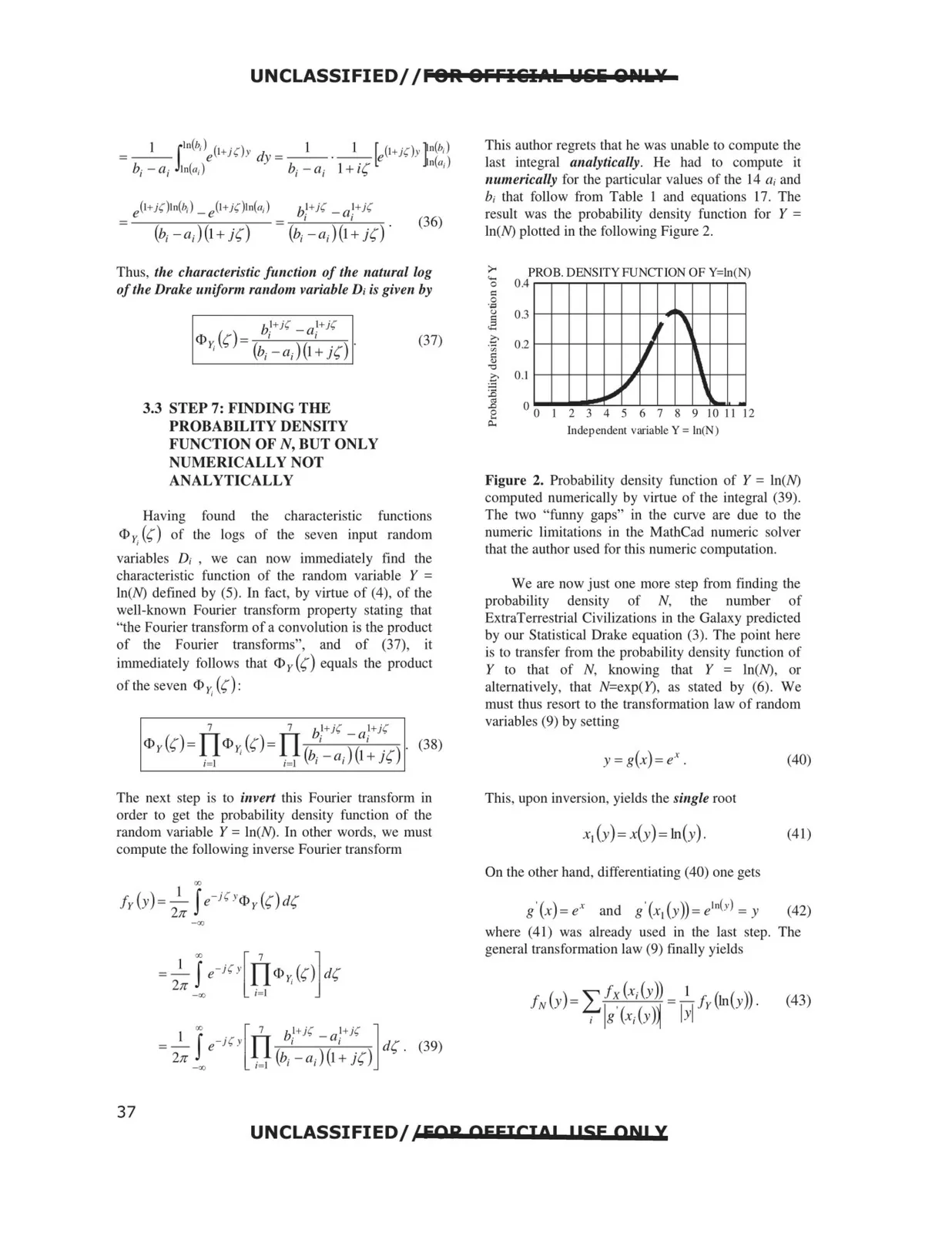
This author regrets that he was unable to compute the
last integral analytically. He had to compute it
numerically for the particular values of the 14 a; and
b; that follow from Table 1 and equations 17. The
result was the probability density function for Y =
ln(N) plotted in the following Figure 2.
...>-
PROB. DENSITY FUNCTION OF Y=ln(N)
0
0.4
C
0
·.:::,
..2
Q
0.3
-f
0.2
ii
"'
~ 0.1
:z;
..8
•
~I....-,
/ '
I
\
\
O O
I
2
3
4
5
6
7
8
9 10 11 12
e
ll,
Independent variable Y = ln(N)
Figure 2. Probability density function of Y = ln(N)
computed numericaJly by virtue of the integral (39).
The two "funny gaps" in the curve are due to the
numeric limitations in the MathCad numeric solver
that the author used for this numeric computation.
We are now just one more step from finding the
probability
density
of
N,
the
number
of
ExtraTerrestrial Civilizations in the Galaxy predicted
by our Statistical Drake equation (3). The point here
is to transfer from the probability density function of
Y to that of N, knowing that Y = ln(N) , or
alternatively, that N=exp(Y), as stated by (6). We
must thus resort to the transformation law of random
variables (9) by setting
(40)
This, upon inversion, yields the single root
(41)
On the other hand, differentiating ( 40) one gets
(42)
where (41) was already used in the last step. The
general transformation law (9) finally yields
UNCLASSIFIED/ /EAR AFFJCJA 1 1!SF QN 1Y
37