AAWSAP DIRD, An Introduction to the Statistical Drake Equation, March 2010
DOW-UAP-D127 · page 40 of 55
Text
This text came with the file. It may have mistakes. When the text and the image disagree, the image is right.
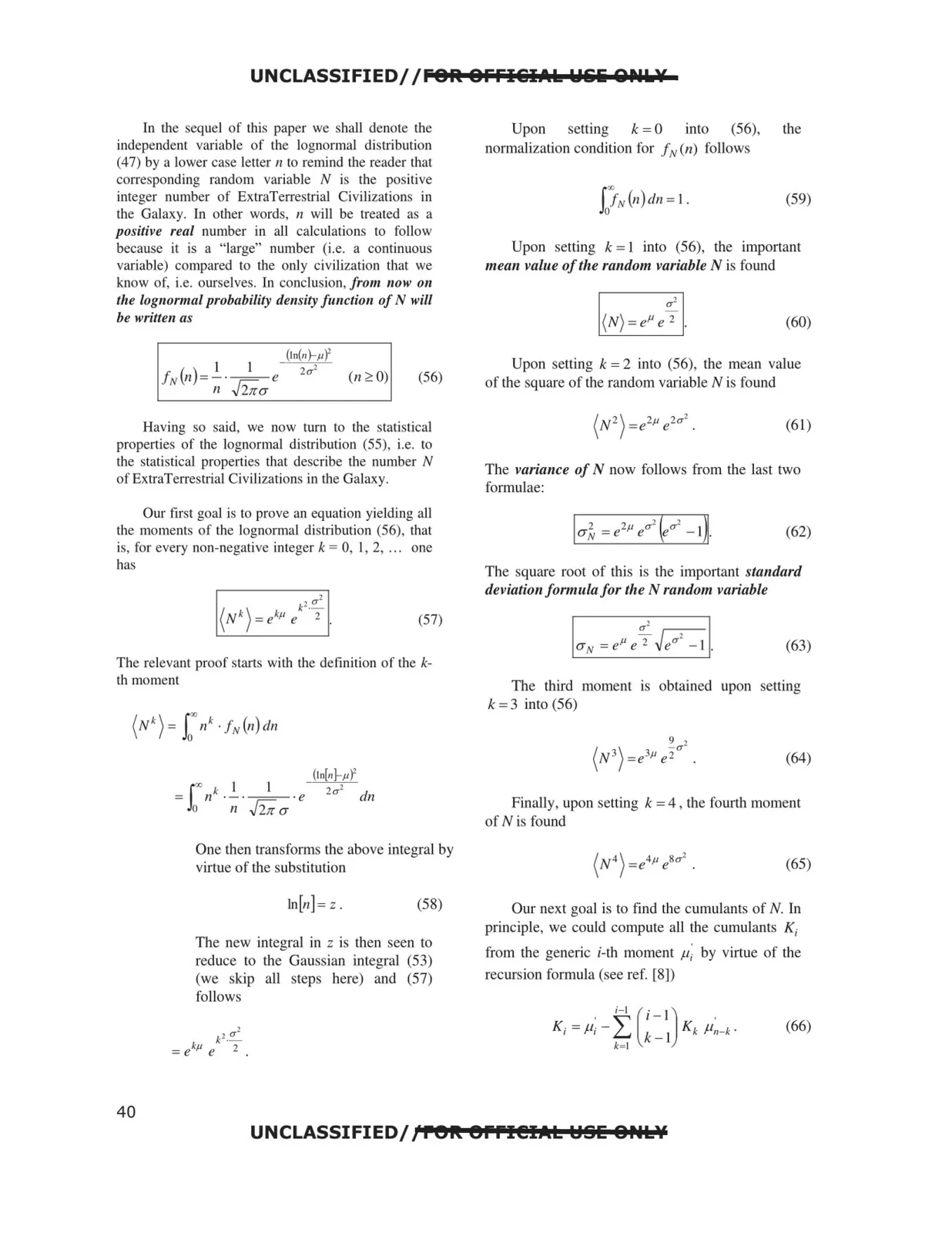
UNCLASSIFIED/ /fOR OFFI&IAk Wlii QPU,¥ In the sequel of this paper we shall denote the independent variable of the lognormal distribution (47) by a lower case letter n to remind the reader that corresponding random variable N is the positive integer number of ExtraTerrestriaJ Civilizations in the Galaxy. In other words, n will be treated as a positive real number in all calculations to follow because it is a "large" number (i.e. a continuous variable) compared to the only civilization that we know of, i.e. ourselves. In conclusion, from 110w 011 the log11or111al probability density f11nction of N will be written as (1n(11}--µ)2 1 1 -~ ( ) (56) n v2na IN n =-· r;:;- e (n~ O) Having so said, we now turn to the statistical properties of the lognormal distribution (55), i.e. to the statistical properties that describe the number N of ExtraTerrestrial Civilizations in the Galaxy. Our first goal is to prove an equation yielding all the moments of the lognormal distribution (56), that is, for every non-negative integer k = 0, I, 2, . . . one has (57) The relevant proof starts with the definition of the k d1 moment (111[11]-p)' k I I -~ = rn •~ •.Ji;a •e dn 0 One then transforms the above integral by virtue of the substitution In[n]= z. (58) The new integral in z is then seen to reduce to the Gaussian integral (53) (we skip all steps here) and (57) follows Upon setting k =0 into (56), the normalization condition for f N (n) follows Upon setting k =1 into (56), the important mean value ofthe ra11dom variable N is found (60) Upon setting k =2 into (56), the mean value of the square of the random variable N is found /N2) - 211 2a2 \ -e e . (61) The variance of N now follows from the last two formulae: (62) The square root of this is the important standard deviation f onnula for the N random variable (63) The third moment is obtained upon setting k =3 into (56) (64) Finally, upon setting k =4, the fourth moment of N is found (65) Our next goal is to find the cumulants of N. In principle, we could compute all the cumulants K; from the generic i-th moment p; by virtue of the recursion formula (see ref. [8]) • i- 1 (i - 1) . (66) K; =A-L k-1 K k f.l11-k· k=i UNCLASSIFIED/ /rOR orrl@IAL HSE O,.LY 40