AAWSAP DIRD, An Introduction to the Statistical Drake Equation, March 2010
DOW-UAP-D127 · page 41 of 55
Text
This text came with the file. It may have mistakes. When the text and the image disagree, the image is right.
UNCLASSIFIED/ /fOR OFFI&IAk WliF QPU,¥
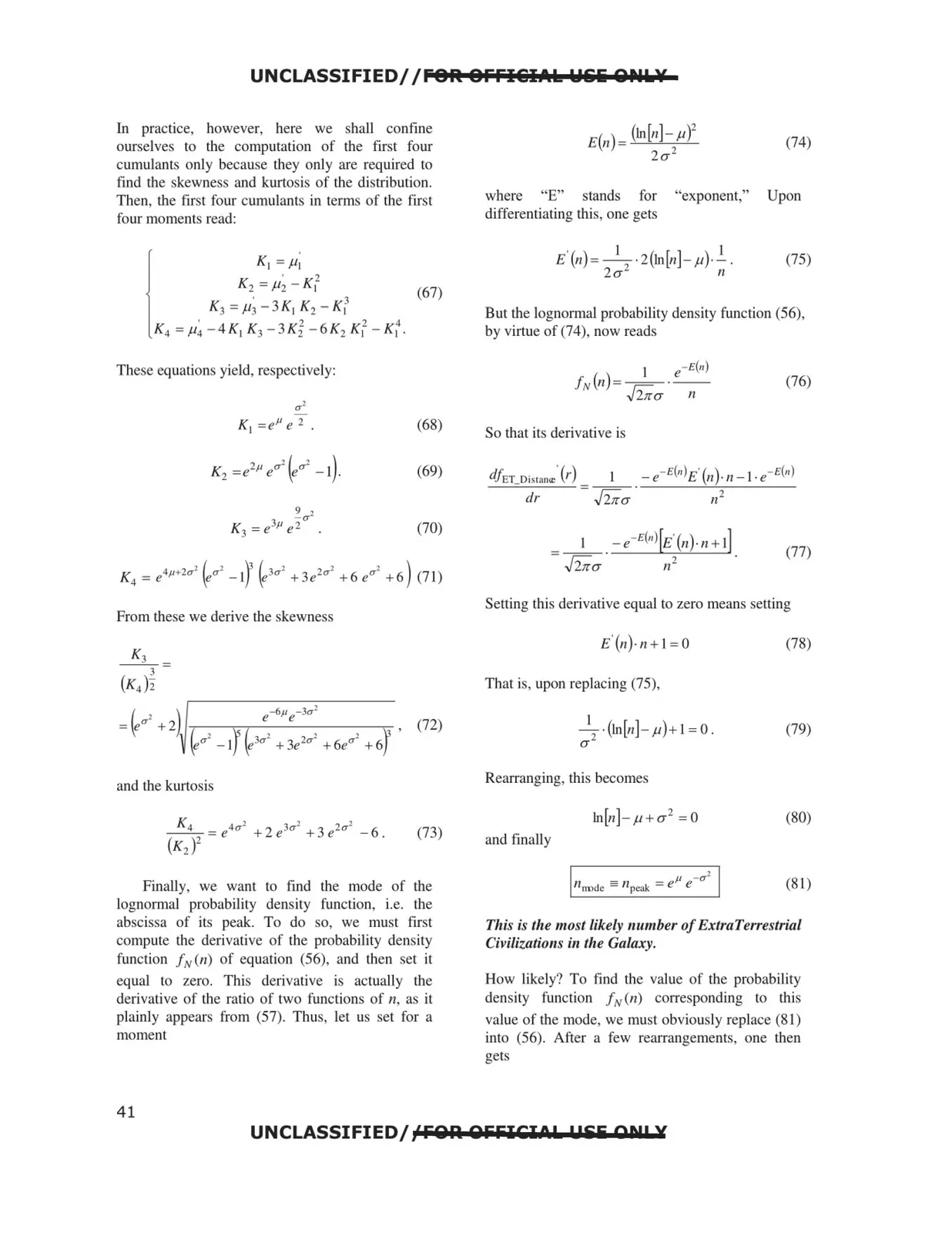
In practice, however, here we shall confine
ourselves to the computation of the first four
cumulants only because they only are required to
find the skewness and kurtosis of the distribution.
Then, the first four cumulants in terms of the first
four moments read:
These equations yield, respectively:
(68)
(69)
(70)
From these we derive the skewness
(72)
and the kurtosis
(73)
Finally, we want to find the mode of the
lognormal probability density function, i.e. the
abscissa of its peak. To do so, we must first
compute the derivative of the probability density
function f N (n) of equation (56), and then set it
equal to zero. This derivative is actually the
derivative of the ratio of two functions of n, as it
plainly appears from (57). Thus, let us set for a
moment
E(n) =(1n [n] - ,u)2
(74)
2a 2
where
"E"
stands
for
"exponent,"
Upon
differentiating this, one gets
1
E' (n) = - -
• 2(In [n] - ,u)· _!_ .
(75)
2a2
n
But the lognormal probability density function (56),
by virtue of (74), now reads
(76)
So that its derivative is
dfET_Dis1ana,' (r)
- e- E(")E' (n )· n-1 · e- E(")
dr
.Ji;a •
n2
I
-e-E(")[E'(n)·n + i]
(77)
= &a.
n2
Setting this derivative equal to zero means setting
E'(n) ·n+l=O
(78)
That is, upon replacing (75),
~
-(In[n]- µ)+1 =0.
(79)
a
Rean-anging, this becomes
In[n]- µ+a 2 = 0
(80)
and finally
I _
I
_fl - a'
11ntJde = 11pcak -
e
e
(81)
This is the most likely number of ExtraTerrestrial
Civilizations i11 the Galaxy.
How likely? To find the value of the probability
density function
f N (n) corresponding to this
value of the mode, we must obviously replace (81)
into (56). After a few rearrangements, one then
gets
UNCLASSIFIED/ ;'FOA OlililCil0 L. P!SF ON! Y
41