AAWSAP DIRD, An Introduction to the Statistical Drake Equation, March 2010
DOW-UAP-D127 · page 42 of 55
Text
This text came with the file. It may have mistakes. When the text and the image disagree, the image is right.
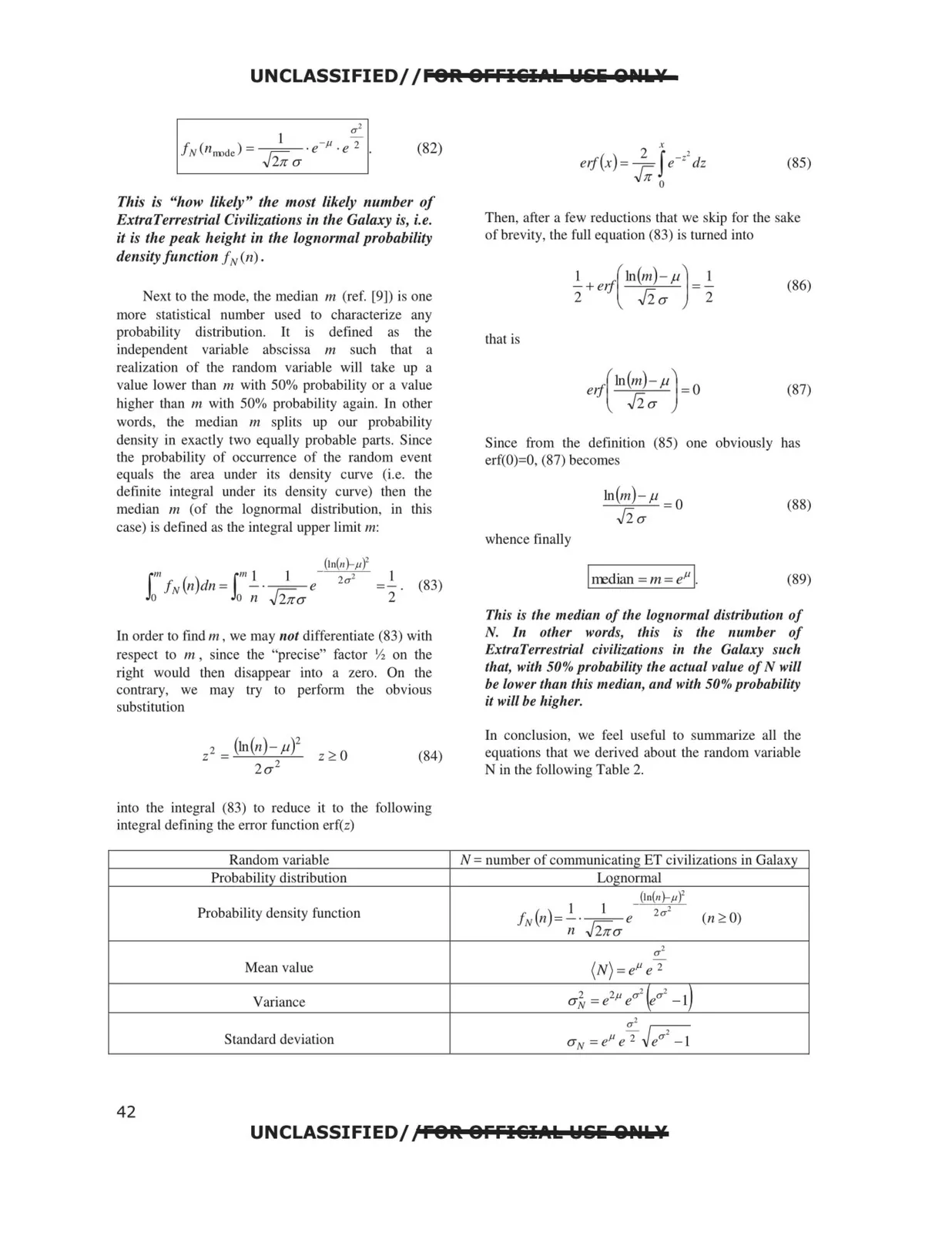
UNCLASSIFIED/ /fOR OFFI&IAk Wlii QPU,¥ (82) 2 fx ' erf(x)= r e-:-dz (85) This is "how likely" the most likely number of ExtraTerrestrial Civilizations in the Galaxy is, i.e. it is the peak height in the lognormal probability density function f N(n) . Next to the mode, the median m (ref. (9)) is one more statistical number used to characterize any probability distribution. It is defined as the independent variable abscissa m such that a realization of the random variable will take up a value lower than m with 50% probability or a value higher than m with 50% probability again. In other words, the median m splits up our probability density in exactly two equally probable parts. Since the probability of occurrence of the random event equals the area under its density curve (i.e. the definite integral under its density curve) then the median m (of the lognormal distribution, in this case) is defined as the integral upper limit m: (111(11 )-,,1)2 f 111 JN(n)dn = f"'_!__ rd- e---;;;;r- == (83) Jo Jo n v 2na 2 In order to find m , we may not differentiate (83) with respect to m , since the "precise" factor ½ on the right would then disappear into a zero. On the contrary, we may try to perform the obvious substitution zzO (84) into the integral (83) to reduce it to the following integral defining the error function erf(z) -,/ Ji 0 Then, after a few reductions that we skip for the sake of brevity, the full equation (83) is turned into (86) that is e,f[ln(m) - p) == 0 (87) ✓2a Since from the definition (85) one obviously has erf(0)=0, (87) becomes ln(m)- µ == 0 (88) ✓2a whence finally Irredian = m =e" I. (89) This is the median of the lognormal distribution of N. In other words, this is the number of ExtraTerrestrial civilizations in the Galaxy such that, with 50% probability the actual value of N will be lower than this median, and with 50% probability it will be higher. ln conclusion, we feel useful to summarize all the equations that we derived about the random variable N in the following Table 2. Random variable Probability distribution Probability density function N =number of communicating ET civilizations in Galaxy Lognormal (111(11}--p)' 1 1 ---;;;;r fN(n) =· ..n,; e (n z O) n 2na Mean value (T2 - (N) =e" e 2 Variance a1 =e2" ea2 (ea2 -1) Standard deviation a' a N =e" e2 .Jea' -1 UNCLASSIFIED/ /fOR OFfl&IAk Wlii QNls¥ 42