AAWSAP DIRD, An Introduction to the Statistical Drake Equation, March 2010
DOW-UAP-D127 · page 45 of 55
Text
This text came with the file. It may have mistakes. When the text and the image disagree, the image is right.
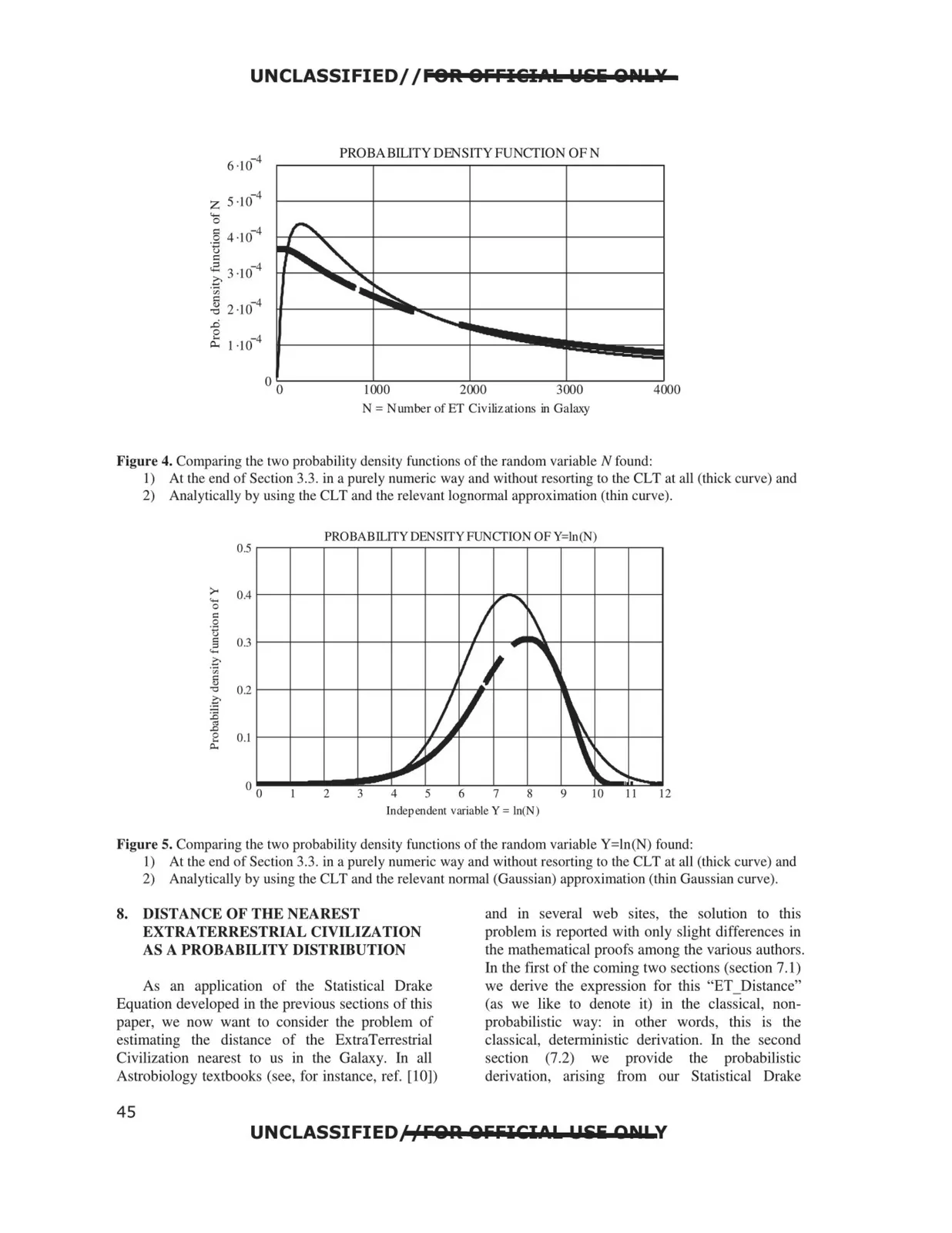
UNCLASSIFIED//fOR OFFI&IAk WliF QPU,¥ 6 ·10-4 1000 2000 3000 4000 N = Number of ET Civilizations in Galaxy Figure 4. Comparing the two probability density functions of the random variable N found: 1) At the end of Section 3.3. in a purely numeric way and without resorting to the CLT at all (thick curve) and 2) AnalyticaJly by using the CLT and the relevant lognormal approximation (thin curve). PROBABILITY DENSITY FUNCTION OF Y=ln(N) 0.5 >- 0.4 ..... 0 g .B § 0.3 ..... •~ 5 "O 0.2 _q ] " .D e 0.1 0.. 00 2 3 12 Independent variable Y = ln(N ) Figure 5. Comparing the two probability density functions of the random variable Y=ln(N) found: I) At the end of Section 3.3. in a purely numeric way and without resorting to the CL Tat all (thick curve) and 2) Analytically by using the CL T and the relevant normal (Gaussian) approximation (thin Gaussian curve). 8. DISTANCE OF THE NEAREST and in several web sites, the solution to this EXTRA TERRESTRIAL CIVILIZATION problem is reported with only slight differences in AS A PROBABILITY DISTRIBUTION the mathematical proofs among the various authors. In the first of the coming two sections (section 7 .1 ) As an application of the Statistical Drake we derive the expression for this "ET_Distance" Equation developed in the previous sections of this (as we like to denote it) in the classical, non paper, we now want to consider the problem of probabilistic way: in other words, this is the estimating the distance of the ExtraTerrestrial classical, deterministic derivation. In the second Civilization nearest to us in the Galaxy. In all section (7.2) we provide the probabilistic Astrobiology textbooks (see, for instance, ref. [10)) derivation, arising from our Statistical Drake UNCLASSIFIED/}FOA OlililCil0L. 1155 ON!¥ 45