AAWSAP DIRD, An Introduction to the Statistical Drake Equation, March 2010
DOW-UAP-D127 · page 46 of 55
Text
This text came with the file. It may have mistakes. When the text and the image disagree, the image is right.
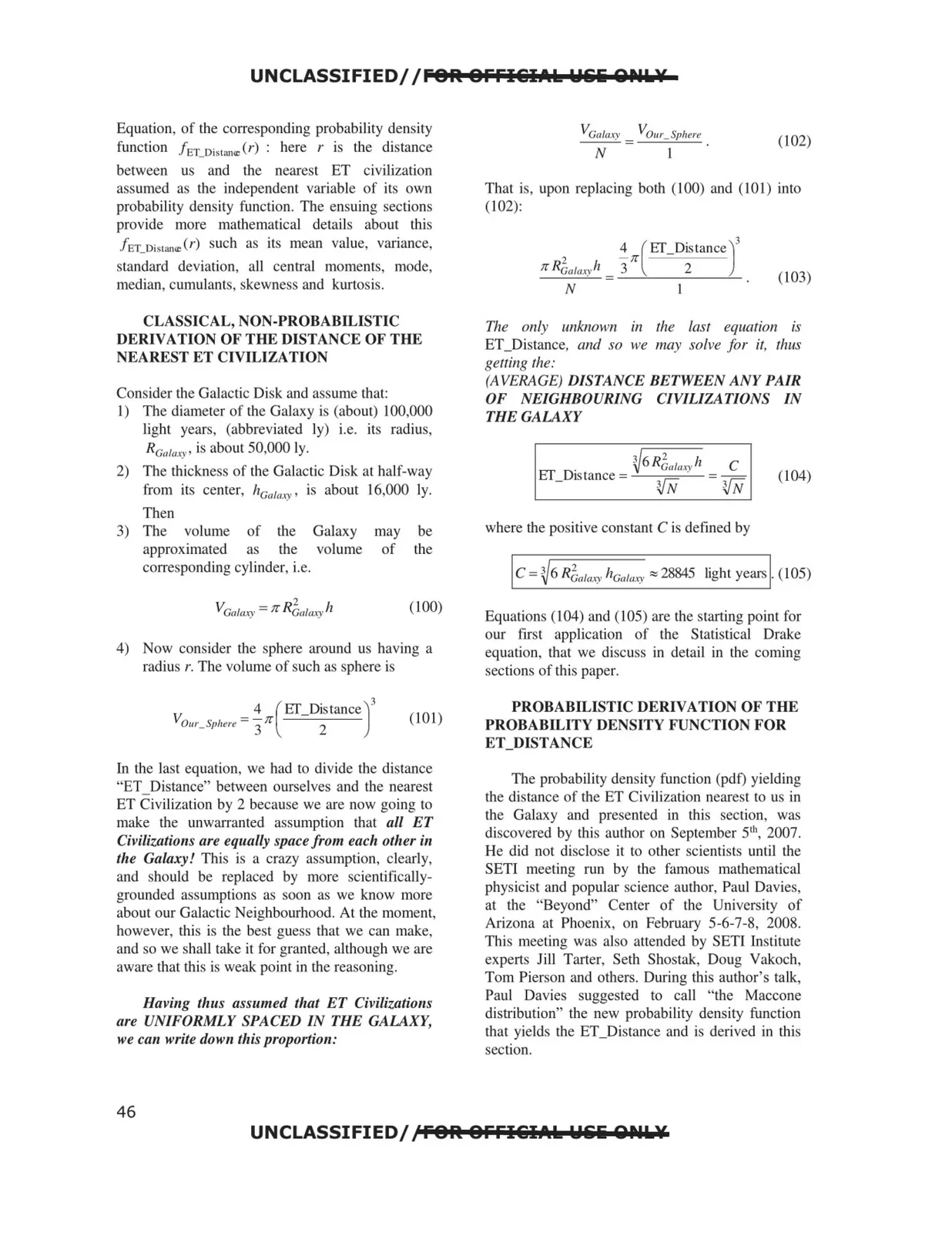
UNCLASSIFIED/ /fOR OFFI&Ial.k Wlili QPU,¥ Equation, of the corresponding probability density function fET_Distance(r) : here r is the distance between us and the nearest ET civilization assumed as the independent variable of its own prob~bility density function. The ensuing sections provide more mathematical details about this .firr_oistana, (r) such as its mean value, variance, standard deviation, all central moments, mode, median, cumulants, skewness and kurtosis. CLASSICAL, NON-PROBABILISTIC DERIVATION OF THE DISTANCE OF THE NEAREST ET CIVILIZATION Consider the Galactic Disk and assume that: 1) The diameter of the Galaxy is (about) 100,000 light years, (abbreviated ly) i.e. its radius, R calaxy• is about 50,000 ly. 2) The thickness of the Galactic Disk at half-way from its center, hcalaxy , is about 16,000 ly. Then 3) The volume of the Galaxy may be approximated as the volume of the corresponding cylinder, i.e. V - R1 h (100) Gal«ry - 1l Ga/,uy 4) Now consider the sphere around us having a radius r. The volume of such as sphere is 4 (Er Distance)3 VOw·_ Sphere =31l' 2 (101) In the last equation, we had to divide the distance "ET_Distance" between ourselves and the nearest ET Civilization by 2 because we are now going to make the unwarranted assumption that all ET Civilizations are equally space from each other in the Galaxy! This is a crazy assumption, clearly, and should be replaced by more scientifically grounded assumptions as soon as we know more about our Galactic Neighbourhood. At the moment, however, this is the best guess that we can make, and so we shall take it for granted, although we are aware that this is weak point in the reasoning. Having thus assumed that ET Civilizations are UNIFORMLY SPACED IN THE GALAXY' we can write down this proportion: Vcal<Lry = Vo11r_ Sphere (102) N That is, upon replacing both (100) and (101) into (102): 4 (Er Distance) 3 1l RJalaxyh = 3" ---=- 2- (103) N I The only unknown in the last equation is ET _Distance, and so we may solve for it, thus getting the: (A VERA GE) DISTANCE BETWEEN ANY PAIR OF NEIGHBOURING CIVILIZATIONS IN THE GALAXY 116 R 2 h _ V Galaxy C Er D. (104) istance - 1 ,.--; = - tN ifii where the positive constant C is defined by C =3 6 Ria1a.,y h calcuy ""28845 light years . ( l 05) Equations (104) and (105) are the starting point for our first application of the Statistical Drake equation, that we discuss in detail in the coming sections of this paper. PROBABILISTIC DERIVATION OF THE PROBABILITY DE SITY FUNCTION FOR ET_DISTA CE ~he probability density function (pdt) yielding the distance of the ET Civilization nearest to us in the Galaxy and pre ented in this section, was discovered by this author on September 5th' 2007. He did not disclose it to other scientists until the SETI meeting run by the famous mathematical physicist and popular science author, Paul Davies, at the "Beyond" Center of the University of Arizona at Phoenix, on February 5-6-7-8, 2008. This meeting was also attended by SETI Institute experts Jill Tarter, Seth Shostak, Doug Vakoch, Tom Pierson and others. During this author's talk, Paul Davies suggested to call "the Maccone distribution" the new probability density function that yields the ET_Distance and is derived in this section. UNCLASSIFIED/ ffOR OFFI&Ial.L Wlili QPII..¥ 46