AAWSAP DIRD, An Introduction to the Statistical Drake Equation, March 2010
DOW-UAP-D127 · page 47 of 55
Text
This text came with the file. It may have mistakes. When the text and the image disagree, the image is right.
UNCLASSIFIED/ /fOR OFFI&IAk Wlii QPU,¥
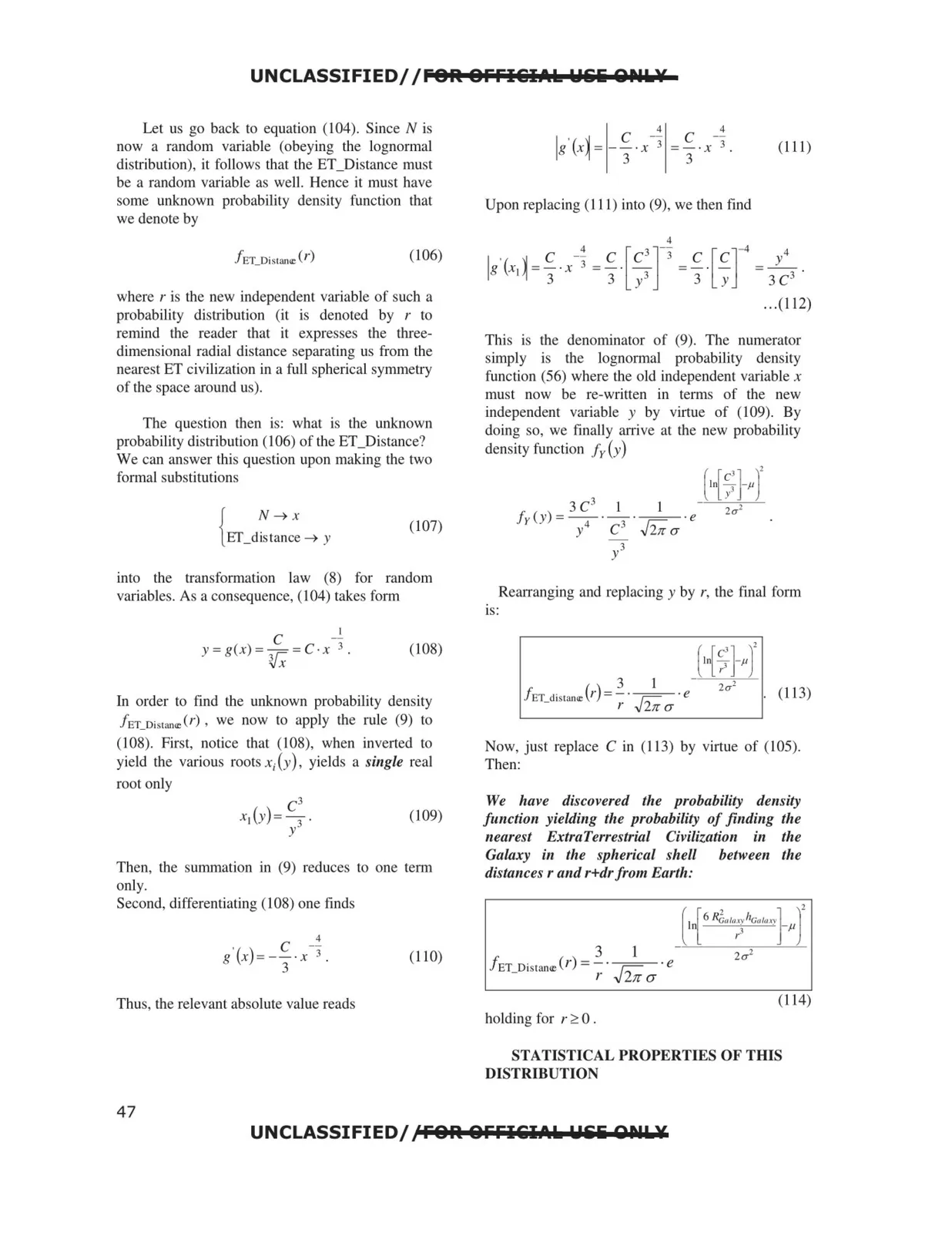
Let us go back to equation (104). Since N is
now a random variable ( obeying the lognorma1
distribution), it follows that the ET _Distance must
be a random variable as well. Hence it must have
some unknown probability density function that
we denote by
(106)
f ET_Di stana, (r)
where r is the new independent variable of such a
probability distribution (it is denoted by r to
remind the reader that it expresses the three
dimensional radial distance separating us from the
nearest ET civilization in a full spherical symmetry
of the space around us).
The question then is: what is the unknown
probability distribution (106) of the ET_Distance?
We can answer this question upon making the two
formal substitutions
N ➔ x
{
(107)
Er_distance ➔ y
into the transformation law (8) for random
variables. As a consequence, ( I 04) takes form
I
C
y = g(x) = -,- = C • x 3 .
(108)
v;;
In order to find the unknown probability density
f ET_Di stru,., (r) , we now to apply the rule (9) to
(108). First, notice that (108), when inverted to
yield the various roots x; (y), yields a single real
root only
(109)
Then, the summation in (9) reduces to one term
only.
Second, differentiating (108) one finds
4
C
-
g' (x) =-- ·x 3 .
(110)
3
Thus, the relevant absolute value reads
(111)
Upon replacing (111) into (9), we then find
This is the denominator of (9). The numerator
simply is
the lognormal probability density
function (56) where the old independent variable x
must now be re-written in terms of the new
independent variable y by virtue of (109). By
doing so, we finally an-ive at the new probability
density function f y (y)
Rearranging and replacing y by r, the final form
is:
2
(In[~]-11]
3
1
-
2u'
f ET_distana, (r) = - • ~
•e
(113)
2
r 'I/ L.Jr a-
Now, just replace C in ( 113) by virtue of ( 105).
Then:
We have discovered the probability density
function yielding the probability of finding the
nearest ExtraTerrestrial Civilization
in
the
Galaxy in the spherical shell
between the
distances r and r+dr from Earth:
(,{ 6 Ri.t11a~~ hc0 1a.Q}l'r
3
l
2 0-l
fET_DistanaJr)=-· ~
·e
2
r "1.,1r a
(114)
holding for r .:: 0 .
STA TISTICAL PROPERTIES OF THIS
DISTRIBUTION
UNCLASSIFIED/ /FOR &FFIGIAk lalii ODIL:¥
47