AAWSAP DIRD, Metallic Spintronics, March 2010
DOW-UAP-D129 · page 12 of 27
Text
This text came with the file. It may have mistakes. When the text and the image disagree, the image is right.
UNCLASSIFIED//FOR OFFl@IAL ~81: 8HLY
3.2 STT EXPERIMENTS
Section 3.1 introduced the physics of STT in magnetic nanosystems. We have seen that
a high-density electrical current can result in torques on magnetic elements of the
system . These torques may be used to control and manipulate the system's magnetic
state. However, the resulting behavior of the system can differ significantly from case
to case, depending on particular conditions of observation. For instance, in modest
external magnetic fields, magnetization of a small element can be repeatedly reversed
between two stable configurations, while at higher fields, where the reversal is
energetically unfavorable, the moment can be set into precession at a very high
...
frequency. To understand details of what happens with a magnetic moment S in a
particular situation, one can use Newton's Second Law.
...
...
For S this would be the Landau-Lifshitz-Gilbert equation, where the rate of change of S
...
is set equal to the net torque acting on S :
Equation 1:
Here the first term on the right is the
...
torque on a magnetic moment S in an
~
effective magnetic field B eff, (including
applied, demagnetizing, anisotropy, and
other fields), with y the gyromagnetic
STT
•
•
ratio; the second term is a
phenomenological damping term
introduced by Gilbert, with a. the Gilbert
damping parameter; ~e thir~ term is
the SST where small s· and * are unit
Damping
vectors along
and the polarizer ' *, I
is the current, µs is the Bohr magneton,
e is the electron charge, and 11 is the
spin-polarization factor.
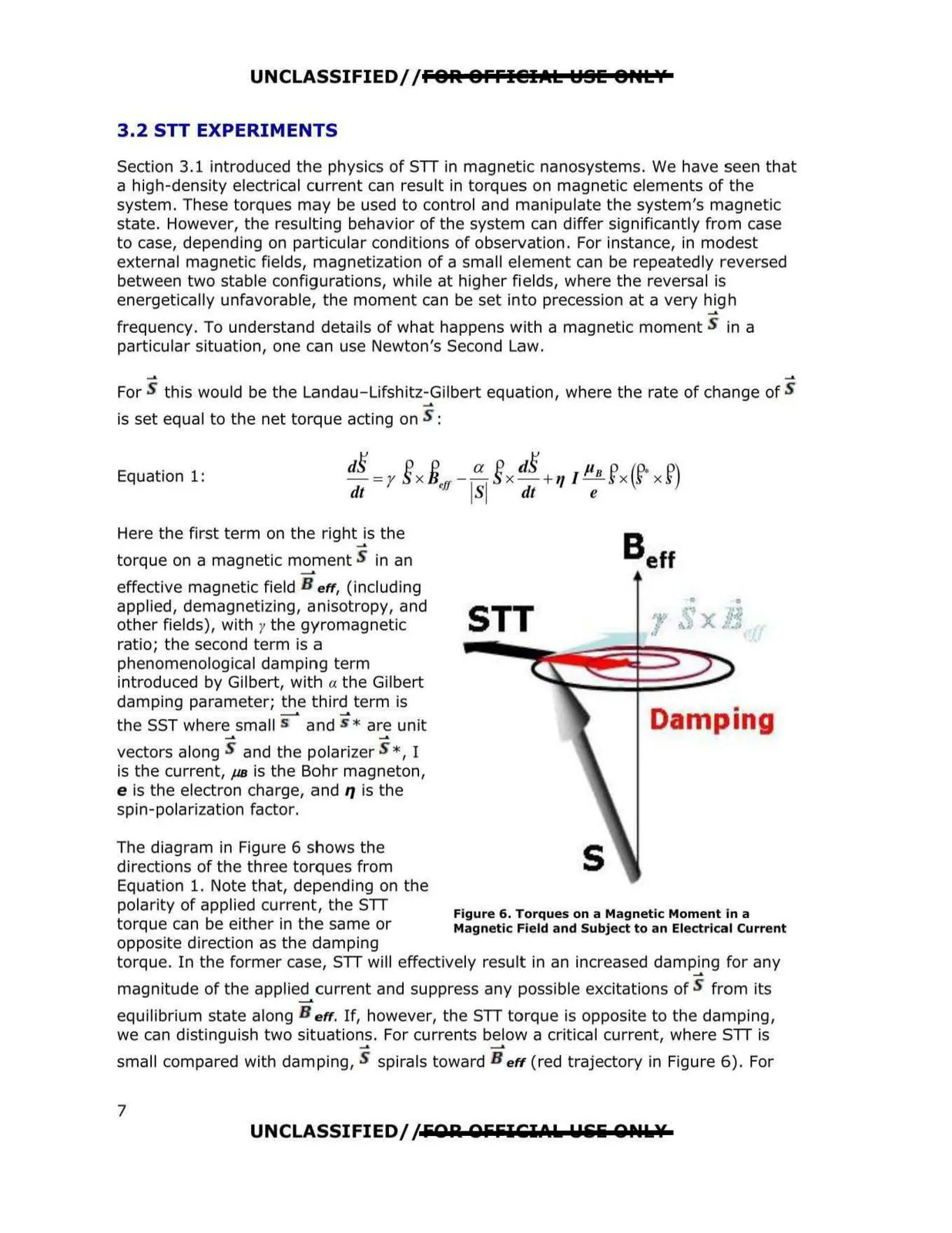
The diagram in Figure 6 shows the
directions of the three torques from
Equation 1. Note that, depending on the
polarity of applied current, the STT
Figure 6. liorques on a Magnetic Moment in a
torque can be either in the same or
Magnetic Field and Subject to an Electrical Current
opposite direction as the damping
torque. In the former case, STT will effectively result in an increased damp~ng for any
magnitude of the applie~ current and suppress any possible excitations of
from its
equilibrium state along B eff. If, however, the STT torque is opposite to the damping,
we can distinguish two situations. For currents below a critical current, where STT is
...
~
small compared with damping, S spirals toward B eff (red traj ectory in Figure 6). For
UNCLASSIFIED//&Olil OfifilCI\L: Wii OPIL:¥
7