AAWSAP DIRD, Metallic Spintronics, March 2010
DOW-UAP-D129 · page 14 of 27
Text
This text came with the file. It may have mistakes. When the text and the image disagree, the image is right.
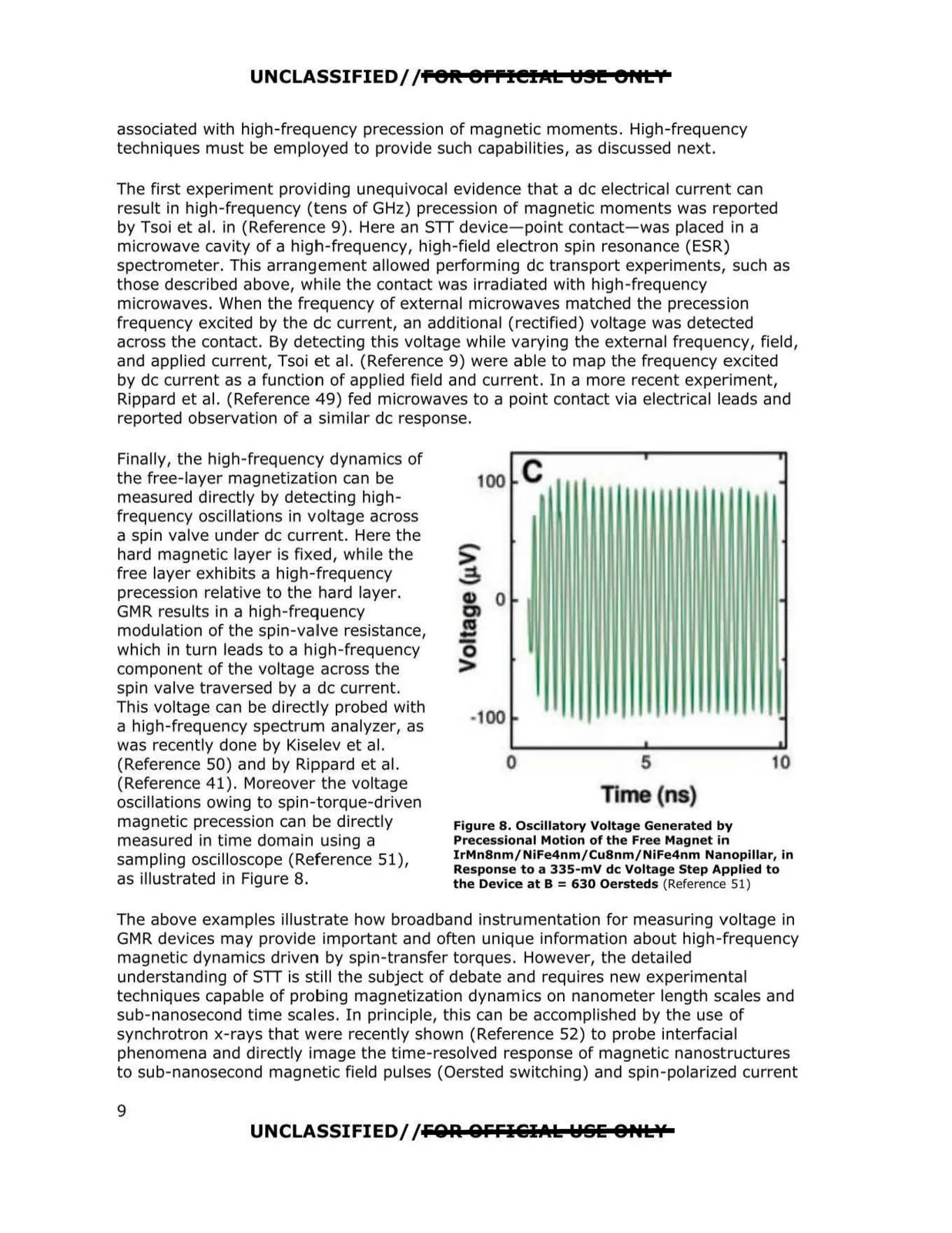
UNCLASSIFIED//P'Olt orr1e1At tt!I!! er~LY associated with high-frequency precession of magnetic moments. High-frequency techniques must be employed to provide such capabilities, as discussed next. The first experiment providing unequivocal evidence that a de electrical current can result in high-frequency (tens of GHz) precession of magnetic moments was reported by Tsoi et al. in (Reference 9). Here an STT device- point contact-was placed in a microwave cavity of a high-frequency, high-field electron spin resonance (ESR) spectrometer. This arrangement allowed performing de transport experiments, such as those described above, while the contact was irradiated with high-frequency microwaves. When the frequency of external microwaves matched the precession frequency excited by the de current, an additional (rectified) voltage was detected across the contact. By detecting this voltage while varying the external frequency, field, and applied current, Tsoi et al. (Reference 9) were able to map the frequency excited by de current as a function of applied field and current. In a more recent experiment, Rippard et al. (Reference 49) fed microwaves to a point contact via electrical leads and reported observation of a similar de response. . . Finally, the high-frequency dynamics of the free-layer magnetization can be 100 .C . measured directly by detecting high frequency oscillations in voltage across a spin valve under de current. Here the hard magnetic layer is fixed, while the > free layer exhibits a high-frequency a precession relative to the hard layer. Cl) 0. I• GMR results in a high-frequency m modulation of the spin-valve resistance, which in turn leads to a high-frequency - 0 component of the voltage across the > spin valve traversed by a de current. This voltage can be directly probed with ·100 • a high-frequency spectrum analyzer, as . . was recently done by Kiselev et al. (Reference SO) and by Rippard et al. 0 5 10 (Reference 41). Moreover the voltage oscillations owing to spin-torque-driven Ti (ns) magnetic precession can be directly Figure 8. Oscillatory Voltage Generated by measured in time domain using a Precessional Motion of the Free Magnet in IrMn8nm/NiFe4nm/Cu8nm/NiFe4nm Nanopillar, in sampling oscilloscope (Reference 51), Response to a 335-mV de Voltage Step Applied to as illustrated in Figure 8. the Device at B = 630 Oersteds (Reference 51) The above examples illustrate how broadband instrumentation for measuring voltage in GMR devices may provide important and often unique information about high-frequency magnetic dynamics driven by spin-transfer torques. However, the detailed understanding of STT is still the subject of debate and requires new experimental techniques capable of probing magnetization dynamics on nanometer length scales and sub-nanosecond time scales. In principle, this can be accomplished by the use of synchrotron x-rays that were recently shown (Reference 52) to probe interfacial phenomena and directly image the time-resolved response of magnetic nanostructures to sub-nanosecond magnetic field pulses (Oersted switching) and spin-polarized current 9 UNCLASSIFIED/ /FOA 8FFIGIAb W&E 8,.b\S