AAWSAP DIRD, Metallic Spintronics, March 2010
DOW-UAP-D129 · page 15 of 27
Text
This text came with the file. It may have mistakes. When the text and the image disagree, the image is right.
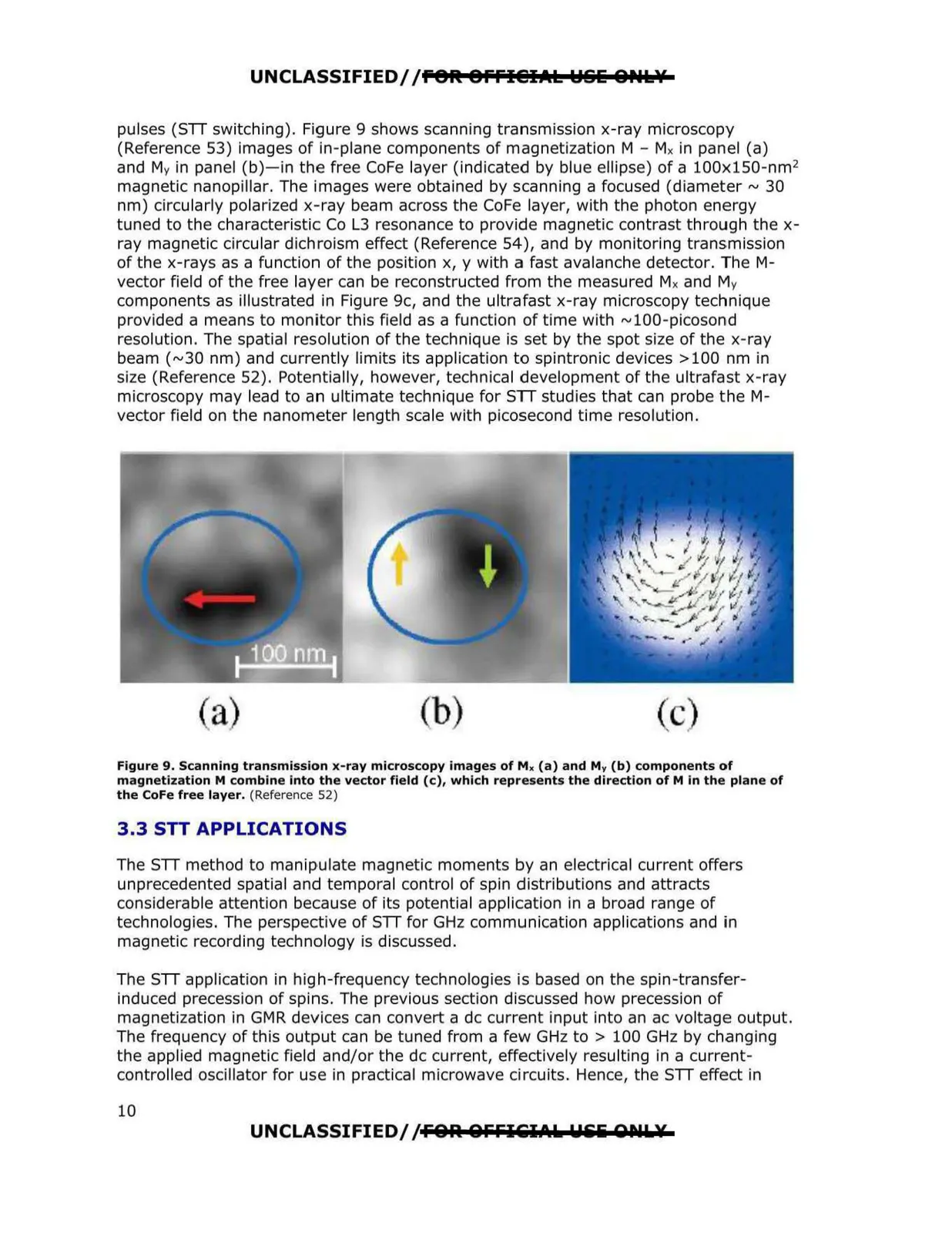
UNCLASSIFIED//fOft Offl@IAL W&E 8,.Llf pulses (STT switching). Figure 9 shows scanning transmission x-ray microscopy (Reference 53) images of in-plane components of magnetization M - Mx in panel (a) and My in panel (b)-in the free Cafe layer (indicated by blue ellipse) of a 100x150-nm 2 magnetic nanopillar. The images were obtained by scanning a focused (diameter~ 30 nm) circularly polarized x-ray beam across the CoFe layer, with the photon energy tuned to the characteristic Co L3 resonance to provide magnetic contrast through the x ray magnetic circular dichroism effect (Reference 54 ), and by monitoring transmission of the x-rays as a function of the position x, y with a fast avalanche detector. The M vector field of the free layer can be reconstructed from the measured Mx and My components as illustrated in Figure 9c, and the ultrafast x-ray microscopy technique provided a means to monitor this field as a function of time with ~ 100-picosond resolution . The spatial resolution of the technique is set by the spot size of the x-ray beam (~30 nm) and currently limits its application to spintronic devices >100 nm in size (Reference 52). Potentially, however, technical development of the ultrafast x-ray microscopy may lead to an ultimate technique for STT studies that can probe the M vector field on the nanometer length scale with picosecond time resolution. (a) (b) (c) Figure 9. Scanning transmission x-ray microscopy images of Mx (a) and Mv (b) components of magnetization M combine into the vector field (c), which represents the direction of Min the plane of the CoFe free layer. (Reference 52) 3.3 STT APPLICATIONS The STT method to manipulate magnetic moments by an electrical current offers unprecedented spatial and temporal control of spin distributions and attracts considerable attention because of its potential application in a broad range of technologies. The perspective of STT for GHz communication applications and in magnetic recording technology is discussed. The STT application in high-frequency technologies is based on the spin-transfer induced precession of spins. The previous section discussed how precession of magnetization in GMR devices can convert a de current input into an ac voltage output. The frequency of this output can be tuned from a few GHz to > 100 GHz by changing the applied magnetic field and/or the de current, effectively resulting in a current controlled oscillator for use in practical microwave circuits. Hence, the STT effect in UNCLASSIFIED/ /FOR OFFIGl.t.k Wii QNk¥ 10