AAWSAP DIRD, Technological Approaches to Controlling External Devices, March 2010
DOW-UAP-D130 · page 26 of 36
Text
This text came with the file. It may have mistakes. When the text and the image disagree, the image is right.
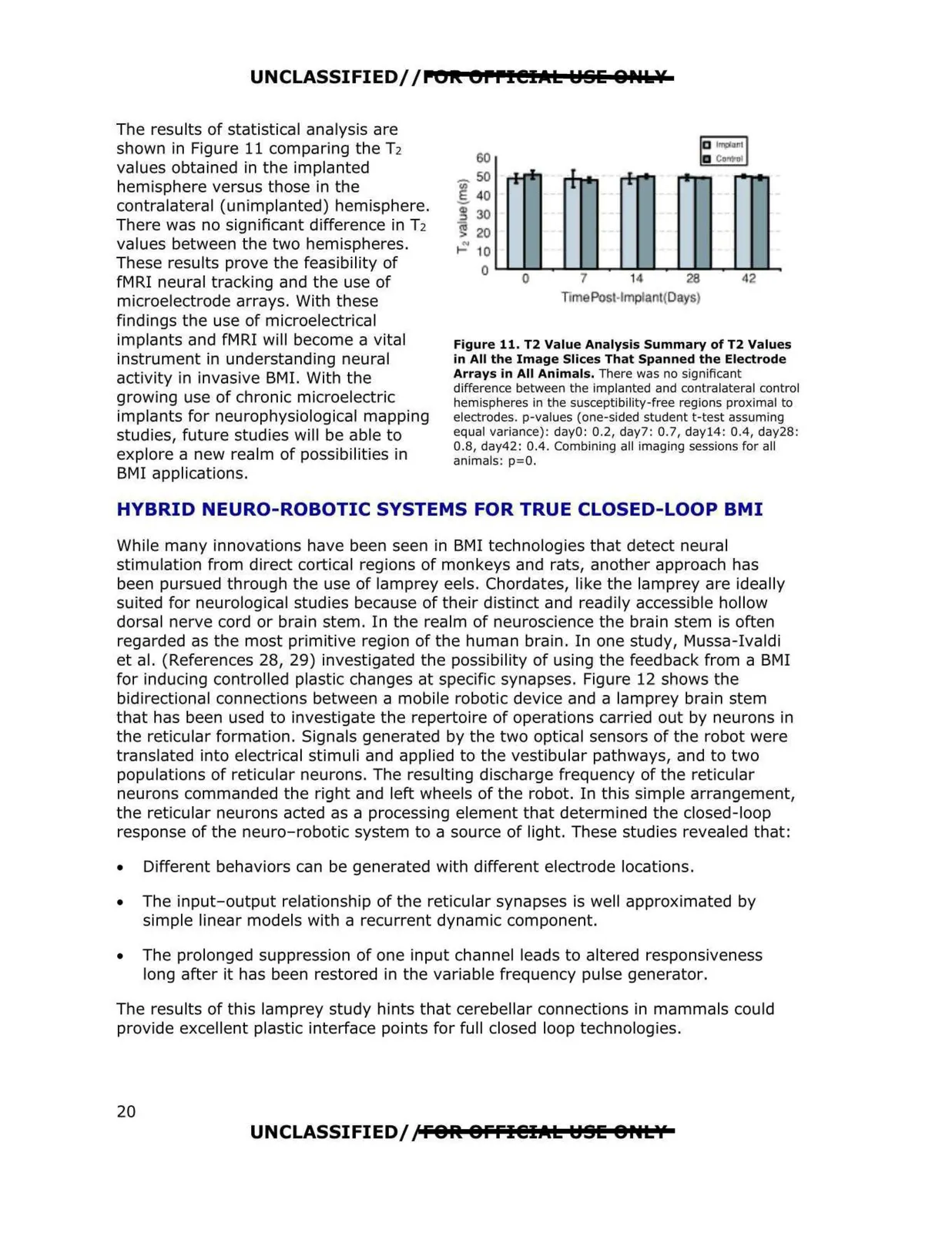
UNCLASSIFIED/ / POI\ OPPlelAL l:l§li &Pn,¥ The results of statistical analysis are shown in Figure 11 comparing the T2 values obtained in the implanted hemisphere versus those in the contralateral (unimplanted) hemisphere. There was no significant difference in T2 values between the two hemispheres. These results prove the feasibility of fMRI neural tracking and the use of microelectrode arrays. With these findings the use of microelectrical implants and fMRI will become a vital instrument in understanding neural activity in invasive BMI. With the growing use of chronic microelectric implants for neurophysiological mapping studies, future studies will be able to explore a new realm of possibilities in BM! applications. Figure 11. T2 Value Analysis Summary of T2 Values in All the Image Slices That Spanned the Electrode Arrays in All Animals. There was no significant difference between the implanted and contralateral control hemispheres in the susceptibility-free regions proximal to electrodes. p-values (one-sided student t-test assuming equal variance): day0 : 0.2, day7: 0.7, day14: 0.4, day28 : 0.8, day42: 0.4. Combining all imaging sessions for all animals: p=0. 60 .-. 50 "' §_ 40 :l 30 ~ .. 20 I 10 0 0 7 1 28 42 nmePosl-lmplant( Days) HYBRID NEURO-ROBOTIC SYSTEMS FOR TRUE CLOSED-LOOP BMI While many innovations have been seen in BMI technologies that detect neural stimulation from direct cortical regions of monkeys and rats, another approach has been pursued through the use of lamprey eels. Chordates, like the lamprey are ideally suited for neurological studies because of their distinct and readily accessible hollow dorsal nerve cord or brain stem. In the realm of neuroscience the brain stem is often regarded as the most primitive region of the human brain. In one study, Mussa-Ivaldi et al. (References 28, 29) investigated the possibility of using the feedback from a BMI for inducing controlled plastic changes at specific synapses. Figure 12 shows the bidirectional connections between a mobile robotic device and a lamprey brain stem that has been used to investigate the repertoire of operations carried out by neurons in the reticular formation. Signals generated by the two optical sensors of the robot were translated into electrical stimuli and applied to the vestibular pathways, and to two populations of reticular neurons. The resulting discharge frequency of the reticular neurons commanded the right and left wheels of the robot. In this simple arrangement, the reticular neurons acted as a processing element that determined the closed-loop response of the neuro-robotic system to a source of light. These studies revealed that: • Different behaviors can be generated with different electrode locations. • The input-output relationship of the reticular synapses is well approximated by simple linear models with a recurrent dynamic component. • The prolonged suppression of one input channel leads to altered responsiveness long after it has been restored in the variable frequency pulse generator. The results of this lamprey study hints that cerebellar connections in mammals could provide excellent plastic interface points for full closed loop technologies . UNCLASSIFIED/,'FOR OFFl@IAL l:l!H! 8HL1/ 20