AAWSAP DIRD, Advanced Space Propulsion Based on Vacuum (Spacetime Metric) Engineering, March 2010
DOW-UAP-D132 · page 10 of 17
Text
This text came with the file. It may have mistakes. When the text and the image disagree, the image is right.
UNCLASSIFIED//Pelt err1e1J11t l!ISl!!! 8HL'I
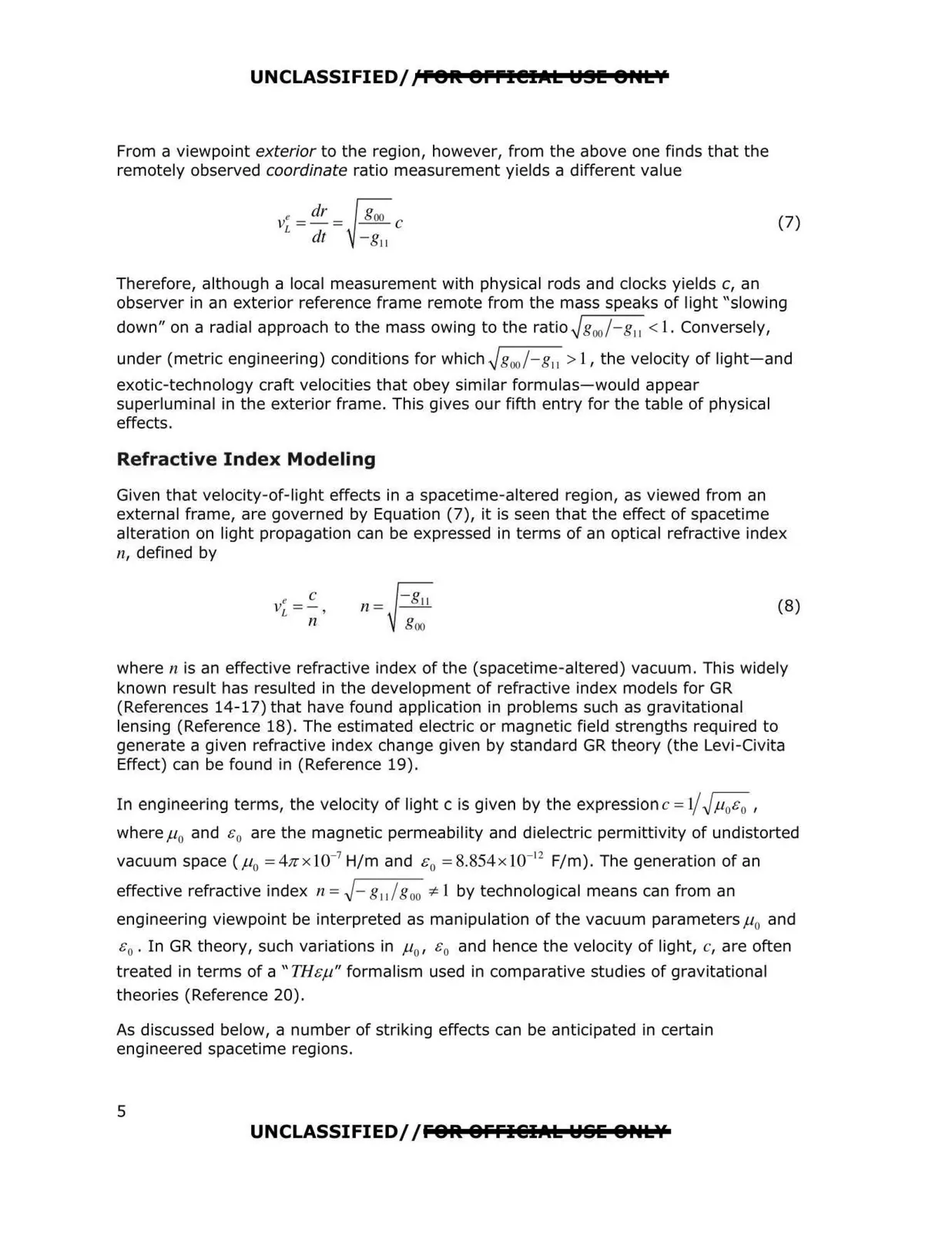
From a viewpoint exterior to the region, however, from the above one finds that the
remotely observed coordinate ratio measurement yields a different value
(7)
Therefore, although a local measurement with physical rods and clocks yields c, an
observer in an exterior reference frame remote from the mass speaks of light "slowing
down" on a radial approach to the mass owing to the ratio.Jg00 /-g I 1 < 1. Conversely,
under (metric engineering) conditions for which .Jg00 /-g 11 > 1, the velocity of light-and
exotic-technology craft velocities that obey similar formulas-would appear
superluminal in the exterior frame. This gives our fifth entry for the table of physical
effects.
Refractive Index Modeling
Given that velocity-of-light effects in a spacetime-altered region, as viewed from an
external frame, are governed by Equation (7), it is seen that the effect of spacetime
alteration on light propagation can be expressed in terms of an optical refractive index
n, defined by
(8)
where n is an effective refractive index of the (spacetime-altered) vacuum. This widely
known result has resu lted in the development of refractive index models for GR
(References 14-17) that have found application in problems such as gravitational
lensing (Reference 18). The estimated electric or magnetic field strengths required to
generate a given refractive index change given by standard GR theory (the Levi-Civita
Effect) can be found in (Reference 19).
In engineering terms, the velocity of light c is given by the expression c = 1/.Jµ 0c0 ,
where µ0 and &0 are the magnetic permeability and dielectric permittivity of undistorted
vacuum space (µ0 = 4Jr x10-7 H/m and &0 = 8.854x l0-12 F/m). The generation of an
effective refractive index n = .j- g 11/ g00 =t:- I by technological means can from an
engineering viewpoint be interpreted as manipulation of the vacuum parameters µ 0 and
&0. In GR theory, such variations in µ0, &0 and hence the velocity of light, c, are often
treated in terms of a "THsµ" formalism used in comparative studies of gravitational
theories (Reference 20).
As discussed below, a number of striking effects can be anticipated in certain
engineered spacetime regions.
UNCLASSIFIED//FOR OFFI@IAI: WSE OHl:l/
5