AAWSAP DIRD, Advanced Space Propulsion Based on Vacuum (Spacetime Metric) Engineering, March 2010
DOW-UAP-D132 · page 9 of 17
Text
This text came with the file. It may have mistakes. When the text and the image disagree, the image is right.
UNCLASSIFIED//FOR OFFI@IAL 1::191!! 8HLY
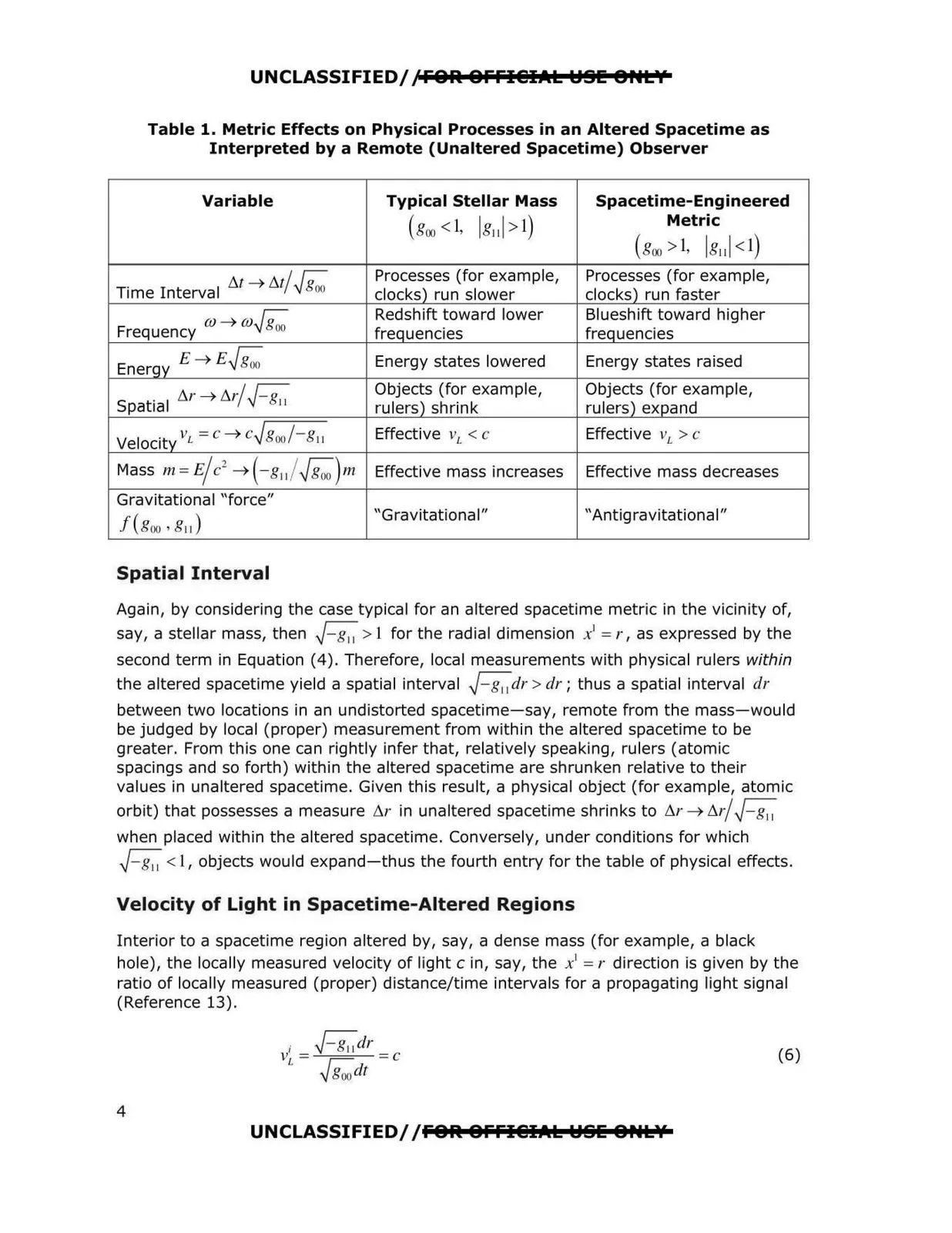
Table 1. Metric Effects on Physical Processes in an Altered Spacetime as
Interpreted by a Remote (Unaltered Spacetime) Observer
Variable
Typical Stellar Mass
(goo < 1, lg11 I>1)
Spacetime-Engineered
Metric
(g(X) > 1, lg11 I < 1)
.
M ➔ tit/ ji:i
Time Interval
00
Processes (for example,
clocks) run slower
Processes (for example,
clocks) run faster
w ➔ wji;;
Frequency
00
Redshift toward lower
frequencies
Blueshift toward higher
frequencies
E ➔ E.ji;;
Enerqv
00
Energy states lowered
Energy states raised
t. 1 !::.r ➔ t::.r/~
Spa ,a
Objects (for example,
rulers) shrink
Objects (for example,
rulers) expand
Velocity vL = c ➔ c.Jgoo / - 811
Effective v L < c
Effective v L > c
Mass m= E/c2 ➔ (-gIJ.Ji:;)m
Effective mass increases
Effective mass decreases
Gravitational "force"
f(goo ,81 1)
"Gravitational"
"Antig ravitationa I"
Spatial Interval
Again, by considering the case typical for an altered spacetime metric in the vicinity of,
say, a stellar mass, then ~ > 1 for the radial dimension x 1 = r, as expressed by the
second term in Equation ( 4 ). Therefore, local measurements with physical rulers within
the altered spacetime yield a spatial interval ~dr > dr; thus a spatial interval dr
between two locations in an undistorted spacetime- say, remote from the mass- would
be judged by local (proper) measurement from within the altered spacetime to be
greater. From this one can rightly infer that, relatively speaking, rulers (atomic
spacings and so forth) within the altered spacetime are shrunken relative to their
values in unaltered spacetime. Given this result, a physical object (for example, atomic
orbit) that possesses a measure !::.r in unaltered spacetime shrinks to !::..r ➔
t::.r/ ~
when placed within the altered spacetime. Conversely, under conditions for which
~ < 1, objects would expand-thus the fourth entry for the table of physical effects.
Velocity of Light in Spacetime-Altered Regions
Interior to a spacetime region altered by, say, a dense mass (for example, a black
hole), the locally measured velocity of light c in, say, the x1 = r direction is given by the
ratio of locally measured (proper) distance/time intervals for a propagating light signal
( Reference 13).
;
.J-g,1 dr
V
= --- = C
(6)
L
..{i;;dt
UNCLASSIFIED//FOR OFFI@IAL l::ISE OHL¥
4