AAWSAP DIRD, Antigravity for Aerospace Applications, March 2010
DOW-UAP-D135 · page 10 of 44
Text
This text came with the file. It may have mistakes. When the text and the image disagree, the image is right.
UNCLASSIFIED/ fFOA OFFIEIAk W&i 0Pilk¥
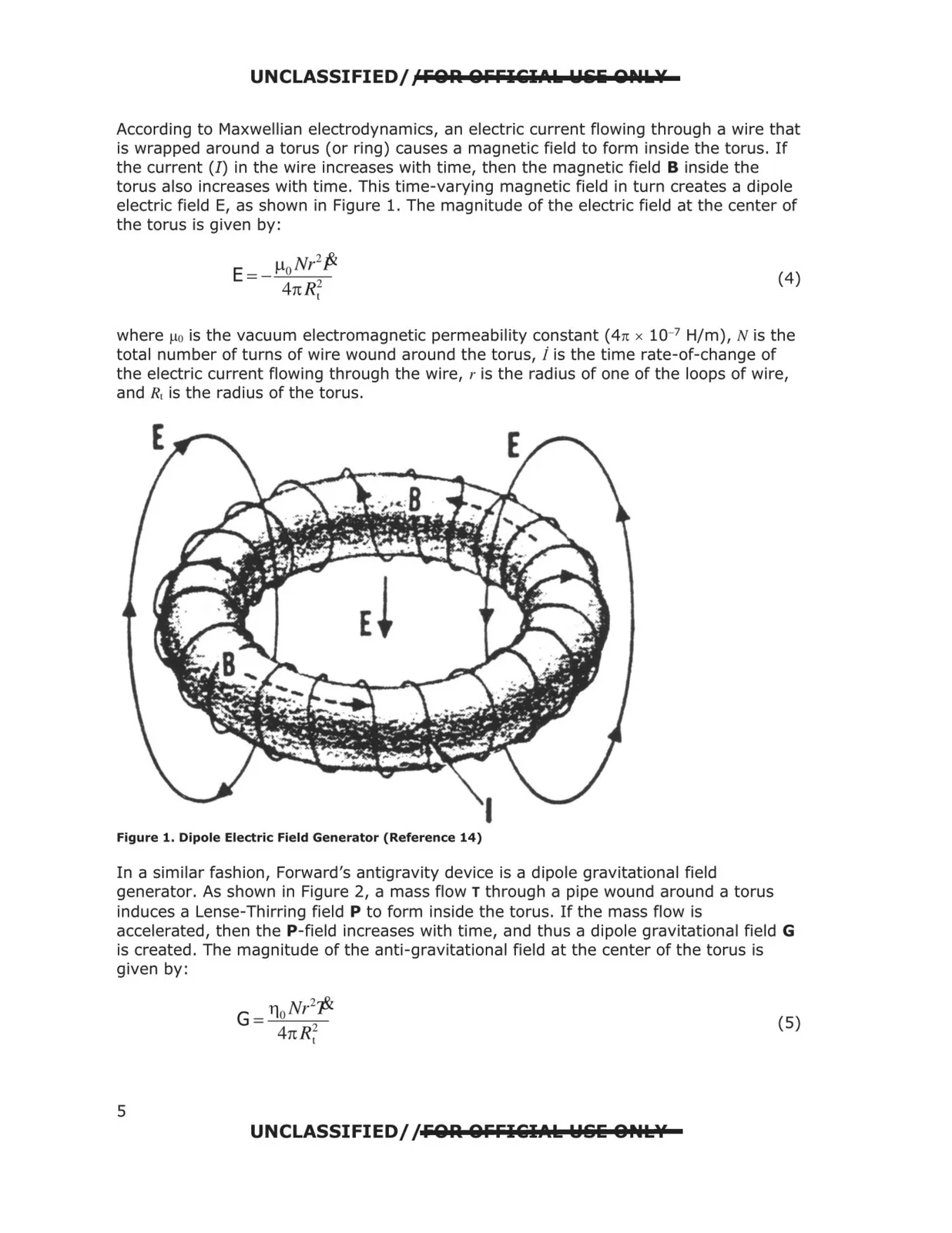
According to Maxwellian electrodynamics, an electric current flowing through a wire that
is wrapped around a torus (or ring) causes a magnetic field to form inside the torus. If
the current (I) in the wire increases with time, then the magnetic field B inside the
torus also increases with time. This time-varying magnetic field in turn creates a dipole
electric field E, as shown in Figure 1. The magnitude of the electric field at the center of
the torus is given by:
(4)
where µo is the vacuum electromagnetic permeability constant (4n x 10-7 H/m), N is the
total number of turns of wire wound around the torus, i is the time rate-of-change of
the electric current flowing through the wire, r is the radius of one of the loops of wire,
and Rt is the radius of the torus.
Figure 1. Dipole Electric Field Generator (Reference 14)
In a similar fashion, Forward's antigravity device is a dipole gravitational field
generator. As shown in Figure 2, a mass flow T through a pipe wound around a torus
induces a Lense-Thirring field P to form inside the torus. If the mass flow is
accelerated, then the P-field increases with time, and thus a dipole gravitational field G
is created. The magnitude of the anti-gravitational field at the center of the torus is
given by:
(5)
UNCLASSIFIED/ /FOA OFFI&IAb Yi&: 8,.bY
5