AAWSAP DIRD, Antigravity for Aerospace Applications, March 2010
DOW-UAP-D135 · page 18 of 44
Text
This text came with the file. It may have mistakes. When the text and the image disagree, the image is right.
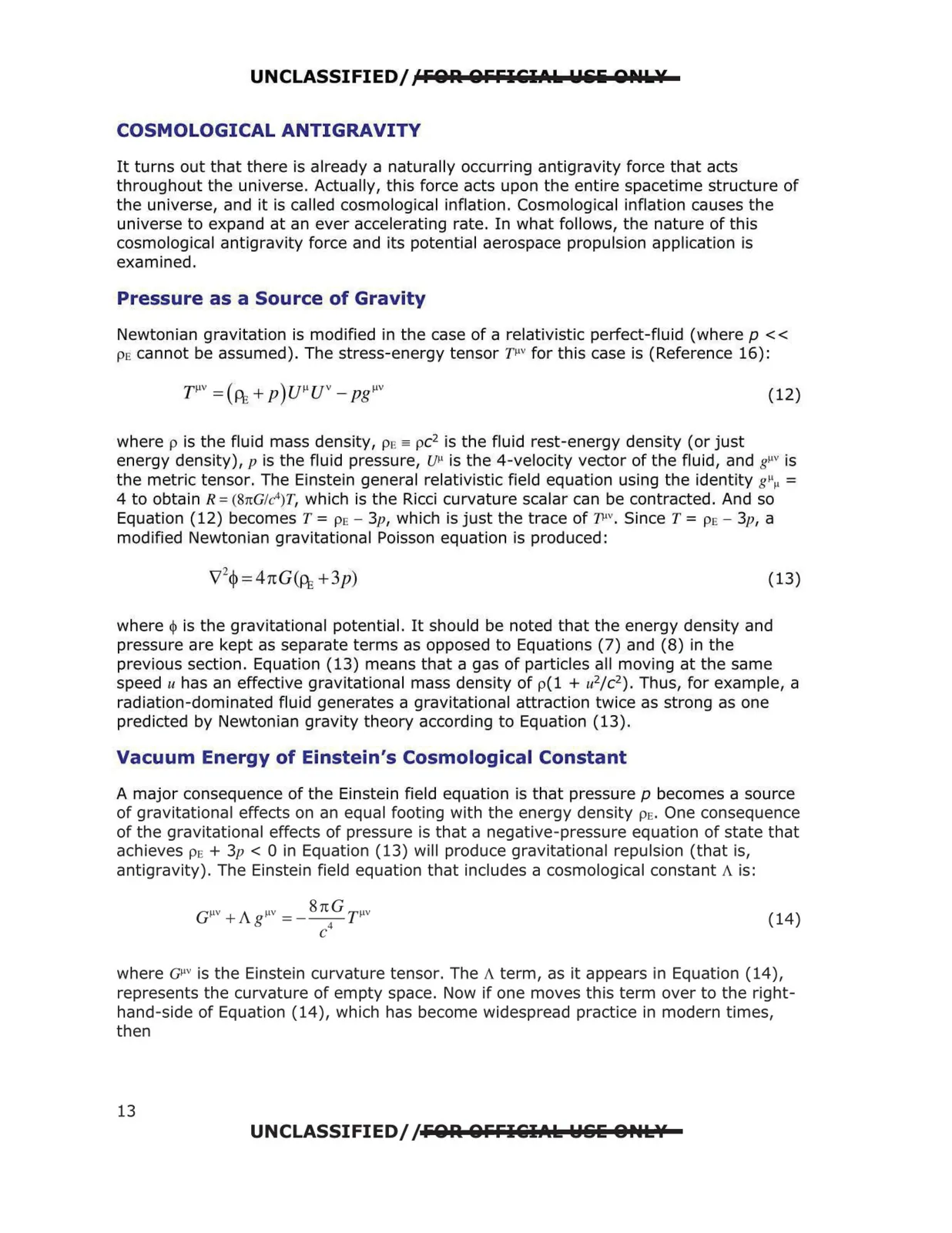
UNCLASSIFIED/fFOA OFFIEIA~ W&li QPI~¥ COSMOLOGICAL ANTIGRAVITY It turns out that there is already a naturally occurring antigravity force that acts throughout the universe. Actually, this force acts upon the entire spacetime structure of the universe, and it is called cosmological inflation. Cosmological inflation causes the universe to expand at an ever accelerating rate. In what follows, the nature of this cosmological antigravity force and its potential aerospace propulsion application is examined. Pressure as a Source of Gravity Newtonian gravitation is modified in the case of a relativistic perfect-fluid (where p << PE cannot be assumed). The stress-energy tensor p v for this case is (Reference 16) : (12) where p is the fluid mass density, PE= pc2 is the fluid rest-energy density (or just energy density), p is the fluid pressure, u µ is the 4-velocity vector of the fluid, and gµ v is the metric tensor. The Einstein general relativistic field equation using the identity gµµ = 4 to obtain R =(8nG!c4)T, which is the Ricci curvature scalar can be contracted. And so Equation (12) becomes T = PE - 3p, which is just the trace of p•v. Since T = PE - 3p, a modified Newtonian gravitational Poisson equation is produced: (13) where ~ is the gravitational potential. It should be noted that the energy density and pressure are kept as separate terms as opposed to Equations (7) and (8) in the previous section. Equation (13) means that a gas of particles all moving at the same speed u has an effective gravitational mass density of p(l + ii2/c2). Thus, for example, a radiation-dominated fluid generates a gravitational attraction twice as strong as one predicted by Newtonian gravity theory according to Equation (13). Vacuum Energy of Einstein's Cosmological Constant A major consequence of the Einstein field equation is that pressure p becomes a source of gravitational effects on an equal footing with the energy density PE• One consequence of the gravitational effects of pressure is that a negative-pressure equation of state that achieves PE + 3p < O in Equation (13) will produce gravitational repulsion (that is, antigravity). The Einstein field equation that includes a cosmological constant A is: (14) where Gµv is the Einstein curvature tensor. The A term, as it appears in Equation (14), represents the curvature of empty space. Now if one moves this term over to the right hand-side of Equation (14), which has become widespread practice in modern times, then UNCLASSIFIED//FOA OFFI&IAk Yi& 8,.k\f 13