AAWSAP DIRD, Antigravity for Aerospace Applications, March 2010
DOW-UAP-D135 · page 19 of 44
Text
This text came with the file. It may have mistakes. When the text and the image disagree, the image is right.
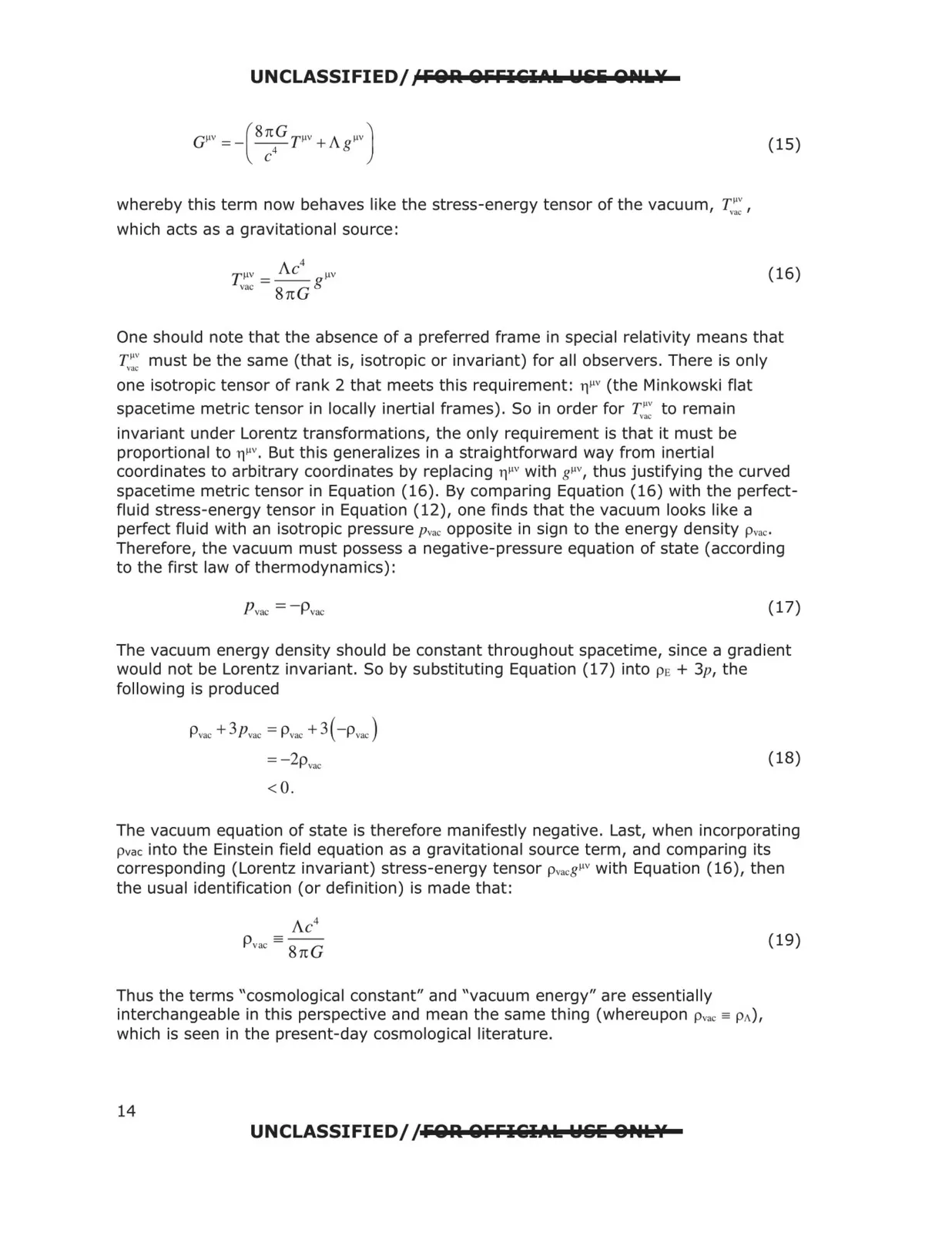
UNCLASSIFIED/fFOA OFFIEIAk W&i 0Pilk¥ (15) whereby this term now behaves like the stress-energy tensor of the vacuum, Tv~; , which acts as a gravitational source: T r,v - Ac4 r,v (16) vac - 87tG g One should note that the absence of a preferred frame in special relativity means that r;.; must be the same (that is, isotropic or invariant) for all observers. There is only one isotropic tensor of rank 2 that meets this requirement: riµv (the Minkowski flat spacetime metric tensor in locally inertial frames). So in order for r;.; to remain invariant under Lorentz transformations, the only requirement is that it must be proportional to ri µv . But this generalizes in a straightforward way from inertial coordinates to arbitrary coordinates by replacing ri µv with gµv, thus justifying the curved spacetime metric tensor in Equation (16). By comparing Equation (16) with the perfect fluid stress-energy tensor in Equation (12), one finds that the vacuum looks like a perfect fluid with an isotropic pressure P vac opposite in sign to the energy density P v•c • Therefore, the vacuum must possess a negative-pressure equation of state (according to the first law of thermodynamics): P vac = -Pvac (17) The vacuum energy density should be constant throughout spacetime, since a gradient would not be Lorentz invariant. So by substituting Equation ( 17) into PE + 3p, the following is produced P vac + 3 P vac = P vac + 3 ( - P vac ) (18) =-2Pvac < 0. The vacuum equation of state is therefore manifestly negative. Last, when incorporating pvac into the Einstein field equation as a gravitational source term, and comparing its corresponding (Lorentz invariant) stress-energy tensor P vacg•" ' with Equation (16), then the usual identification (or definition) is made that: Ac4 (19) P vac = S1tG Thus the terms "cosmological constant" and "vacuum energy" are essentially interchangeable in this perspective and mean the same thing (whereupon P vac = p.,..), which is seen in the present-day cosmological literature. UNCLASSIFIED//FOA OFFI&IAb Yi&: 8,.bY 14