AAWSAP DIRD, Antigravity for Aerospace Applications, March 2010
DOW-UAP-D135 · page 20 of 44
Text
This text came with the file. It may have mistakes. When the text and the image disagree, the image is right.
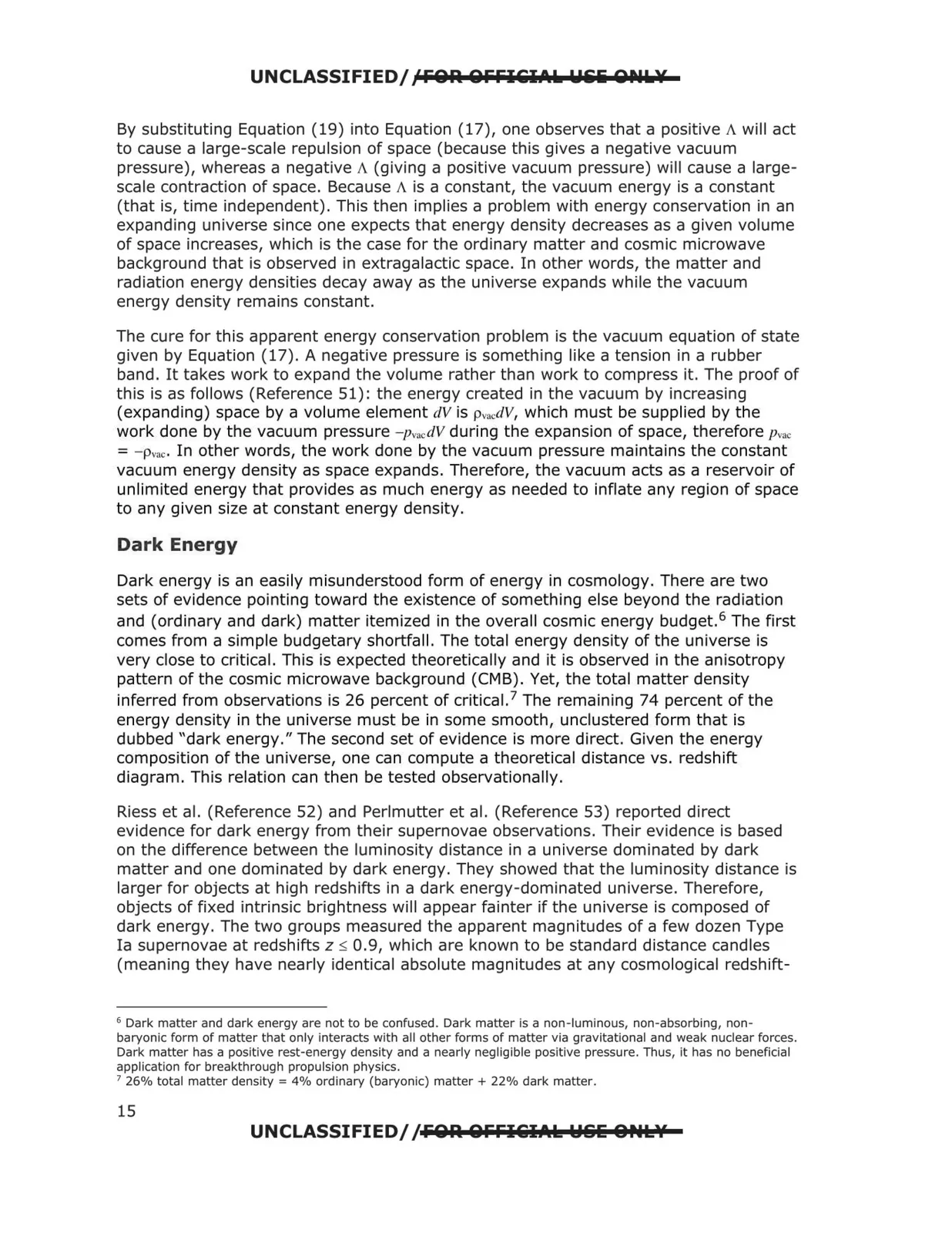
UNCLASSIFIED/fFOA OFFIEIAL: U&i QPIL:¥ By substituting Equation (19) into Equation (17), one observes that a positive A will act to cause a large-scale repulsion of space (because this gives a negative vacuum pressure), whereas a negative A (giving a positive vacuum pressure) will cause a large scale contraction of space. Because A is a constant, the vacuum energy is a constant (that is, time independent) . This then implies a problem with energy conservation in an expanding universe since one expects that energy density decreases as a given volume of space increases, which is the case for the ordinary matter and cosmic microwave background that is observed in extragalactic space. In other words, the matter and radiation energy densities decay away as the universe expands while the vacuum energy density remains constant. The cure for this apparent energy conservation problem is the vacuum equation of state given by Equation (17) . A negative pressure is something like a tension in a rubber band. It takes work to expand the volume rather than work to compress it. The proof of this is as follows (Reference 51): the energy created in the vacuum by increasing (expanding) space by a volume element dV is PvacdV, which must be supplied by the work done by the vacuum pressure -pvac dV during the expansion of space, therefore /Jvac = - p vac , In other words, the work done by the vacuum pressure maintains the constant vacuum energy density as space expands. Therefore, the vacuum acts as a reservoir of unlimited energy that provides as much energy as needed to inflate any region of space to any given size at constant energy density. Dark Energy Dark energy is an easily misunderstood form of energy in cosmology. There are two sets of evidence pointing toward the existence of something else beyond the radiation and ( ordinary and dark) matter itemized in the overall cosmic energy budget. 6 The first comes from a simple budgetary shortfall. The total energy density of the universe is very close to critical. This is expected theoretically and it is observed in the anisotropy pattern of the cosmic microwave background (CMB). Yet, the total matter density inferred from observations is 26 percent of critical. 7 The remaining 74 percent of the energy density in the universe must be in some smooth, unclustered form that is dubbed "dark energy." The second set of evidence is more direct. Given the energy composition of the universe, one can compute a theoretical distance vs. redshift diagram. This relation can then be tested observationally. Riess et al. (Reference 52) and Perlmutter et al. (Reference 53) reported direct evidence for dark energy from their supernovae observations. Their evidence is based on the difference between the luminosity distance in a universe dominated by dark matter and one dominated by dark energy. They showed that the luminosity distance is larger for objects at high redshifts in a dark energy-dominated universe. Therefore, objects of fixed intrinsic brightness will appear fainter if the universe is composed of dark energy. The two groups measured the apparent magnitudes of a few dozen Type Ia supernovae at redshifts z ::; 0.9, which are known to be standard distance candles (meaning they have nearly identical absolute magnitudes at any cosmological redshift 6 Dark matter and dark energy are not to be confused. Dark matter is a non-luminous, non-absorbing, non baryonic form of matter that only interacts with all other forms of matter via gravitational and weak nuclear forces. Dark matter has a positive rest-energy density and a nearly negligible positive pressure. Thus, it has no beneficial application for breakthrough propulsion physics. 7 26% total matter density = 4% ordinary (baryonic) matter + 22% dark matter. 15 UNCLASSI FIED/ / FOA OFFI€1Ak Yi& 8,.k\f