AAWSAP DIRD, Antigravity for Aerospace Applications, March 2010
DOW-UAP-D135 · page 21 of 44
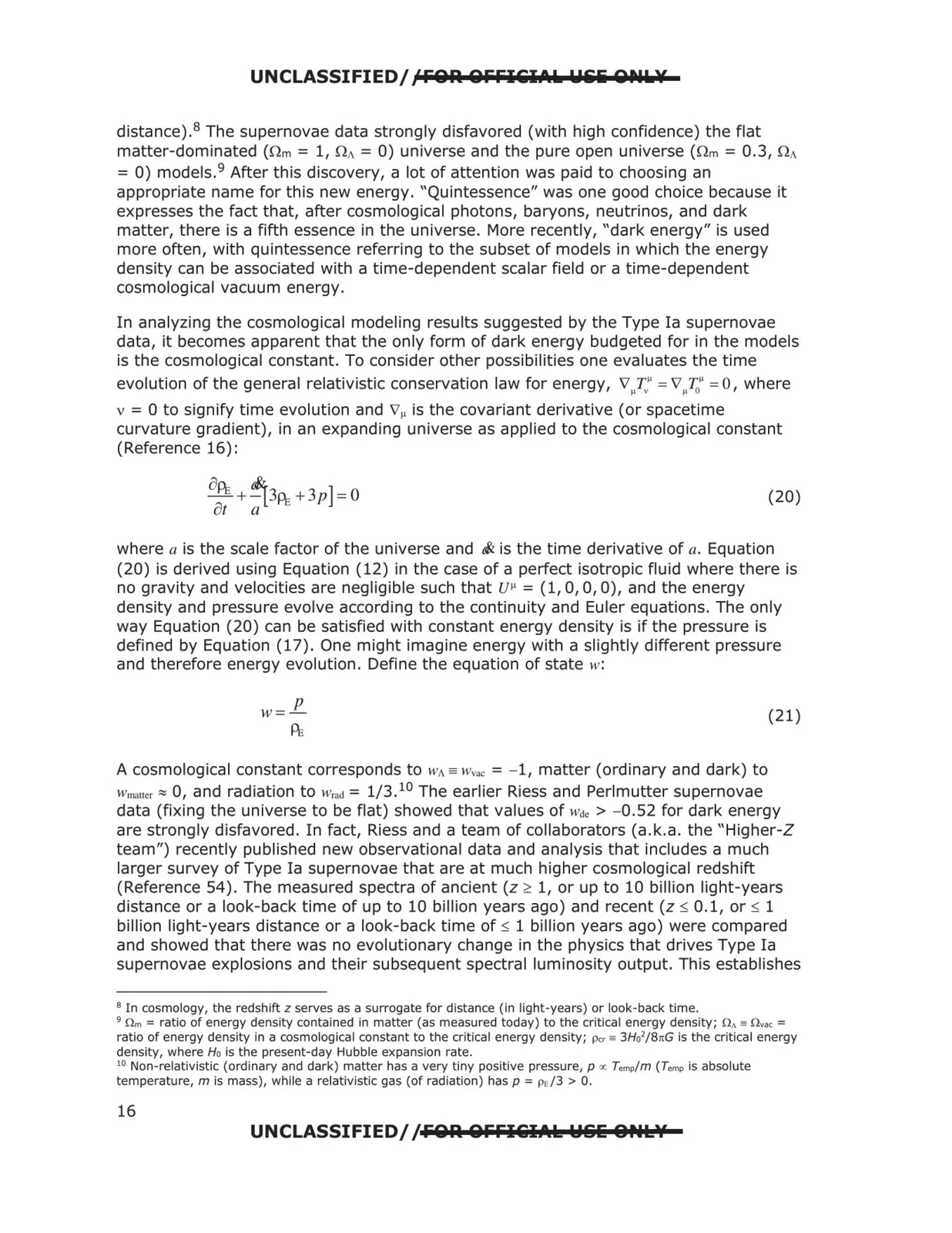
Text
This text came with the file. It may have mistakes. When the text and the image disagree, the image is right.
UNCLASSIFIED/fFOA OFFIEIAk W&i 0Pilk¥
distance).8 The supernovae data strongly disfavored (with high confidence) the flat
matter-dominated (nm = 1, n /\ = 0) universe and the pure open universe (nm = 0.3, n /\
= 0) models.9 After this discovery, a lot of attention was paid to choosing an
appropriate name for this new energy. "Quintessence" was one good choice because it
expresses the fact that, after cosmological photons, baryons, neutrinos, and dark
matter, there is a fifth essence in the universe. More recently, "dark energy" is used
more often, with quintessence referring to the subset of models in which the energy
density can be associated with a time-dependent scalar field or a time-dependent
cosmological vacuum energy.
In analyzing the cosmological modeling results suggested by the Type Ia supernovae
data, it becomes apparent that the only form of dark energy budgeted for in the models
is the cosmological constant. To consider other possibilities one evaluates the time
evolution of the general relativistic conservation law for energy, VJ:= V,l ; = O, where
v = 0 to signify time evolution and Vr, is the covariant derivative (or spacetime
curvature gradient), in an expanding universe as applied to the cosmological constant
(Reference 16):
8PE +~3PE + 3p] = O
(20)
at
a
where a is the scale factor of the universe and t& is the time derivative of a. Equation
(20) is derived using Equation (12) in the case of a perfect isotropic fluid where there is
no gravity and velocities are negligible such that u µ = (1, 0, 0, 0), and the energy
density and pressure evolve according to the continuity and Euler equations. The only
way Equation (20) can be satisfied with constant energy density is if the pressure is
defined by Equation (17). One might imagine energy with a slightly different pressure
and therefore energy evolution. Define the equation of state w:
(21)
A cosmological constant corresponds to w"' = wvac = -1, matter (ordinary and dark) to
w mauer ::::: 0, and radiation to Wract = 1/3.10 The earlier Riess and Perlmutter supernovae
data (fixing the universe to be flat) showed that values of Wcte > - 0.52 for dark energy
are strongly disfavored. In fact, Riess and a team of collaborators (a.k.a. the "Higher-Z
team") recently published new observational data and analysis that includes a much
larger survey of Type Ia supernovae that are at much higher cosmological redshift
(Reference 54). The measured spectra of ancient (z ~ 1, or up to 10 billion light-years
distance or a look-back time of up to 10 billion years ago) and recent (z ~ 0.1, or ~ 1
billion light-years distance or a look-back time of ~ 1 billion years ago) were compared
and showed that there was no evolutionary change in the physics that drives Type Ia
supernovae explosions and their subsequent spectral luminosity output. This establishes
8 In cosmology, the redshi~ z serves as a surrogate for distance (in light-years) or look-back time.
9 O m = ratio of energy density contained in matter (as measured today) to the critical energy density; n A = Ovac =
ratio of energy density in a cosmological constant to the critical energy density; Per= 3Hl /8rcG is the critical energy
density, where Ho is the present-day Hubble expansion rate .
10 Non-relativistic (ordinary and dark) matter has a very tiny positive pressure, p oc Temp/m (Temp is absolute
temperature, m is mass), while a relativistic gas (of radiation) hasp = pE/3 > 0.
UNCLASSIFIED//FOA OFFI&IAb Yi&: 8,.bY
16