AAWSAP DIRD, Antigravity for Aerospace Applications, March 2010
DOW-UAP-D135 · page 22 of 44
Text
This text came with the file. It may have mistakes. When the text and the image disagree, the image is right.
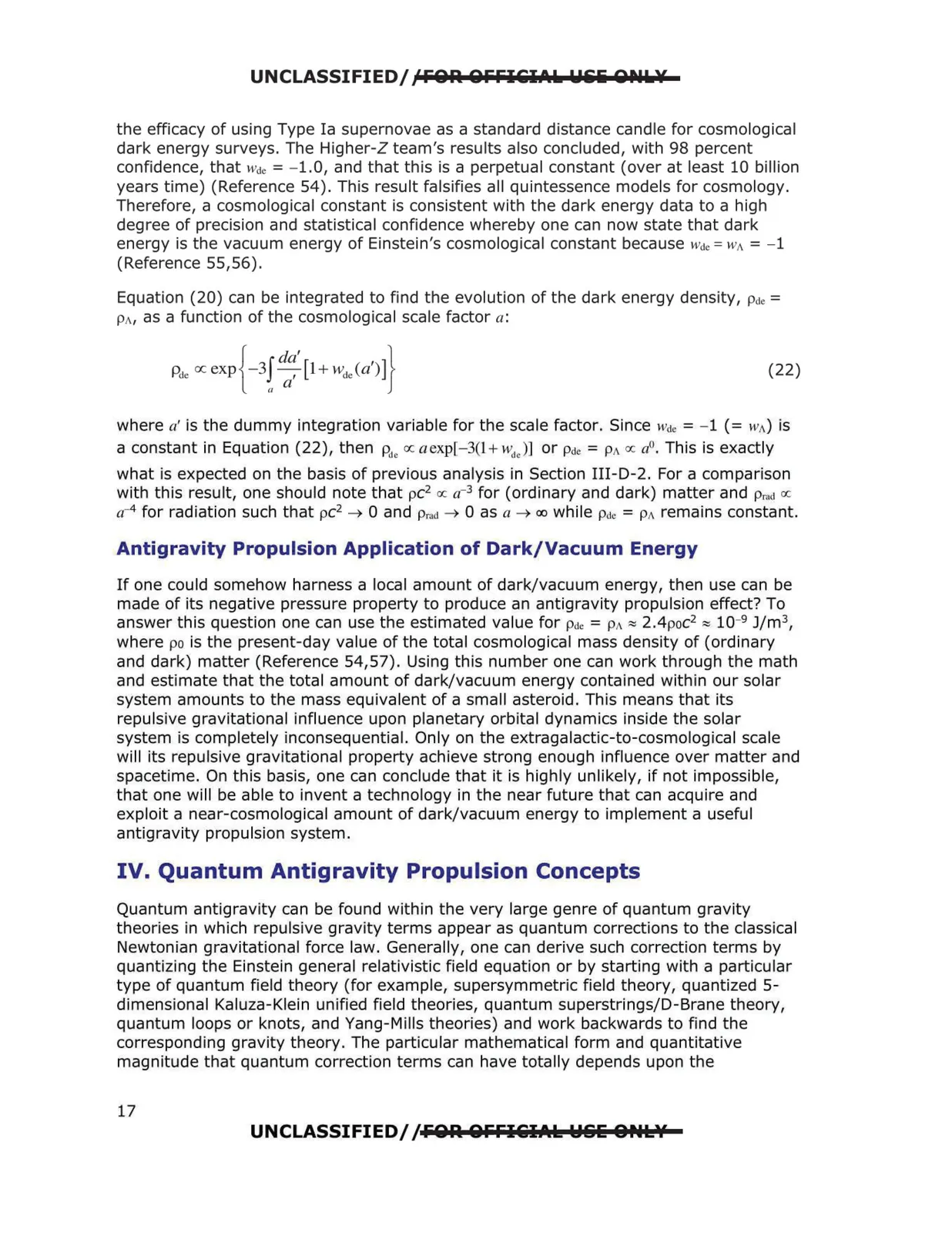
UNCLASSIFIED/fFOA OFFIEIAL: U&i QPIL:¥ the efficacy of using Type Ia supernovae as a standard distance candle for cosmological dark energy surveys. The Higher-Z team's results also concluded, with 98 percent confidence, that wde = - 1.0, and that this is a perpetual constant (over at least 10 billion years time) (Reference 54). This result falsifies all quintessence models for cosmology. Therefore, a cosmological constant is consistent with the dark energy data to a high degree of precision and statistical confidence whereby one can now state that dark energy is the vacuum energy of Einstein's cosmological constant because wdc = wA = -1 (Reference 55,56). Equation (20) can be integrated to find the evolution of the dark energy density, Pde = PA, as a function of the cosmological scale factor a: (22) where a' is the dummy integration variable for the scale factor. Since wde = - 1 (= wA ) is a constant in Equation (22), then Pc,•. oc aexp[-3(1 + ~1,)] or Pde = P A oc a0. This is exactly what is expected on the basis of previous analysis in Section III-D-2. For a comparison with this result, one should note that pc2 oc a-3 for (ordinary and dark) matter and Prn<1 oc a-4 for radiation such that pc2 ➔ 0 and p,,d ➔ 0 as a ➔ oo while Pde = PA remains constant. Antigravity Propulsion Application of Dark/Vacuum Energy If one could somehow harness a local amount of dark/vacuum energy, then use can be made of its negative pressure property to produce an antigravity propulsion effect? To answer this question one can use the estimated value for Pde = PA:=:; 2.4poc2 ~ 10-9 J/m3, where po is the present-day value of the total cosmological mass density of (ordinary and dark) matter (Reference 54,57). Using this number one can work through the math and estimate that the total amount of dark/vacuum energy contained within our solar system amounts to the mass equivalent of a small asteroid. This means that its repulsive gravitational influence upon planetary orbital dynamics inside the solar system is completely inconsequential. Only on the extragalactic-to-cosmological scale will its repulsive gravitational property achieve strong enough influence over matter and spacetime. On this basis, one can conclude that it is highly unlikely, if not impossible, that one will be able to invent a technology in the near future that can acquire and exploit a near-cosmological amount of dark/vacuum energy to implement a useful antigravity propulsion system. IV. Quantum Antigravity Propulsion Concepts Quantum antigravity can be found within the very large genre of quantum gravity theories in which repulsive gravity terms appear as quantum corrections to the classical Newtonian gravitational force law. Generally, one can derive such correction terms by quantizing the Einstein general relativistic field equation or by starting with a particular type of quantum field theory (for example, supersymmetric field theory, quantized 5 dimensional Kaluza-Klein unified field theories, quantum superstrings/D-Brane theory, quantum loops or knots, and Yang-Mills theories) and work backwards to find the corresponding gravity theory. The particular mathematical form and quantitative magnitude that quantum correction terms can have totally depends upon the UNCLASSIFIED//FOA OFFI€il.t.k Y&li 8,.LY 17