AAWSAP DIRD, Antigravity for Aerospace Applications, March 2010
DOW-UAP-D135 · page 23 of 44
Text
This text came with the file. It may have mistakes. When the text and the image disagree, the image is right.
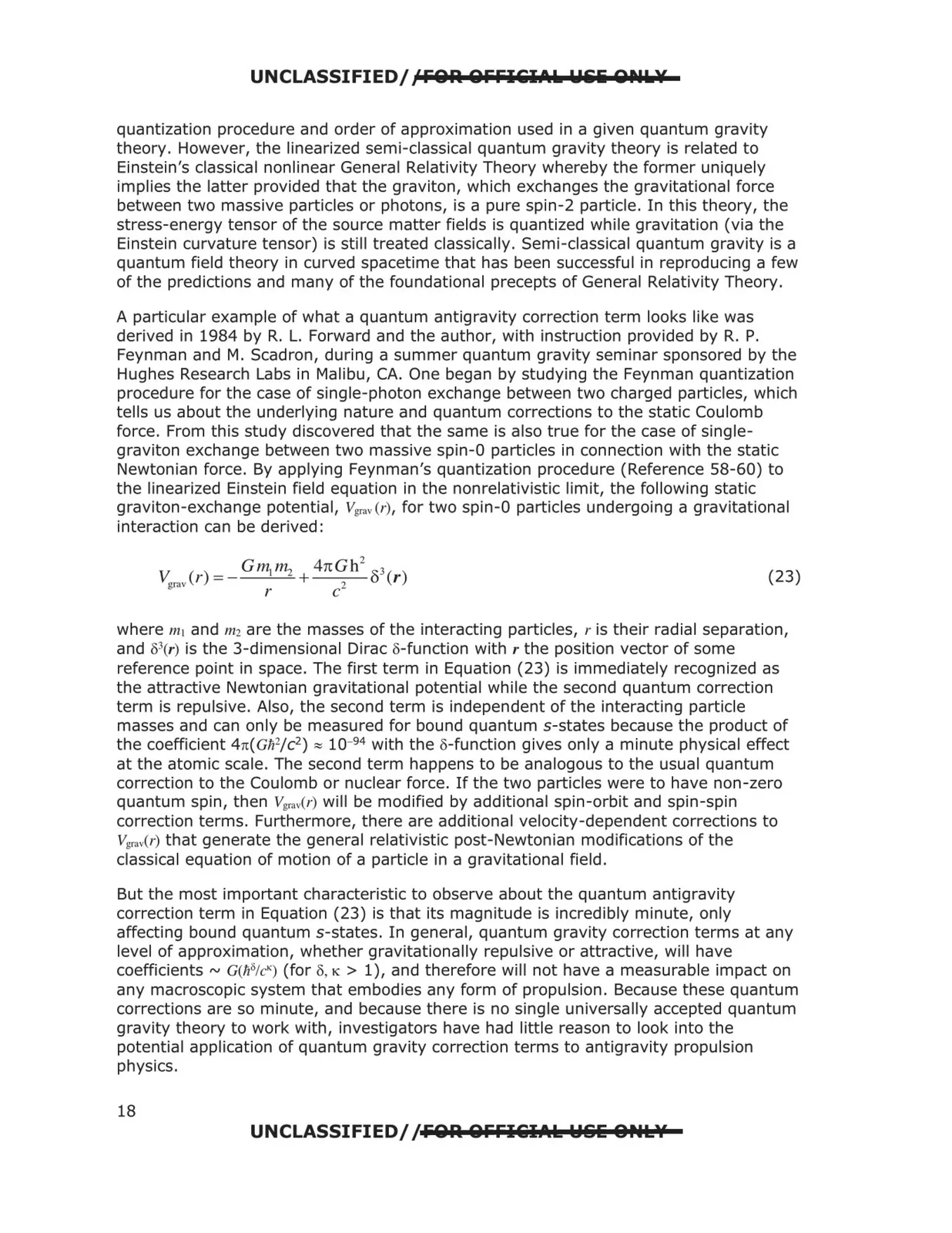
UNCLASSIFIED/fFOA OFFIEIAk W&i 0Pilk¥ quantization procedure and order of approximation used in a given quantum gravity theory. However, the linearized semi-classical quantum gravity theory is related to Einstein's classical nonlinear General Relativity Theory whereby the former uniquely implies the latter provided that the graviton, which exchanges the gravitational force between two massive particles or photons, is a pure spin-2 particle. In this theory, the stress-energy tensor of the source matter fields is quantized while gravitation (via the Einstein curvature tensor) is still treated classically. Semi-classical quantum gravity is a quantum field theory in curved spacetime that has been successful in reproducing a few of the predictions and many of the foundational precepts of General Relativity Theory. A particular example of what a quantum antigravity correction term looks like was derived in 1984 by R. L. Forward and the author, with instruction provided by R. P. Feynman and M. Scadron, during a summer quantum gravity seminar sponsored by the Hughes Research Labs in Malibu, CA. One began by studying the Feynman quantization procedure for the case of single-photon exchange between two charged particles, which tells us about the underlying nature and quantum corrections to the static Coulomb force. From this study discovered that the same is also true for the case of single graviton exchange between two massive spin-0 particles in connection with the static Newtonian force. By applying Feynman's quantization procedure (Reference 58-60) to the linearized Einstein field equation in the nonrelativistic limit, the following static graviton-exchange potential, V gr.,v (r), for two spin-0 particles undergoing a gravitational interaction can be derived: (23) where m1 and m 2 are the masses of the interacting particles, r is their radial separation, and 83(r) is the 3-dimensional Dirac 8-function with r the position vector of some reference point in space. The first term in Equation (23) is immediately recognized as the attractive Newtonian gravitational potential while the second quantum correction term is repulsive. Also, the second term is independent of the interacting particle masses and can only be measured for bound quantum s-states because the product of the coefficient 4n(Gli2/c2) ~ 10-94 with the 8-function gives only a minute physical effect at the atomic scale. The second term happens to be analogous to the usual quantum correction to the Coulomb or nuclear force. If the two particles were to have non-zero quantum spin, then Vgrav(r) will be modified by additional spin-orbit and spin-spin correction terms. Furthermore, there are additional velocity-dependent corrections to Vgrav(r) that generate the general relativistic post-Newtonian modifications of the classical equation of motion of a particle in a gravitational field. But the most important characteristic to observe about the quantum antigravity correction term in Equation (23) is that its magnitude is incredibly minute, only affecting bound quantum s-states. In general, quantum gravity correction terms at any level of approximation, whether gravitationally repulsive or attractive, will have coefficients ~G(li0/cK) (for 8, K > 1), and therefore will not have a measurable impact on any macroscopic system that embodies any form of propulsion. Because these quantum corrections are so minute, and because there is no single universally accepted quantum gravity theory to work with, investigators have had little reason to look into the potential application of quantum gravity correction terms to antigravity propulsion physics. UNCLASSIFIED//FOA OFFI&IAb Yi&: 8,.bY 18