AAWSAP DIRD, Biosensors and BioMEMS: A Survey of the Present Field, March 2010
DOW-UAP-D136 · page 22 of 45
Text
This text came with the file. It may have mistakes. When the text and the image disagree, the image is right.
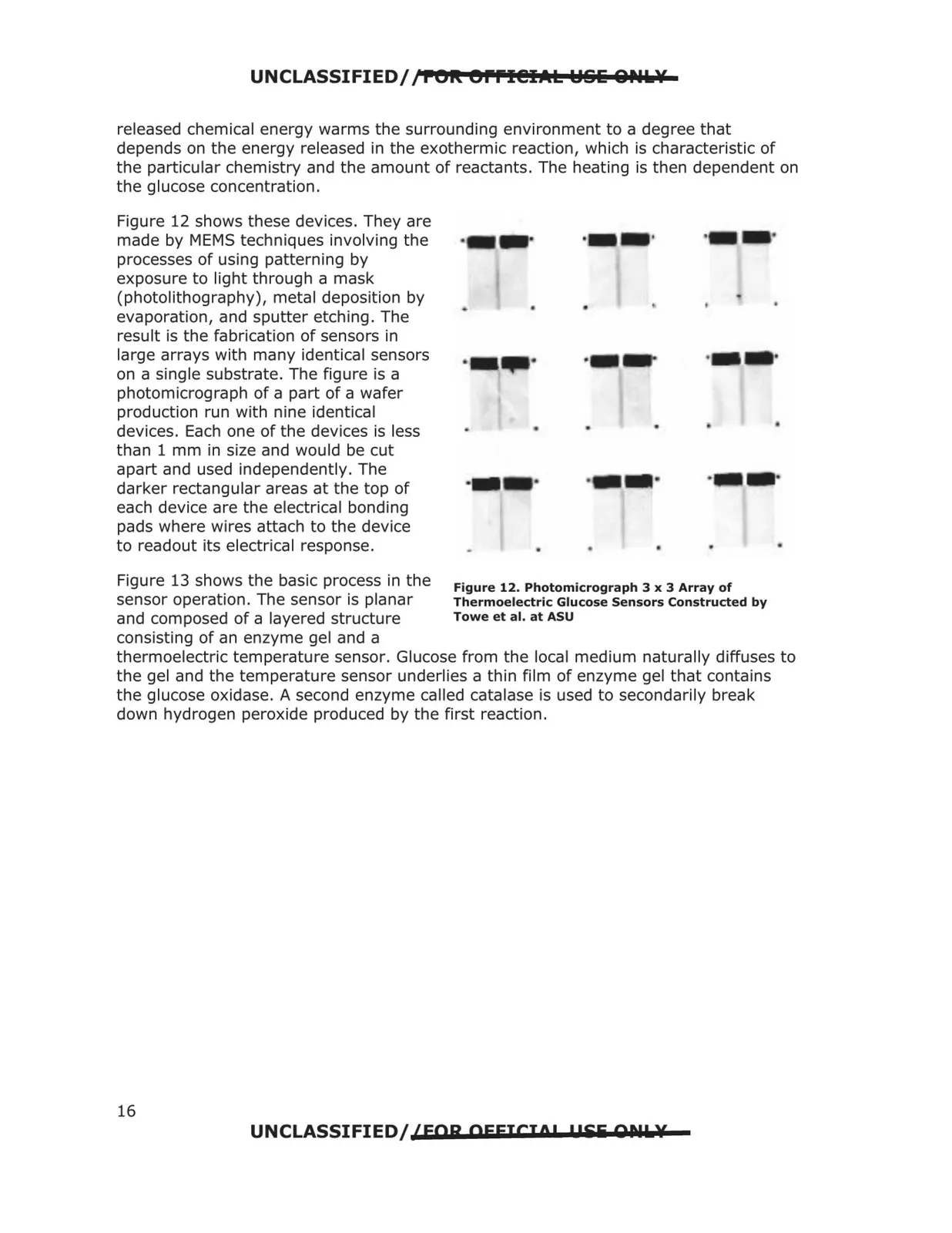
UNCLASSIFIED//P"OR: OP"P"l@IAL WSli 01'11.¥ released chemical energy warms the surrounding environment to a degree that depends on the energy released in the exothermic reaction, which is characteristic of the particular chemistry and the amount of reactants. The heating is then dependent on the glucose concentration. Figure 12 shows these devices. They are made by MEMS techniques involving the •--· processes of using patterning by exposure to light through a mask (photolithography), metal deposition by evaporation, and sputter etching. The result is the fabrication of sensors in large arrays with many identical sensors on a single substrate. The figure is a ·-- photomicrograph of a part of a wafer production run with nine identical devices. Each one of the devices is less than 1 mm in size and would be cut apart and used independently. The ·--- ·--· darker rectangular areas at the top of ·•- each device are the electrical bonding pads where wires attach to the device to readout its electrical response. Figure 13 shows the basic process in the Figure 12_Photomicrograph 3 x 3 Array of sensor operation. The sensor is planar Thermoelectric Glucose Sensors Constructed by and composed of a layered structure Towe et al. at ASU consisting of an enzyme gel and a thermoelectric temperature sensor. Glucose from the local medium naturally diffuses to the gel and the temperature sensor underlies a thin film of enzyme gel that contains the glucose oxidase. A second enzyme called catalase is used to secondarily break down hydrogen peroxide produced by the first reaction. UNCLASSIFIED/ (FOR OFFICJA 1 1155 01!1.¥ 16