AAWSAP DIRD, High-Frequency Gravitational Wave Communications, April 2010
DOW-UAP-D140 · page 19 of 57
Text
This text came with the file. It may have mistakes. When the text and the image disagree, the image is right.
UNCLASSIFIED//&Olil OiiiilCI0L Llili QPIL¥
According to Cruise (2008) of Birmingham University its frequency is limited to 100 MHz
and at higher frequencies its sensitivity diminishes. In the case of the Infrared-excited
molecules approach, on might employ a variant of the Robinson Gravitational Wave
Background Telescope for the receiver or detector (Yoon, et al., 2006). It is a
bolometric large angular scale Cosmic Microwave Background (CMB) polarimeter, but
might possibly be modifiable for direct HFGW detection.
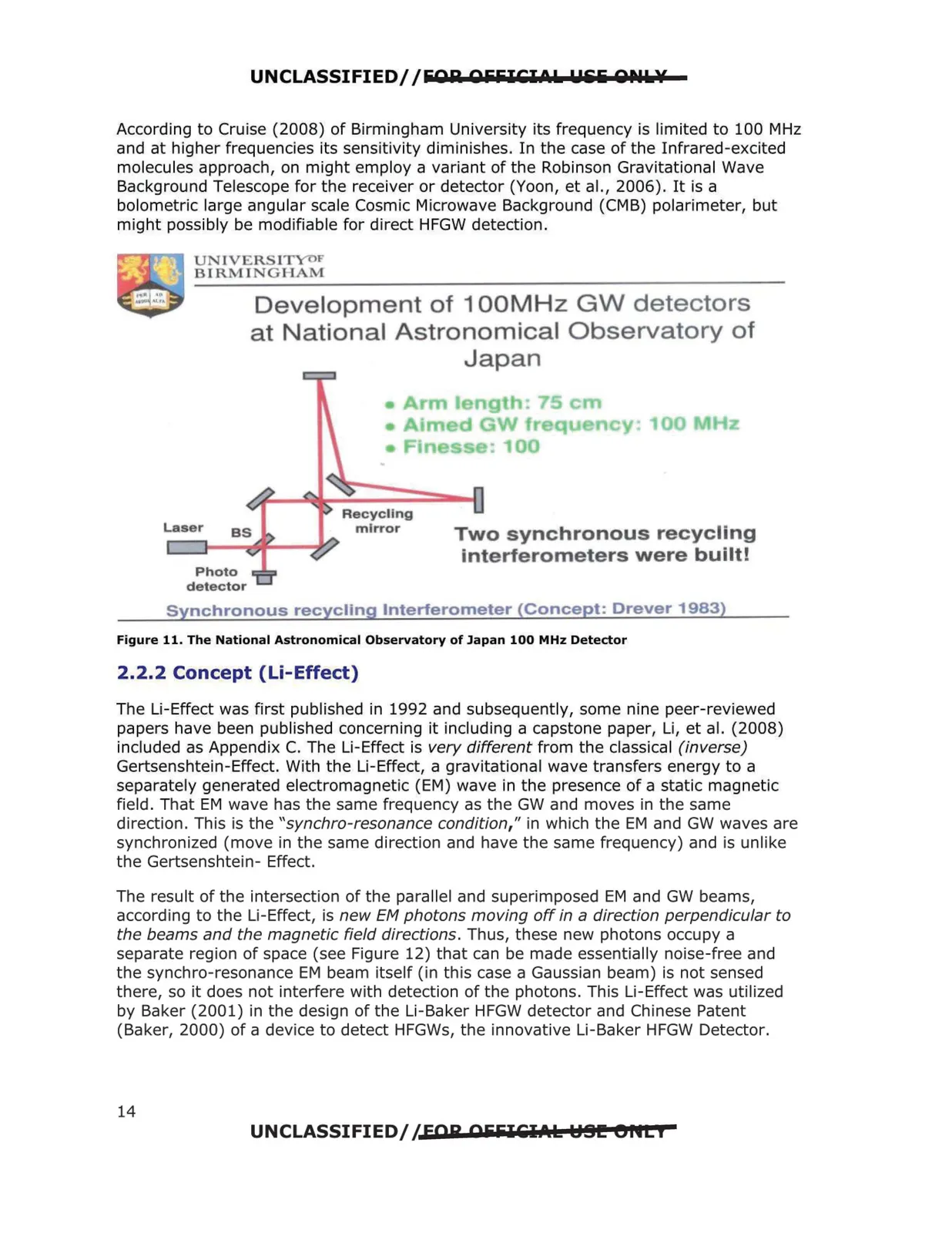
Development of 100MHz GW detectors
at National Astronomical Observatory of
Japan
Two synchronous recycling
interferometers were built!
S ynchronous recycling Interferometer (Concept: Drever 1983)
Figure 11. The National Astronomical Observatory of Japan 100 MHz Detector
2.2.2 Concept (Li-Effect)
The Li-Effect was first published in 1992 and subsequently, some nine peer-reviewed
papers have been published concerning it including a capstone paper, Li, et al. (2008)
included as Appendix C. The Li-Effect is very different from the classical (inverse)
Gertsenshtein-Effect. With the Li-Effect, a gravitational wave transfers energy to a
separately generated electromagnetic (EM) wave in the presence of a static magnetic
field. That EM wave has the same frequency as the GW and moves in the same
direction. This is the "synchro-resonance condition," in which the EM and GW waves are
synchronized (move in the same direction and have the same frequency) and is unlike
the Gertsenshtein- Effect.
The result of the intersection of the parallel and superimposed EM and GW beams,
according to the Li-Effect, is new EM photons moving off in a direction perpendicular to
the beams and the magnetic field directions. Thus, these new photons occupy a
separate region of space (see Figure 12) that can be made essentially noise-free and
the synchro-resonance EM beam itself (in this case a Gaussian beam) is not sensed
there, so it does not interfere with detection of the photons. This Li-Effect was utilized
by Baker (2001) in the design of the Li-Baker HFGW detector and Chinese Patent
(Baker, 2000) of a device to detect HFGWs, the innovative Li-Baker HFGW Detector.
UNCLASSIFIED//FOR OiiiilCl.t.k HSI!! eflti
14