AAWSAP DIRD, High-Frequency Gravitational Wave Communications, April 2010
DOW-UAP-D140 · page 32 of 57
Text
This text came with the file. It may have mistakes. When the text and the image disagree, the image is right.
..
.
·
.
UNCLASSIFIED//&Olil OiiiilCI0L Llili QPIL¥
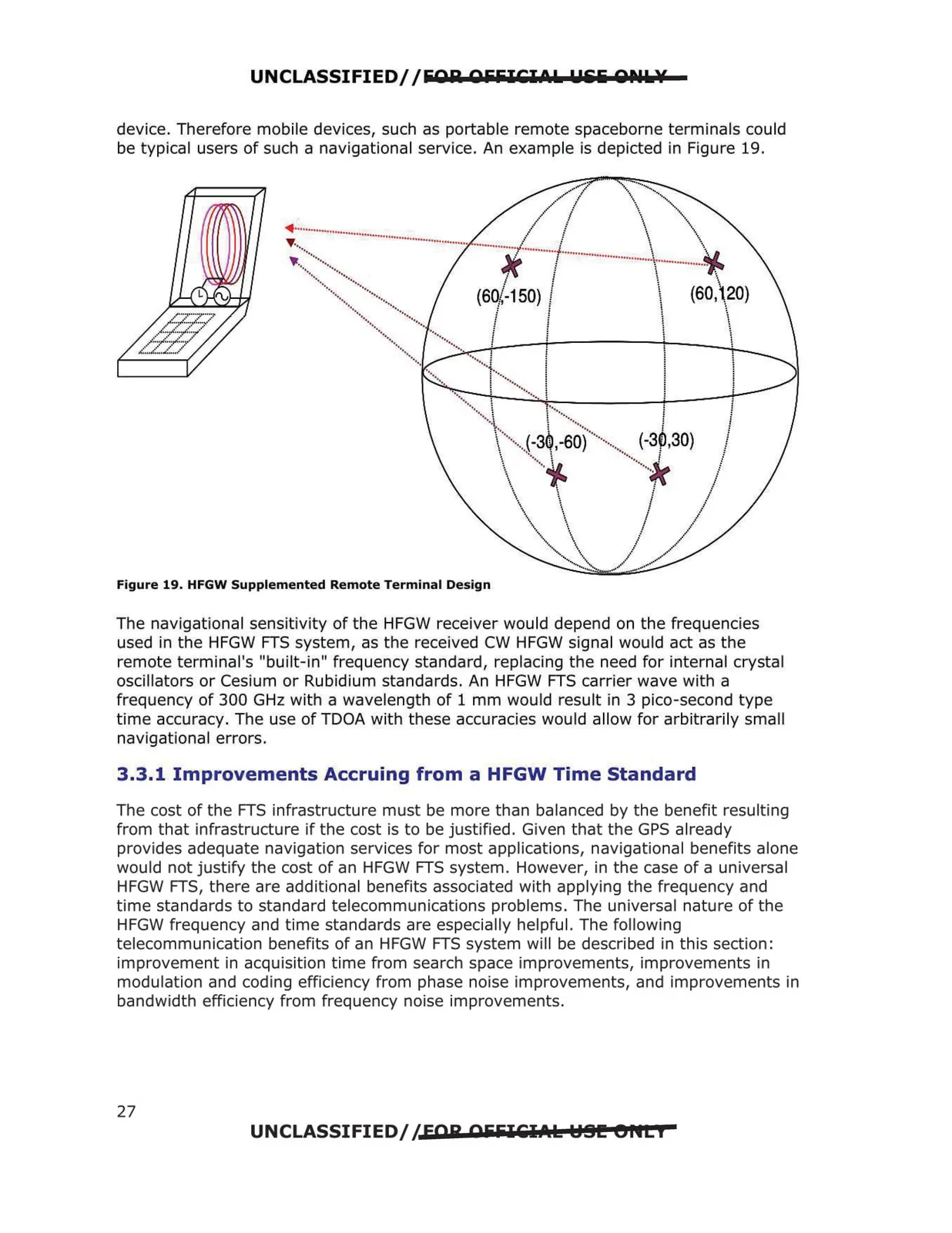
device. Therefore mobile devices, such as portable remote spaceborne terminals could
be typical users of such a navigational service. An example is depicted in Figure 19.
.......
.., ...........
/II
\
'
./
I
\
-..._'\.
/
'
\
......
i'
I
..,
\
~:.·.·.:··••......................................................... ................. !.......... I
\
\\
"·•••·······
~ .,.................................\..................~
··• . ·•. ....
"
I
\
·~
····•••..... .:·····.............
(So/,-150) /
\
(60,\20)
',<:::
I I
1
\
Figure 19. HFGW Supplemented Remote Terminal Design
The navigational sensitivity of the HFGW receiver would depend on the frequencies
used in the HFGW FTS system, as the received CW HFGW signal would act as the
remote terminal's "built-in" frequency standard, replacing the need for internal crystal
oscillators or Cesium or Rubidium standards. An HFGW FTS carrier wave with a
frequency of 300 GHz with a wavelength of 1 mm would result in 3 pico-second type
time accuracy. The use of TDOA with these accuracies would allow for arbitrarily small
navigational errors.
3.3.1 Improvements Accruing from a HFGW Time Standard
The cost of the FTS infrastructure must be more than balanced by the benefit resulting
from that infrastructure if the cost is to be justified . Given that the GPS already
provides adequate navigation services for most applications, navigational benefits alone
would not justify the cost of an HFGW FTS system. However, in the case of a universal
HFGW FTS, there are additional benefits associated with applying the frequency and
time standards to standard telecommunications problems. The universal nature of the
HFGW frequency and time standards are especially helpful. The following
telecommunication benefits of an HFGW FTS system will be described in this section:
improvement in acquisition time from search space improvements, improvements in
modulation and coding efficiency from phase noise improvements, and improvements in
bandwidth efficiency from frequency noise improvements.
UNCLASSIFIED//FOR OiiiilCl.t.k HSI!! eflti
27