AAWSAP DIRD, Metamaterials for Aerospace Applications, April 2010
DOW-UAP-D141 · page 24 of 38
Text
This text came with the file. It may have mistakes. When the text and the image disagree, the image is right.
UNCLASSIFIED/ (FOR OFFIClt.k YSE 8Htt
Metamaterials for Energy Harvesting
One of the most important applications of meta materials is related to developing
"perfect absorbers" of infrared electromagnetic radiation, be it in the mid-to-long
infrared part of the spectrum (making it relevant for night vision, harvesting of the
Earth glow mid-infrared radiation, and so forth) or in the near-to-mid-IR spectrum
(making it relevant for day-time infrared photography of the earth terrain). For
example, day-time infrared photography relies on the different sunlight reflectivities of
surfaces (for example, snow, brick walls, concrete walls, grass, and so forth), and can
easily distinguish between those surfaces. This reflectivity differential tends to be the
greatest between 2-3 microns, and rapidly decays toward longer wavelengths. Open
sky contains very little infrared radiation which explains why infrared
imaging/photography is very important for aerial and satellite surveys. Because light
scattering in the atmosphere scales as >,.-4 , imaging through the atmosphere in the
visible range is impossible, and infrared imaging becomes important. This is especially
true for the 1 < A < 4 µm range. For longer wavelengths {A> 10 µm) this brightness
differential is largely gone because the emission spectrum is dominated by thermal
emission. In fact, the Earth glow maximum is around A> 10 µm, with most of the
energy contained in the 3 µm < A < 14 µm range. This longer wavelength (mid-to-far
IR) spectral range is also very important. It can be used for night-time energy
scavenging by high-altitude satellites and other aerospace platforms.
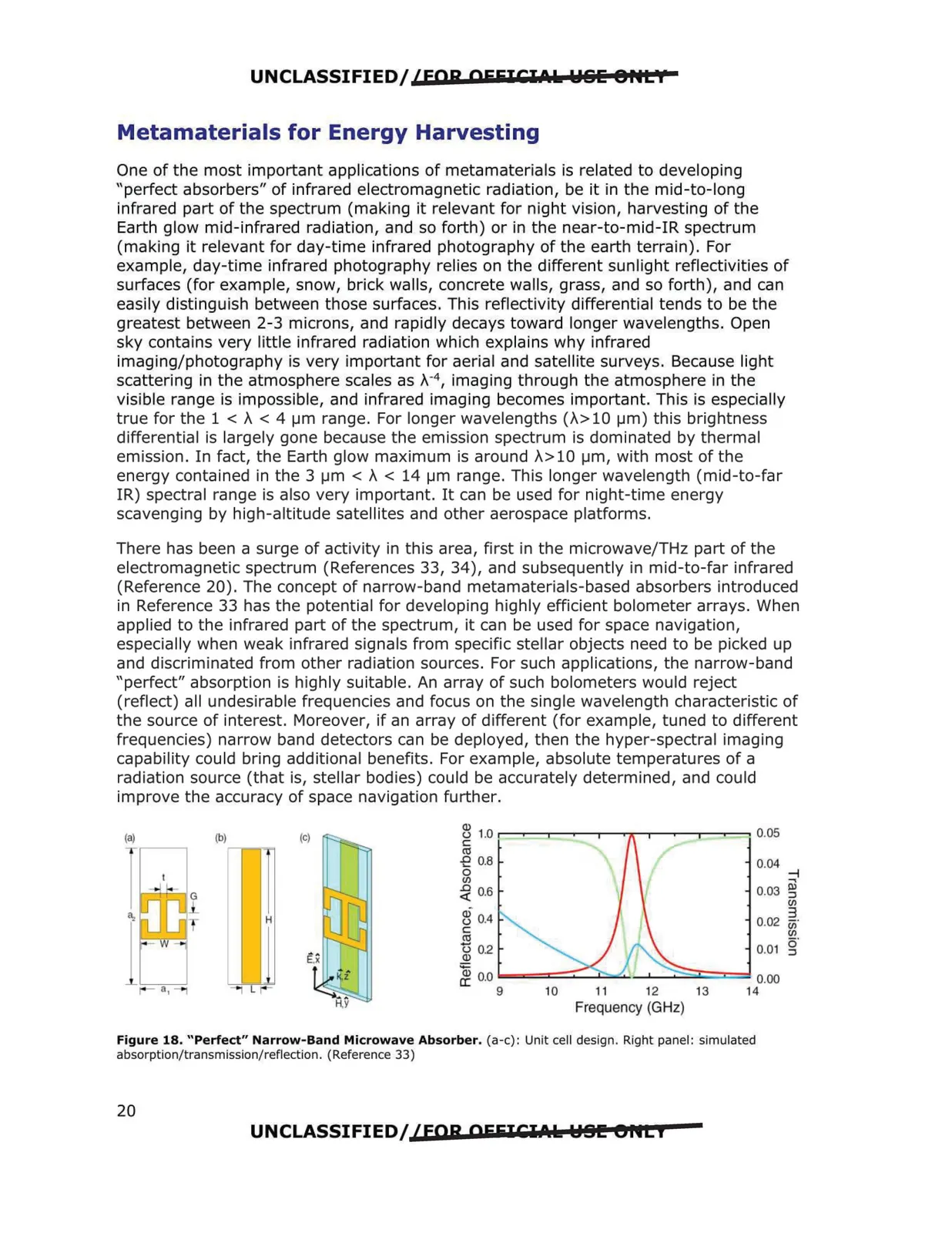
There has been a surge of activity in this area, first in the microwave/THz part of the
electromagnetic spectrum (References 33, 34), and subsequently in mid-to-far infrared
(Reference 20). The concept of narrow-band metamaterials-based absorbers introduced
in Reference 33 has the potential for developing highly efficient bolometer arrays. When
applied to the infrared part of the spectrum, it can be used for space navigation,
especially when weak infrared signals from specific stellar objects need to be picked up
and discriminated from other radiation sources. For such applications, the narrow-band
"perfect" absorption is highly suitable. An array of such bolometers would reject
(reflect) all undesirable frequencies and focus on the single wavelength characteristic of
the source of interest. Moreover, if an array of different (for example, tuned to different
frequencies) narrow band detectors can be deployed, then the hyper-spectral imaging
capability could bring additional benefits. For example, absolute temperatures of a
radiation source (that is, stellar bodies) could be accurately determined, and could
improve the accuracy of space navigation further.
(a)
(b)
(c)
-l
~
(J)
3
iii"
(J)
6"
:::,
H
0.04
0.03
0.02
0.01
Figure 18. "Perfect" Narrow-Band Microwave Absorber. (a-c): Unit cell design. Right panel: simulated
absorption/transmission/reflection. (Reference 33)
UNCLASSIFIED/ /EAR QFFICl.t.ls W8I! Bfltf
20