AAWSAP DIRD, Aneutronic Fusion Propulsion I, November 2010
DOW-UAP-D145 · page 10 of 50
Text
This text came with the file. It may have mistakes. When the text and the image disagree, the image is right.
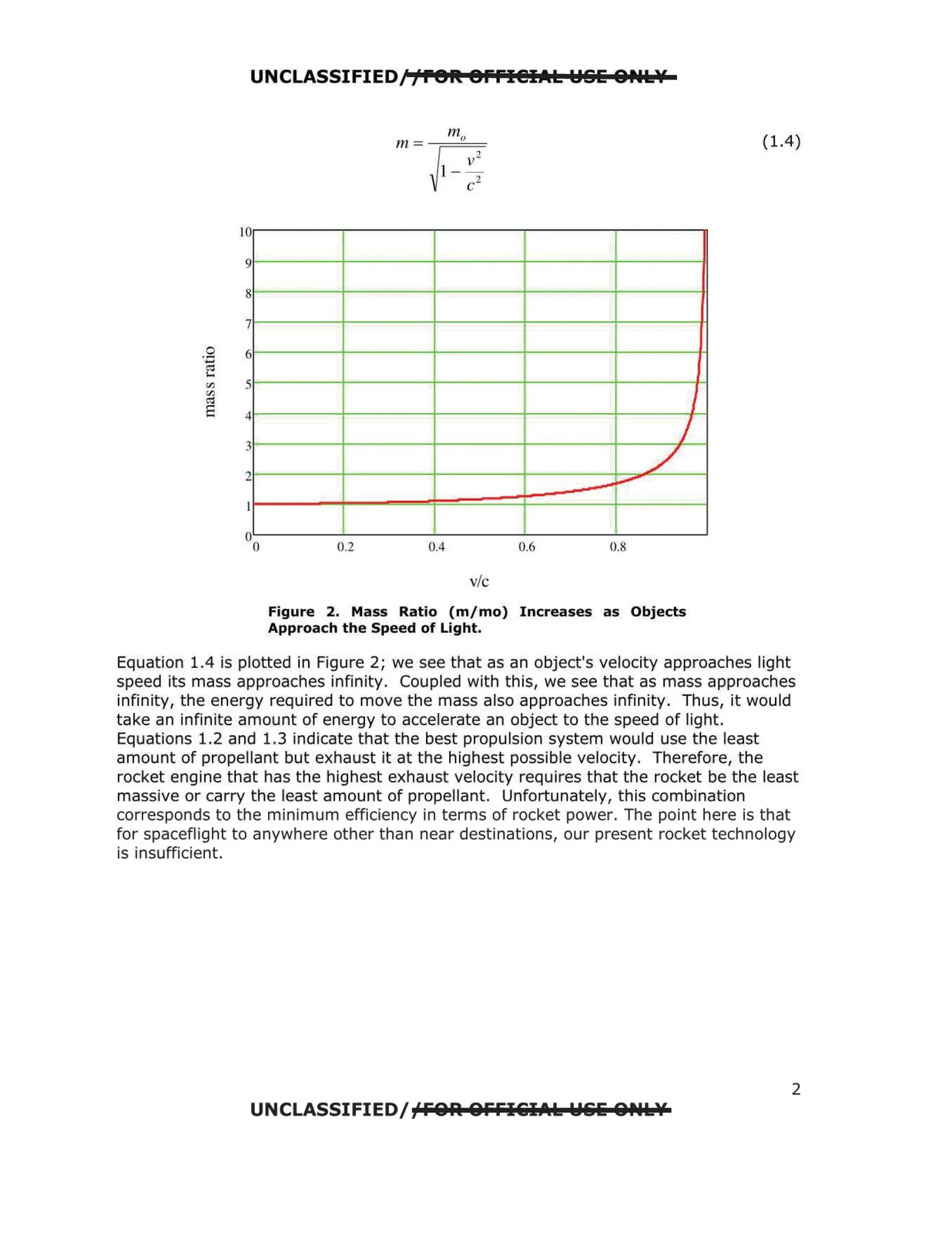
UNCLASSIFIED//POlt Offl@IAL WS& &NkY (1.4) m=g ? 9 8 7 ' 3 2 I / - ..--- 0.2 0.4 0.6 0.8 v/c Figure 2. Mass Ratio (m/mo) Increases as Objects Approach the Speed of Light. Equation 1.4 is plotted in Figure 2; we see that as an object's velocity approaches light speed its mass approaches infinity. Coupled with this, we see that as mass approaches infinity, the energy required to move the mass also approaches infinity. Thus, it would take an infinite amount of energy to accelerate an object to the speed of light. Equations 1.2 and 1.3 indicate that the best propulsion system would use the least amount of propellant but exhaust it at the highest possible velocity. Therefore, the rocket engine that has the highest exhaust velocity requires that the rocket be the least massive or carry the least amount of propellant. Unfortunately, this combination corresponds to the minimum efficiency in terms of rocket power. The point here is that for spaceflight to anywhere other than near destinations, our present rocket technology is insufficient. UNCLASSIFIED/fF&A &FFI&I:.l.k W&li &NkY 2