AAWSAP DIRD, Aneutronic Fusion Propulsion I, November 2010
DOW-UAP-D145 · page 11 of 50
Text
This text came with the file. It may have mistakes. When the text and the image disagree, the image is right.
UNCLASSIFIED//POlt Offl@IAL WS& &NkY
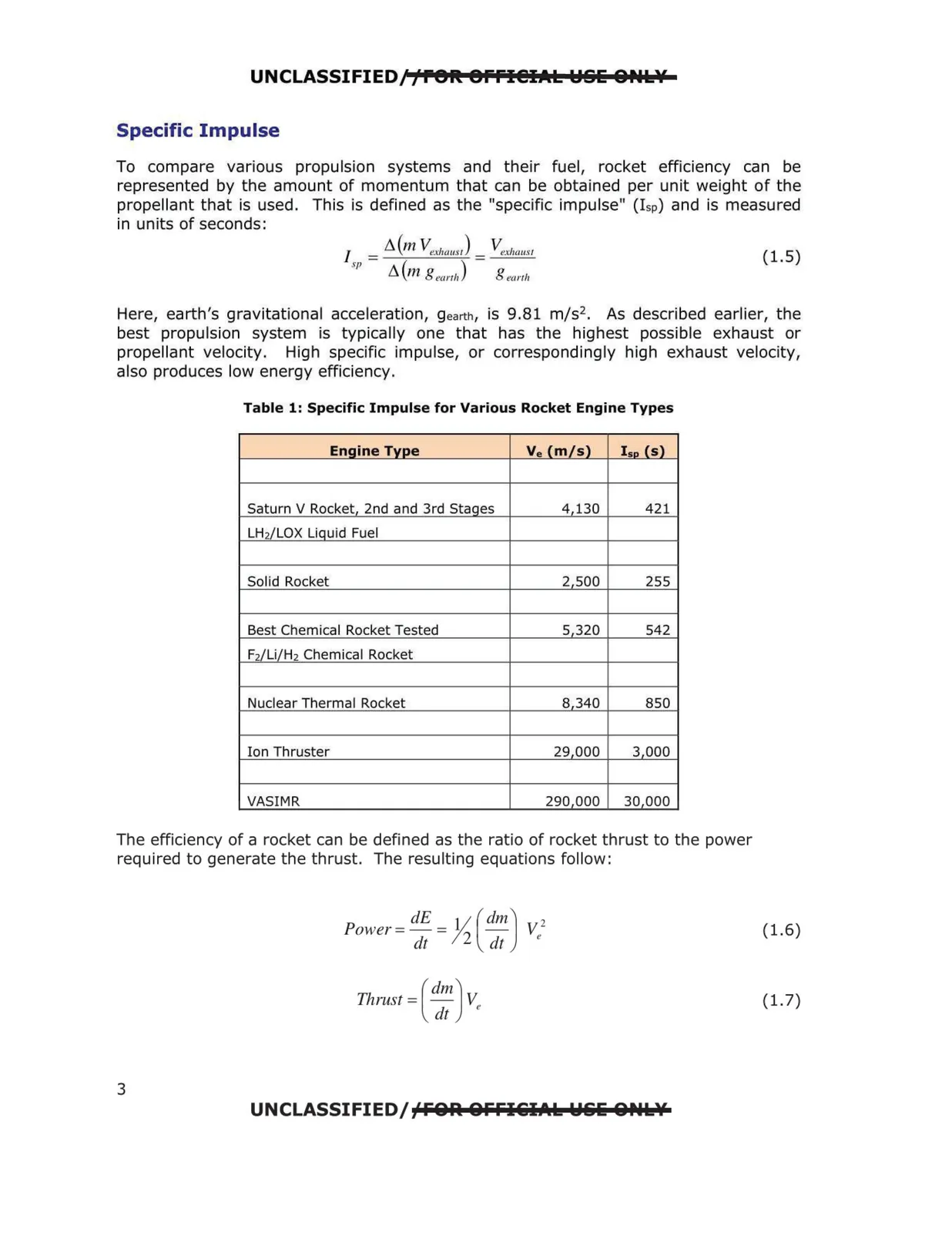
Specific Impulse
To compare various propulsion systems and their fuel, rocket efficiency can be
represented by the amount of momentum that can be obtained per unit weight of the
propellant that is used. This is defined as the "specific impulse" (lsp) and is measured
in units of seconds:
I = Li(m v • . ,1w 11s,) = v ,x/11111S/
(1.5)
,.,,
(
)
•
Li ni gearth
g ea1·1/t
Here, earth's gravitational acceleration, gearth, is 9.81 m/s2.
As described earlier, the
best propulsion system is typically one that has the highest possible exhaust or
propellant velocity.
High specific impulse, or correspondingly high exhaust velocity,
also produces low energy efficiency.
Table 1: Specific Impulse for Various Rocket Engine Types
En<1ine Tvpe
Ve (m/s)
Isa (s)
Saturn V Rocket 2nd and 3rd Staqes
4 130
421
LH2/LOX Liquid Fuel
Solid Rocket
2,500
255
Best Chemical Rocket Tested
5 320
542
F2/Li/H2 Chemical Rocket
Nuclear Thermal Rocket
8 340
850
Ion Thruster
29 000
3 000
VASIMR
290,000
30,000
The efficiency of a rocket can be defined as the ratio of rocket thrust to the power
required to generate the thrust. The resulting equations follow:
Power = dE
2
(1.6)
= ½(dm) V
dt
2 dt
e
Thrust =
(1.7)
(dm)V
dt
'
UNCLASSIFIED/fF&A &FFI&I:.l.k W&li &NkY
3