AAWSAP DIRD, Ultracapacitors as Energy and Power Storage Devices, November 2010
DOW-UAP-D147 · page 27 of 34
Text
This text came with the file. It may have mistakes. When the text and the image disagree, the image is right.
UNCLASSIFIED1/FOR 8ffl@IAL tt91! e"t I
r------- /
MCap nanocell
/
/
1.6µm
o.55µmJ•
•I
/
/
Magnetic materials
"'i
/
/
Dielectric layer --
/
MCap cell
Magnetic materials
,----,•...____
/
Made up of millions
(all proprietary compositions)
/
/
MCap nanocells
~- - - - - - - -
../
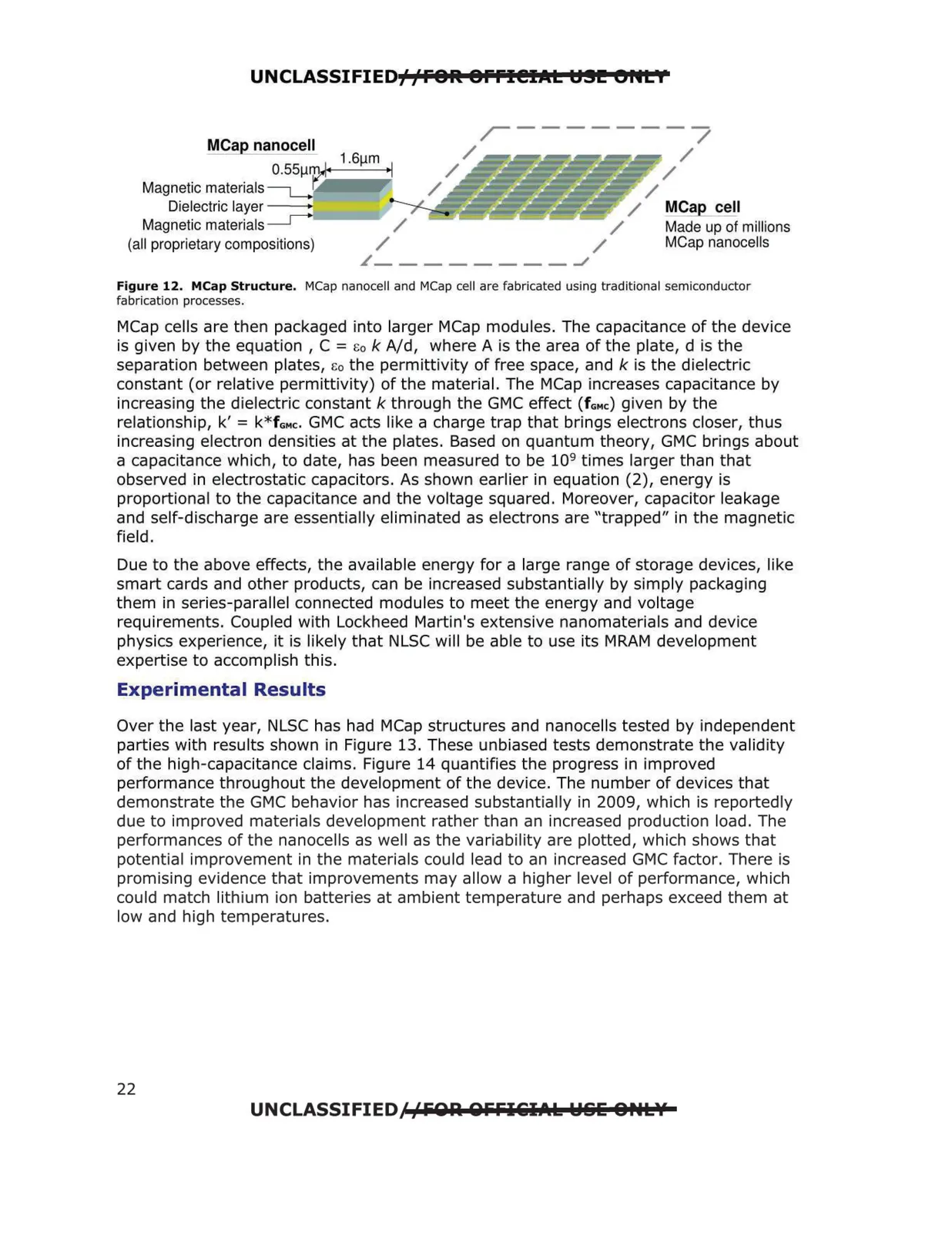
Figure 12. MCap Structure. MCap nanocell and MCap cell are fabricated using traditional semiconductor
fabrication processes.
MCap cells are then packaged into larger MCap modules. The capacitance of the device
is given by the equation , C = so k A/d, where A is the area of the plate, d is the
separation between plates, so the permittivity of free space, and k is the dielectric
constant (or relative permittivity) of the material. The MCap increases capacitance by
increasing the dielectric constant k through the GMC effect (fGMc) given by the
relationship, k' = k*fGMc- GMC acts like a charge trap that brings electrons closer, thus
increasing electron densities at the plates. Based on quantum theory, GMC brings about
a capacitance which, to date, has been measured to be 109 times larger than that
observed in electrostatic capacitors. As shown earlier in equation (2), energy is
proportional to the capacitance and the voltage squared. Moreover, capacitor leakage
and self-discharge are essentially eliminated as electrons are "trapped" in the magnetic
field.
Due to the above effects, the available energy for a large range of storage devices, like
smart cards and other products, can be increased substantially by simply packaging
them in series-parallel connected modules to meet the energy and voltage
requirements. Coupled with Lockheed Martin's extensive nanomaterials and device
physics experience, it is likely that NLSC will be able to use its MRAM development
expertise to accomplish this.
Experimental Results
Over the last year, NLSC has had MCap structures and nanocells tested by independent
parties with results shown in Figure 13. These unbiased tests demonstrate the validity
of the high-capacitance claims. Figure 14 quantifies the progress in improved
performance throughout the development of the device. The number of devices that
demonstrate the GMC behavior has increased substantially in 2009, which is reportedly
due to improved materials development rather than an increased production load. The
performances of the nanocells as well as the variability are plotted, which shows that
potential improvement in the materials could lead to an increased GMC factor. There is
promising evidence that improvements may allow a higher level of performance, which
could match lithium ion batteries at ambient temperature and perhaps exceed them at
low and high temperatures.
UNCLASSIFIEO/fFOA OFFI&I:.l.b YS& ONLY
22