AAWSAP DIRD, Ultracapacitors as Energy and Power Storage Devices, November 2010
DOW-UAP-D147 · page 7 of 34
Text
This text came with the file. It may have mistakes. When the text and the image disagree, the image is right.
UNCLASSIFIED11FOR. 8FFl@IAL tt.!! e"t I
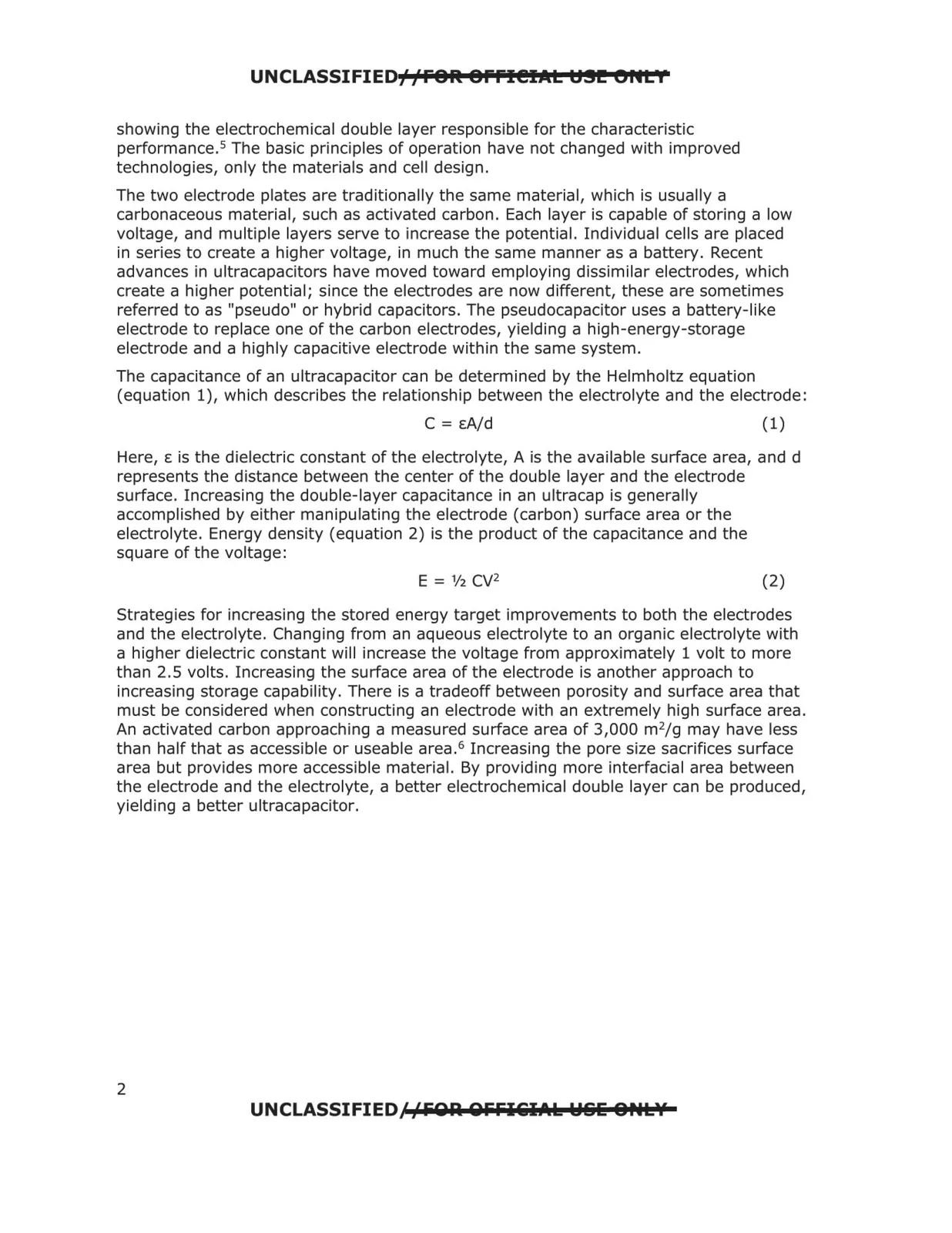
showing the electrochemical double layer responsible for the characteristic
performance.5 The basic principles of operation have not changed with improved
technologies, only the materials and cell design.
The two electrode plates are traditionally the same material, which is usually a
carbonaceous material, such as activated carbon. Each layer is capable of storing a low
voltage, and multiple layers serve to increase the potential. Individual cells are placed
in series to create a higher voltage, in much the same manner as a battery. Recent
advances in ultracapacitors have moved toward employing dissimilar electrodes, which
create a higher potential; since the electrodes are now different, these are sometimes
referred to as "pseudo" or hybrid capacitors. The pseudocapacitor uses a battery-like
electrode to replace one of the carbon electrodes, yielding a high-energy-storage
electrode and a highly capacitive electrode within the same system.
The capacitance of an ultracapacitor can be determined by the Helmholtz equation
(equation 1), which describes the relationship between the electrolyte and the electrode:
C = EA/d
(1)
Here, £ is the dielectric constant of the electrolyte, A is the available surface area, and d
represents the distance between the center of the double layer and the electrode
surface. Increasing the double-layer capacitance in an ultracap is generally
accomplished by either manipulating the electrode (carbon) surface area or the
electrolyte. Energy density (equation 2) is the product of the capacitance and the
square of the voltage:
E = ½ cv2
(2)
Strategies for increasing the stored energy target improvements to both the electrodes
and the electrolyte. Changing from an aqueous electrolyte to an organic electrolyte with
a higher dielectric constant will increase the voltage from approximately 1 volt to more
than 2.5 volts. Increasing the surface area of the electrode is another approach to
increasing storage capability. There is a tradeoff between porosity and surface area that
must be considered when constructing an electrode with an extremely high surface area.
An activated carbon approaching a measured surface area of 3,000 m2/g may have less
than half that as accessible or useable area. 6 Increasing the pore size sacrifices surface
area but provides more accessible material. By providing more interfacial area between
the electrode and the electrolyte, a better electrochemical double layer can be produced,
yielding a better ultracapacitor.
UNCLASSIFIEO/;LFOA OFFI&il:.l.b YS& OrtLY
2