AAWSAP DIRD, Detection and High-Resolution Tracking of Vehicles at Hypersonic Velocities, November 2010
DOW-UAP-D148 · page 14 of 46
Text
This text came with the file. It may have mistakes. When the text and the image disagree, the image is right.
UNCLASSIFIED/fFOR. QFFIEl.t.L: Uii QD:I! X
Chapter 2: Hypersonic Compressible Flow Theory
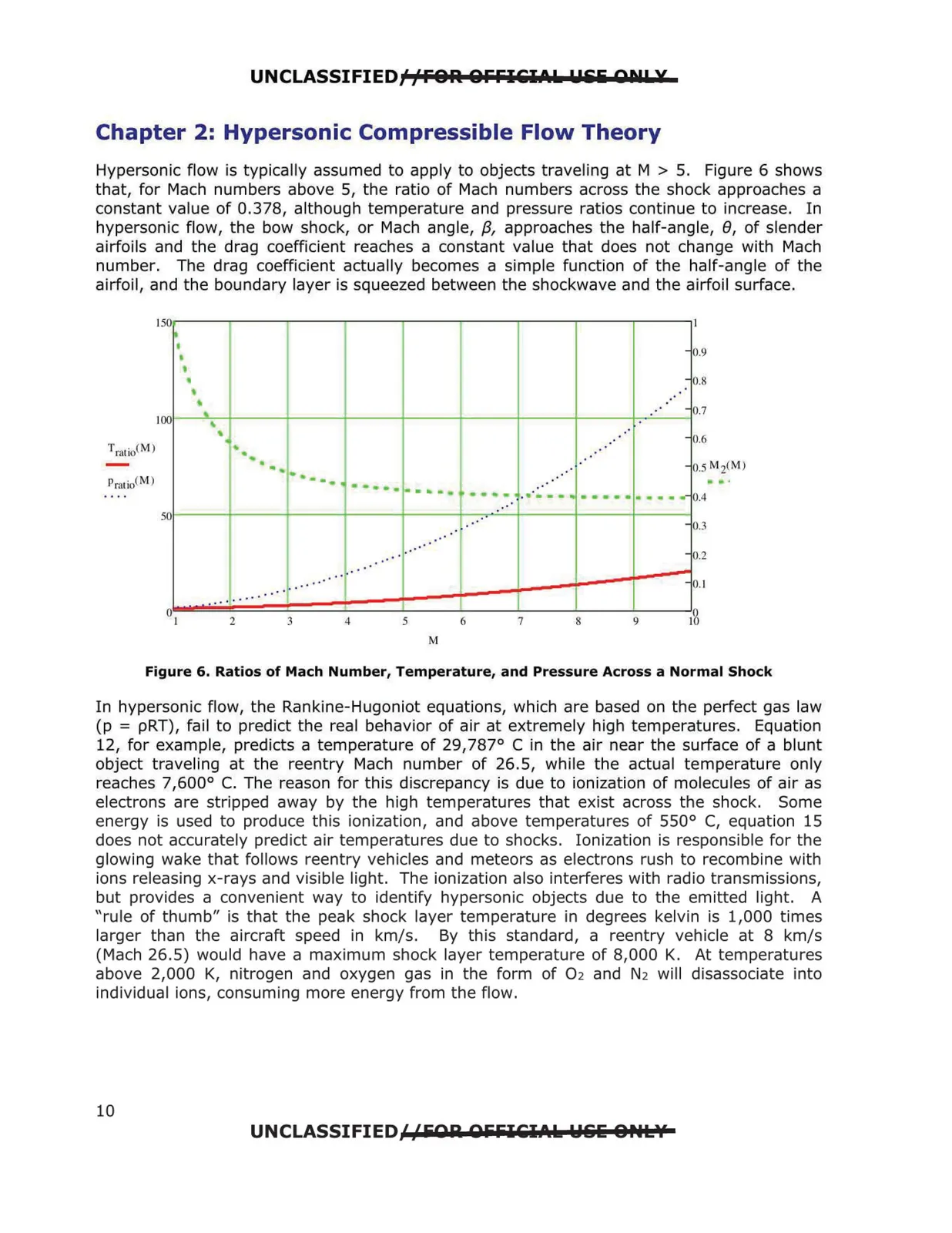
Hypersonic flow is typically assumed to apply to objects traveling at M > 5. Figure 6 shows
that, for Mach numbers above 5, the ratio of Mach numbers across the shock approaches a
constant value of 0.378, although temperature and pressure ratios continue to increase. In
hypersonic flow, the bow shock, or Mach angle, /3, approaches the half-angle, 0, of slender
airfoils and the drag coefficient reaches a constant value that does not change with Mach
number. The drag coefficient actually becomes a simple function of the half-angle of the
airfoil, and the boundary layer is squeezed between the shockwave and the airfoil surface.
150 •
I•
-
'
-
-~..-+---+----+-----ie-----+---+----+----+--'---l-
'
-
.. • .....
-
·--.. , ·-···-·•--1111---
..
.. • • • • • "' • • • • • • • • • .-
-
:::::::::l:±::t::c J-
-
OL
J d
09
0.8
0.7
100
06
Tnllio(M )
0.5 M z(M )
P,mio(M )
...
0.4
50
03
0.2
.-~-. -;;;
-·· -~· --~----~·-····-,~·
o.J
I
2
3
4
5
6
7
9
1S
M
Figure 6. Ratios of Mach Number, Temperature, and Pressure Across a Normal Shock
In hypersonic flow, the Rankine-Hugoniot equations, which are based on the perfect gas law
(p = pRT), fail to predict the real behavior of air at extremely high temperatures. Equation
12, for example, predicts a temperature of 29, 787° C in the air near the surface of a blunt
obj ect traveling at the reentry Mach number of 26.5, while the actual temperature only
reaches 7,600° C. The reason for this discrepancy is due to ionization of molecules of air as
electrons are stripped away by the high temperatures that exist across the shock.
Some
energy is used to produce this ionization, and above temperatures of 550° C, equation 15
does not accurately predict air temperatures due to shocks. Ionization is responsible for the
glowing wake that follows reentry vehicles and meteors as electrons rush to recombine with
ions releasing x-rays and visible light. The ionization also interferes with radio transmissions,
but provides a convenient way to identify hypersonic objects due to the emitted light. A
"rule of thumb" is that the peak shock layer temperature in degrees kelvin is 1,000 times
larger than the aircraft speed in km/s.
By this standard, a reentry vehicle at 8 km/s
(Mach 26.5) would have a maximum shock layer temperature of 8,000 K. At temperatures
above 2,000 K, nitrogen and oxygen gas in the form of 02 and N2 will disassociate into
individual ions, consuming more energy from the flow.
UNCLASSIFIED//EQA: QlililEl.t.L: W&&: O,.L'l
10