AAWSAP DIRD, Detection and High-Resolution Tracking of Vehicles at Hypersonic Velocities, November 2010
DOW-UAP-D148 · page 15 of 46
Text
This text came with the file. It may have mistakes. When the text and the image disagree, the image is right.
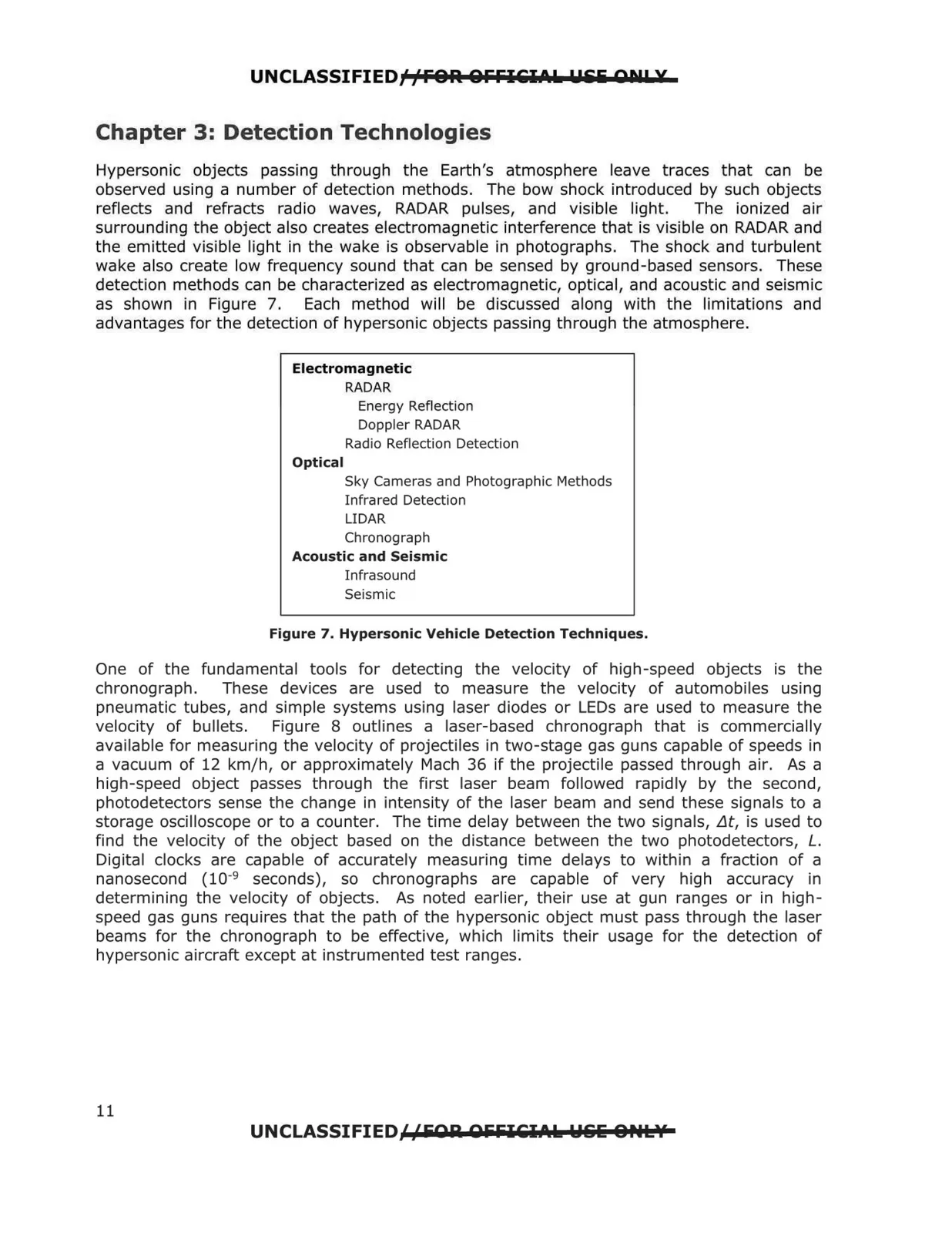
UNCLASSIFIED/fFOR. QFFIEl.t.L: Uii QD:I! X Chapter 3: Detection Technologies Hypersonic objects passing through the Earth's atmosphere leave traces that can be observed using a number of detection methods. The bow shock introduced by such objects reflects and refracts radio waves, RADAR pulses, and visible light. The ionized air surrounding the object also creates electromagnetic interference that is visible on RADAR and the emitted visible light in the wake is observable in photographs. The shock and turbulent wake also create low frequency sound that can be sensed by ground-based sensors. These detection methods can be characterized as electromagnetic, optical, and acoustic and seismic as shown in Figure 7. Each method will be discussed along with the limitations and advantages for the detection of hypersonic objects passing through the atmosphere. Electromagnetic RADAR Energy Reflection Doppler RADAR Radio Reflection Detection Optical Sky Cameras and Photographic Methods Infrared Detection LIDAR Chronograph Acoustic and Seismic Infrasound Seismic Figure 7. Hypersonic Vehicle Detection Techniques. One of the fundamental tools for detecting the velocity of high-speed objects is the chronograph. These devices are used to measure the velocity of automobiles using pneumatic tubes, and simple systems using laser diodes or LEDs are used to measure the velocity of bullets. Figure 8 outlines a laser-based chronograph that is commercially available for measuring the velocity of projectiles in two-stage gas guns capable of speeds in a vacuum of 12 km/h, or approximately Mach 36 if the projectile passed through air. As a high-speed object passes through the first laser beam followed rapidly by the second, photodetectors sense the change in intensity of the laser beam and send these signals to a storage oscilloscope or to a counter. The time delay between the two signals, Lit, is used to find the velocity of the object based on the distance between the two photodetectors, L. Digital clocks are capable of accurately measuring time delays to within a fraction of a nanosecond (10·9 seconds), so chronographs are capable of very high accuracy in determining the velocity of objects. As noted earlier, their use at gun ranges or in high speed gas guns requires that the path of the hypersonic object must pass through the laser beams for the chronograph to be effective, which limits their usage for the detection of hypersonic aircraft except at instrumented test ranges. UNCLASSIFIED//EQA: QlililEl.t.L: W&&: O,.L'l 11