AAWSAP DIRD, Detection and High-Resolution Tracking of Vehicles at Hypersonic Velocities, November 2010
DOW-UAP-D148 · page 16 of 46
Text
This text came with the file. It may have mistakes. When the text and the image disagree, the image is right.
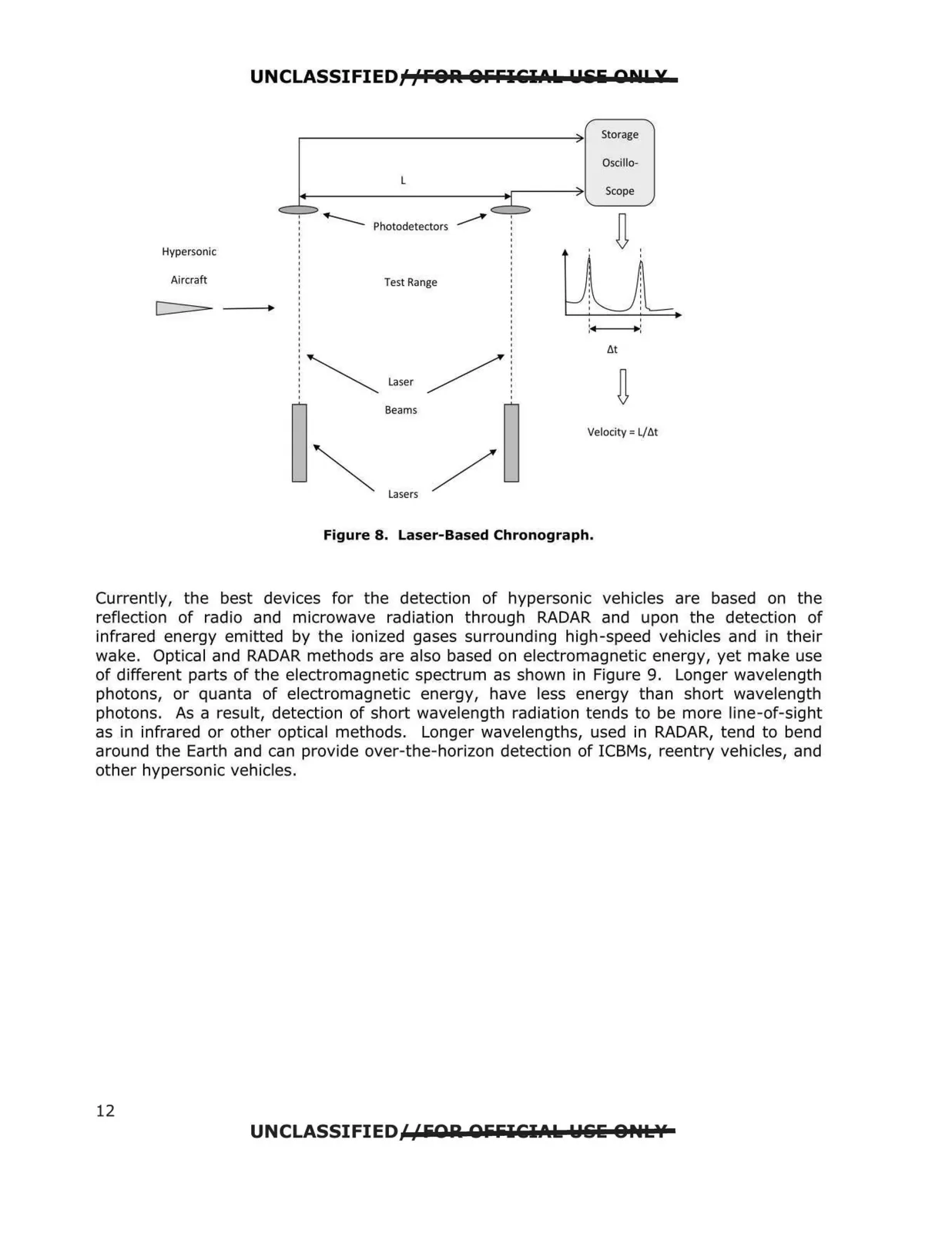
UNCLASSIFIED/fFOR. QFFIEl.t.L: Uii QD:I! X Storage Oscillo ~ l : scope ~--- --~ : Photodetectors Hypersonic Aircraft c=== ' ' ' ' ' ' ' ' ' Test Range llL : .. 111: ~Laser / 1 lit D Velocity= L/llt ~~~ams /~ Lasers Figure 8. Laser-Based Chronograph. Currently, the best devices for the detection of hypersonic vehicles are based on the reflection of radio and microwave radiation through RADAR and upon the detection of infrared energy emitted by the ionized gases surrounding high-speed vehicles and in their wake. Optical and RADAR methods are also based on electromagnetic energy, yet make use of different parts of the electromagnetic spectrum as shown in Figure 9. Longer wavelength photons, or quanta of electromagnetic energy, have less energy than short wavelength photons. As a result, detection of short wavelength radiation tends to be more line-of-sight as in infrared or other optical methods. Longer wavelengths, used in RADAR, tend to bend around the Earth and can provide over-the-horizon detection of ICBMs, reentry vehicles, and other hypersonic vehicles. UNCLASSIFIED//EQA: QlililEl.t.L: W&&: O,.L'l 12